16th Century: Manhattan Before New York

1948040_10203762998655123_8196160829139370982_n

By the time Europeans appeared on the scene, a mere five hundred years ago, what is now New York City had as many as fifteen thousand inhabitants—estimates vary widely—with perhaps another thirty to fifty thousand in the adjacent parts of New Jersey, Connecticut, Westchester County, and Long Island. Most spoke Munsee, a dialect of the Delaware language in which their name for themselves was Lenape— “Men” or “People.”

Nothing made it harder for Europeans to see the link between the Lenapes and their environment than the fact that kinship—not class—was the basis of their society. Private ownership of land and the hierarchical relations of domination and exploitation familiar in Europe were unknown in Lenapehoking…..More perplexing still, kinship in Lenape society was traced matrilineally. Families at each location were grouped into clans that traced their descent from a single female ancestor; phratries, or combinations of two or more clans, were identified by animal signs, usually “wolf,” “turtle,” and “turkey.” Children belonged by definition to their mother’s phratry: if she was a turtle, they were turtles. Land was assigned to clans, and the family units that comprised them, for their use only: they did not “own” it as Europeans understood the word and had no authority to dispose of it by sale, gift, or bequest. If the land “belonged” to anyone, it belonged to the inhabitants collectively.

—Edwin G. Burrows and Mike Wallace, Gotham: A History of New York City to 1898 (1998)

Image found here.
Posted in Uncategorized | Tagged , , , , | Leave a comment

17th Century: Metaphor for Something

NG-MC-1889-83-26

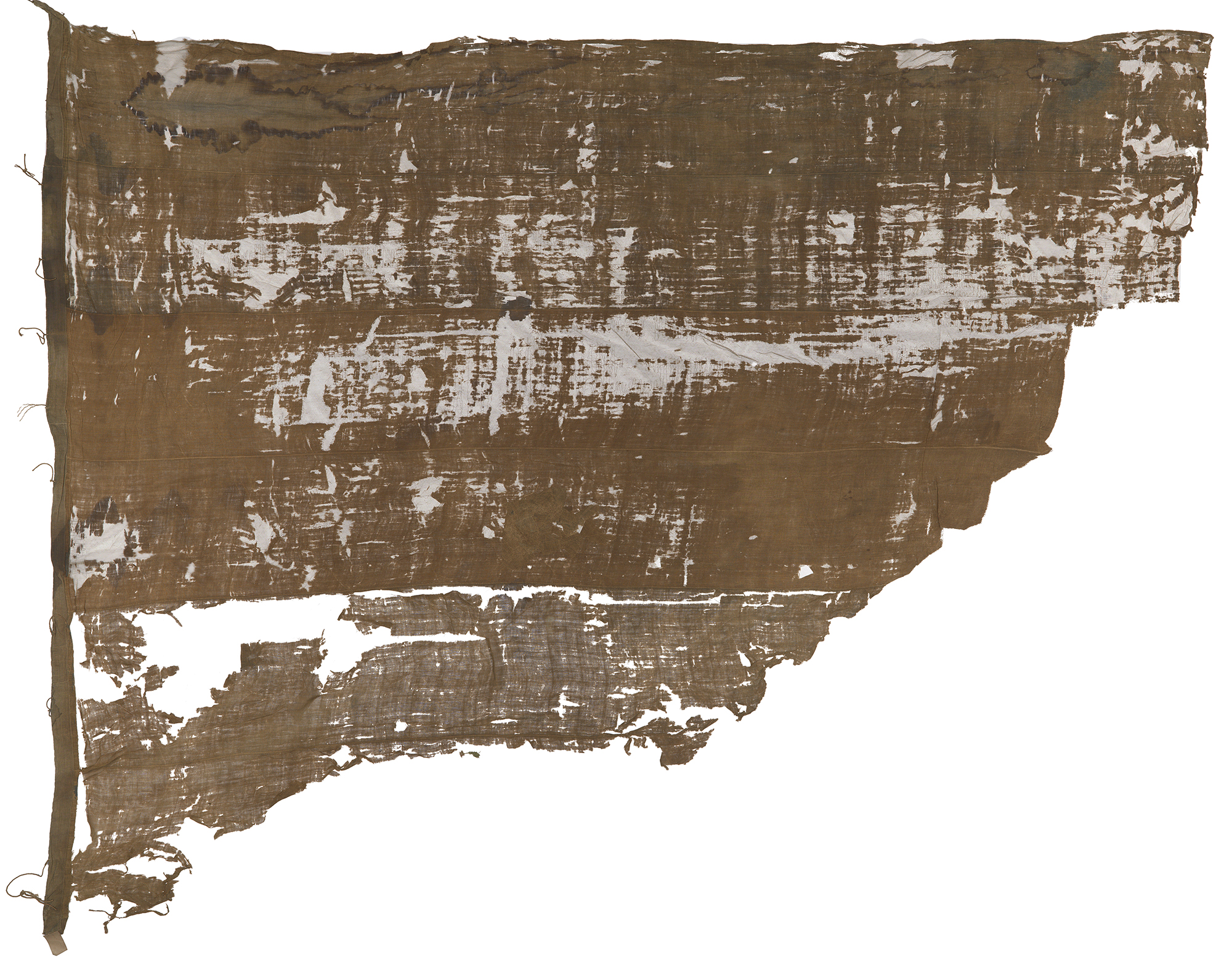
Fragment of a flag (c. 1600 – c. 1700) [Date and origin cannot be traced.] (source)

Posted in Uncategorized | Tagged , , | Leave a comment

1747: The Government of Ants

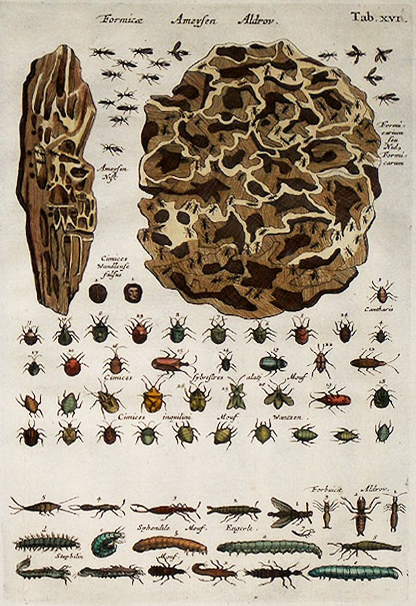
Mattias Merian AntsFrom William Gould’s An Account of English Ants (1747):

In whatever Apartment a Queen Ant condescends to be present, she commands Obedience and Respect and universal Gladness spreads itself through the whole Cell, which is expressed by particular Acts of Joy and Exultation. They have a peculiar way of skipping, leaping, and standing upon their Hind Legs, and prancing with the others. These Frolicks they make use of, both to congratulate each other when they meet, and to show their Regard for the Queen. Some of them gently walk over her, others dance round her, and all endeavor to exert their Loyalty and Affection. She is generally encircled with a Clutter of Attendants, who, if you separate them from her, soon collect themselves into a Body, and inclose her in the midst. Howsoever romantick this Description may appear, it may easily be proved by an obvious Experiment. If you place a Queen Ant with her Retinue under a Glass, you will in a few Moments be convinced of the Honour they pay, and Esteem they entertain for her. There cannot be a more remarkable Instance than what happened to a Black Queen, the beginning of last Spring. I had placed her with a large Retinue in a sliding Box, in the Cover of which was an Opening sufficient for the Workers to pass to and fro, but so narrow as to confine the Queen. A Corps was constantly  in waiting and surrounded her, whilst others went out in search of Provisions. By some Misfortune she died; the Ants, as if not apprised of her Death, continued their Obedience. They even removed her from one Part of the Box to another, and treated her with the same Court and Formality as if she had been alive. This lasted two Months, at the End of which the Cover being open, they forsook the Box, and carried her off.

Continue reading

Posted in Uncategorized | Tagged , , , , , , , | Leave a comment

1957: The Mayflower Arrives in New York City

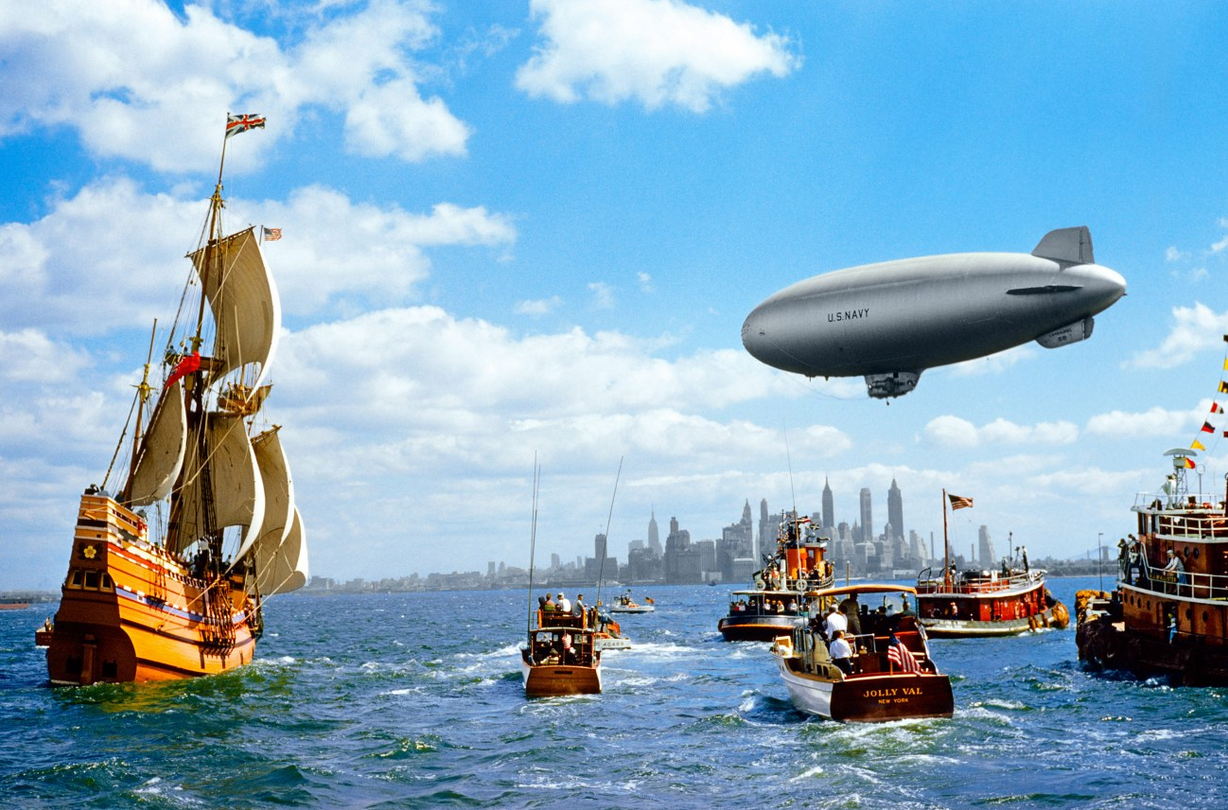
Mayflower 1957

In 1957, a replica of the Mayflowerthe Mayflower II—was built in England based on reconstructed blueprints of the ship from an American museum. It set sail for the United States on April 20, 1957 and arrived in New York City on July 1. Of the original Mayflower‘s passengers and crew, only half survived the first winter in Plymouth Harbor; the rest died from scurvy, pneumonia, and tuberculosis.

B. Anthony Stewart: The Mayflower II Enters New York Harbor, 1957. Photo from the National Geographic archives.

Posted in Uncategorized | Tagged , , , , , , | Leave a comment

1737: The One Was Dress’d as a Man

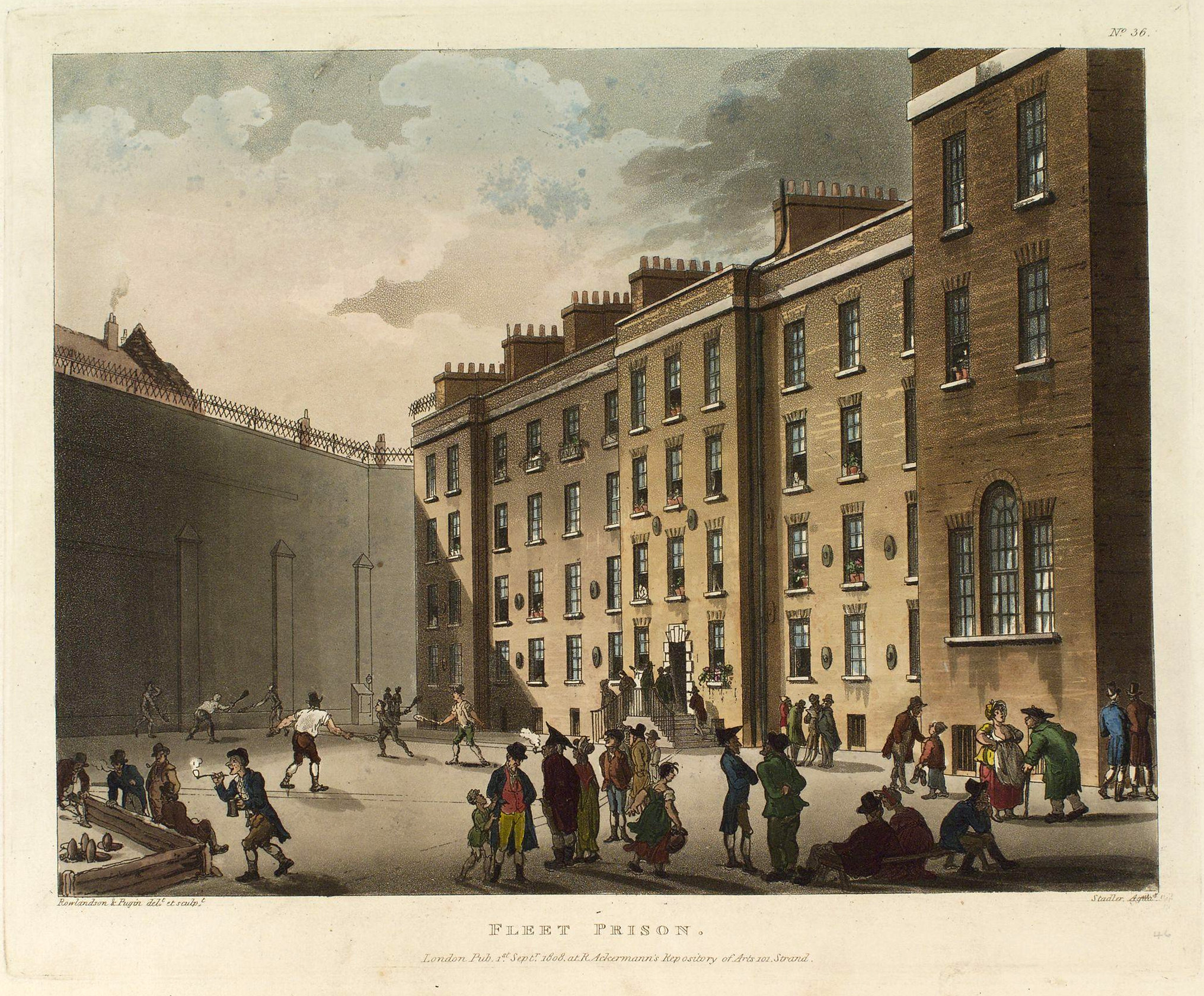
Fleet_Prison_by_Thomas_Rowlandson_and_Augustus_Pugin

In the early 18th century, “Fleet Marriages” were clandestine and unsanctioned marriages that were conducted in London’s Fleet prison, or in the rough neighborhoods surrounding it. They took place away from the home parishes of the spouses, often without marriage licensesfrequently  because couples simply wanted to get married quickly or at low expense. By  the 1740’s, over half of all London weddings (up to 6,000 a year) were Fleet Marriages, with special “marriage houses” and taverns sprouting up to cash in on the phenomenon. They were ultimately outlawed by the 1753 Marriage Act.

For his book The Fleet: Its River, Prison and Marriages, published in 1834, John Ashton combed through the registers of these marriages and discovered another reason that people opted for a Fleet Marriage:

Perhaps the most extraordinary entries in these books are those of two women going through the ceremony of marriage with each other

“20 May, 1737. Jno Smith, Gent. of St James Westr, Batchelor & Eliz. Huthall of St Giles’s Spr at Wilsons. By ye opinion after Matrimony, my Clark judg’d they were both women, if ye person by name John Smith be a man, he’s a little short fair thin man, not above 5 foot. After marriage I almost c’d prove ym both women, the one was dress’d as a man, thin pale face, & wrinkled chin.”

“1734 Dec. 15. John Mountford of St Ann’s Sohoe, Taylor. B., Mary Cooper. Ditto. Sp. Suspected 2 Women, no Certif.”

“1 Oct. 1747. John Ferren, Gent, Ser. of St Andrew’s Holborn Br and Deborah Nolan. Do Spr. The supposed John Ferren was discovered after ye Ceremonies were over, to be in person a woman.”

Fleet Prison was also the birthplace of racquetball and squash.

Image: “Fleet Prison” by Thomas Rowlandson and Auguste Charles Pugin, aquatinted by Joseph Constantine Stadler (1808) (source).

Posted in Uncategorized | Tagged , , , , | Leave a comment

1890: Portrait of an Anarchist

display_image.phjp

Paul Signac’s portrait of his friend and fellow anarchist Felix Fénéon was painted in 1890, four years before Fénéon was arrested by Paris police on suspicion of participating in the bombing of a restaurant and aiding in the assassination of French President Sadi Carnot. Twenty-nine others were arrested as well, leading to what became known as the “Trial of Thirty.” Fénéon was ultimately acquitted, as were many of the others.

Paul Signac: Portrait of Félix Fénéon (1890)

Posted in Uncategorized | Tagged , , , , , , | Leave a comment

1694: An Unusual Incident at Sea

800px-Pierre_Puget_-_Great_Vessel_of_War_-_WGA18476

The following story I had from the mouth of the very person who was chiefly concerned in it. I mean the captain of the ship itself.

One Captain Thomas Rogers, commander of a ship called the Society, was bound on a voyage from London to Virginia, about the year 1694.

The ship was hired in London, and being sent light, as they call it, to Virginia, for a loading of tobacco, had not many goods in her outward bound, suppose about two or three hundred ton, which was not counted a loading, or indeed half her loading; the ship being very large, about five hundred tons burden.

They had a pretty good passage, and the day before had had an observation, whereupon the mates and proper officers had brought their books and cast up the reckonings with the captain, to see how near they were to the coasts of America; they all agreed that they were at least about an hundred leagues distant from the capes of Virginia. Upon these customary reckonings, and withal heaving the lead, and finding no ground at an hundred fathoms, they set the watch, and the captain turned in (as they call it at sea), that is, went to bed.

The weather was good, a moderate gale of wind, and blowing fair for the coast; so that, the ship might have run about twelve or fifteen leagues in the night, after the captain was in the cabin.

He fell asleep, and slept very soundly for about three hours, when he awaked again and lay till he heard his second mate turn out, and relieve the watch ; and then he called his chief mate, as he was going off from the watch, and asked him how all things fared: who answered, that all was well, and the gale freshened, and they run at a great rate; but it was a fair wind, and a fine clear night; so the captain went to sleep again.

About an hour after he had been asleep again, he dreamed that a man pulled him, or waked him, and he did wake. I am not sure but I think he said, the thing that waked him, bade him get up, that is, turn out and look abroad. But whether it was so or no, he lay still and composed himself to sleep, and was suddenly awaked again, and thus several times; and though he knew not what was the reason, yet he found it was impossible for him to go to sleep: and still he heard the vision say, or thought he heard it say, turn out and look abroad.

Continue reading

Posted in Uncategorized | Tagged , , , , , | Leave a comment

1901: In the Fir Forest

display_image.php
Gustav Klimt: Fir Forest I (1901)

Posted in Uncategorized | Tagged , , , , , | Leave a comment

1st Century AD: You Aren’t Even Sure What This Is at First

20-Statue of a Young Satyr Wearing a Theater Mask of Silenos

Statue of a Young Satyr Wearing a Theater Mask of Silenos. Roman, about 1st century A.D. Restorations by Alessandro Algardi, 1628. (source)

Silenos (or Silenus) was, in Greek mythology, the tutor and companion of Dionysus, the god of wine and ritual ecstasy—as well as theater. He was generally portrayed as a shaggy forest man with the ears of a horsesometimes the tail and legs too. He was, as a rule, so drunk that he had to be propped up by satyrs or carried by a donkey. When drunk he had the power of prophecy.

Posted in Uncategorized | Tagged , , , , , , , , , | Leave a comment

1884: A Prophetic Dream

Screen Shot 05-24-17 at 05.27 PM

A STRANGE DREAM

A curious instance of a dream coming true occurred to me this winter.

While at college last term I had the following dream: I dreamt I was going to visit a strange place, and I was permitted to take a friend with me. I took a fellow named A., and we started for the visit.

It was a pouring wet day, and we were compelled to take a cab from the station. We drove several miles before we reached the house, and when we did so the friend had gone.

I rang the bell and a servant showed me into a room—I supposed the drawing-room. On my left on entering was a fire-place; a lady was working by it. I could not recognise her features. A window was opposite, through which I saw a lovely landscape, though spoilt by the rain; a young man was in the window, and, as I entered, he was saying, “Bother the rain; I meant to have gone to meet H.” (myself). I noticed his face particularly. I also noticed other articles of furniture in the room.

With that my dream ended. I was so struck with it that I related it fully to A., and also to another friend, next morning.

I forgot all about it until the vacation.

I was staying with A., when I had a letter from some distant relations, up to now unknown by me, inviting me to go and stay with them while I was in the neighbourhood. I accepted, and the day on which I left A’s house was a “drenching” one.

I reached the station of E——, and as it was so wet, I thought, no one would meet me, so I took a cab. C—— was five miles from the station. I reached the house at length, and was shown into the drawing-room.

The lady of the house was working by the fire on my left, as I entered; and one of my cousins was standing at the window, and I heard him saying, before he saw me, “I wish H would come. Bother the rain; I meant to have gone to meet him.” He turned towards me as I went in, and I recognised at once the face in my dream.

The view was exactly the view I had seen before, and the details of furniture were placed as dreamed. I had never seen the people before, nor even heard of them, and had never been within fifty miles of the house.

I was much struck with the circumstance, and should like to know any good theory as regards prophetic dreams.

H. D. Hinde

—from Knowledge: A Monthly Record of Science, Vol. 5 (March 14, 1884), p. 170.

Posted in Uncategorized | Tagged , , , | Leave a comment