
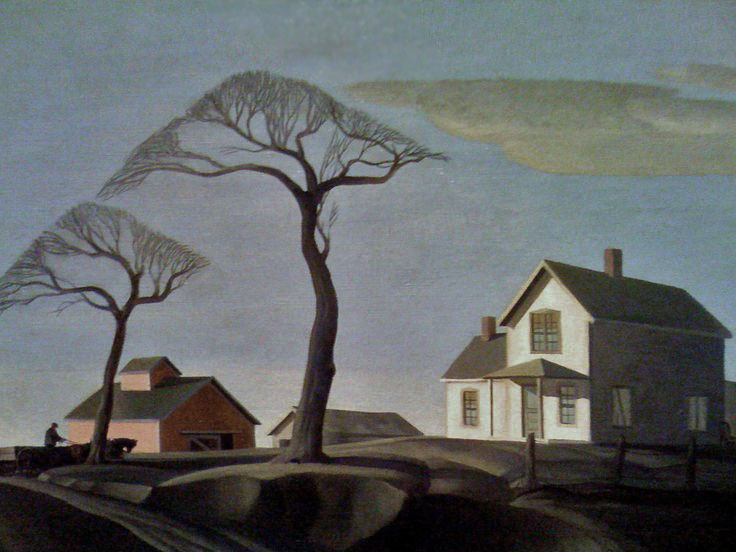
Dale Nichols: The Twins (1946) (source)
Dale Nichols: The Twins (1946) (source)

Quirin Boel: Two Monkeys Playing Backgammon (1635 – 1690) (source)
“Twee apen spelen triktrak” in Dutch; “triktrak” is a nice onomatopoeia.


EXTRAORDINARY PHENOMENON
The following account of an extraordinary phenomenon that appeared to a number of people in the county of Rutherford, state of North Carolina, was made the 7th of August, 1806, in presence of David Dickle, Esq. of county and state aforesaid. Jesse Anderson, and the Rev George Newton, of the county of Buncombe, and Miss Betsey Newton of the state of Georgia, who unanimously agreed, with the relators, that Mr. Newton should communicate it to Mr. J. Gales, Editor of the Raleigh Register and State Gazette.
Patsy Reaves, a widow woman, who lives near the Apalachian mountains, declares, that on the 31st of July last about, 6 o’clock P. M. her daughter Elizabeth, about eight years old, was in the cotton-field, about: ten poles from the dwelling. house, which. stands by computation, six furlongs from the Chimney mountain, and that Elizabeth told her brother Morgan, aged eleven years that there was a man on the mountain. —Morgan was incredulous at first; but the little girl affirmed it, and she saw him rolling rocks or picking up sticks, adding that she saw a heap of people. Morgan then went to the place where she was, and calling out, said that he saw a thousand or ten thousand things flying in the air. On which Polly, daughter of Mrs. Reaves aged fourteen years, and a negro woman, ran to the children, and called to Mrs. Reaves to come and see what a sight yonder was: —Mrs Reaves says she went about three poles towards them, and, without any sensible alarm or fright, she turned towards the Chimney mountain, and discovered a very numerous crowd of beings resembling the human species; but could not discern, any particular members of the human body, nor distinction of sex: that they were every size, from the tallest men down to the least infants; that there were more of the small than of the full grown, that they were all clad with brilliant white raiment, but could not describe any form of their raiment; that they appeared to rise off the side of the mountain, south of said rock, and about as high; that a considerable part of the mountain’s top was visible above this shining host, that they moved in a northern direction, and collected about the Chimney rock. When all but a few had reached said rock, two seemed to rise together, and behind them about two feet a third rose. These three moved with great agility toward the crowd, and had the nearest resemblance to men of any before seen. While beholding these three, her eyes were attracted by three more rising nearly from the same place, and moving swiftly in the same order and direction. After these, several others rose and went toward the rock.
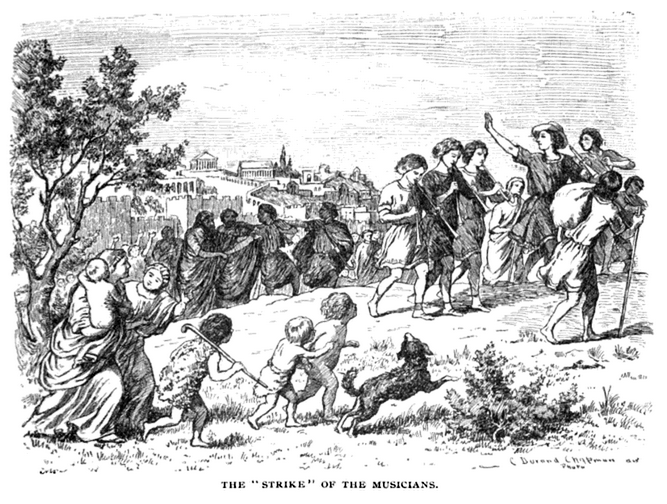
It is…a mistaken idea to suppose that strikes are modern inventions. They are indeed of ancient origin. Livy speaks of an organized strike in the year 312 b.c., the description of which, although sufficiently humorous to make a background to a classical comedy, shows nevertheless the power of those ancient unions when desiring to use the strike as a weapon for their rights.
Livy, of course, could not have suspected the future developments and importance of the strike; he therefore dismisses the subject as an affair of very little importance,” which he “would not have mentioned were it not for its being closely connected with religion.” (Book ix., cap. 3o.)
The strikers on this occasion were the musicians, and the strike was caused by an act of the public censors, that seemed an infringement on the rights and privileges of the former. The musicians, who always assisted at the worship of the gods, enjoyed the privilege of annually celebrating a feast at communal expense in the temple of Jupiter.
In the year 312 B.C., however, Rome happened to be in financial straits; the Samnite wars had swallowed up millions; just then large sums were needed to fight the Etruscans, who had risen against Rome and who had a great and well-equipped army. The newly elected censors therefore advised the Roman senate to curtail all the domestic expenses, especially to grant no money for the annual feast of the musicians.
The censors then conferred with the board of the musicians’ union, explaining the position and telling them to forego their usual festivities. The musicians could not see the necessity of being deprived of their pleasure, they protested against the censorial order, and the board ordered a general strike.

Once the financial capital of the world, New York began in the early twenty-first century to attempt to defend its elaborate and expensive infrastructure against the sea. But that infrastructure had been designed and built with an expectation of constant seas and was not easily adapted to continuous, rapid rise. Like the Netherlands, New York City gradually lost its struggle. Ultimately, it proved less expensive to retreat to higher ground, abandoning centuries’ worth of capital investments.
—Erik M. Conway and Naomi Oreskes: The Collapse of Western Civilization: A View from the Future (2014)
Image: Heidi Cullen: Weather of the Future (2011)

Anton Egorov: Impossible Interior (2107) (source)

Sennertus [Daniel Sennert, 1572–1637], on the authority of a respectable man, informs us that a certain woman was apprehended on the suspicion that she was a werewolf; which she also acknowledged. The magistrate promised to spare her life, provided she would shew him how she effected her transformation, which she promised to do, provided that he would send to her house for a certain pot of ointment. On its being brought to her she anointed her head, neck, shoulders, and other members with it, and immediately fell down before him in a profound slumber, which lasted three hours. On her awaking, she was asked where she had been in the interval, and what had kept her so long. She replied that she had taken the form of a wolf, and had proceeded to a neighbouring town where she had first torn a sheep and afterwards a cow. The magistrate, by way of ascertaining the truth of her statement, sent thither to inquire, when he found that this precise damage had actually been done.
—Major P. I. Begbie, Supernatural Illusions (London, T. C. Newby, 1851)
Image: Frans Snyders (Flemish, 1579-1657) (attributed to): “The Wolf” (after Rubens’ Whitehall Ceiling, London) (date unknown) (source)
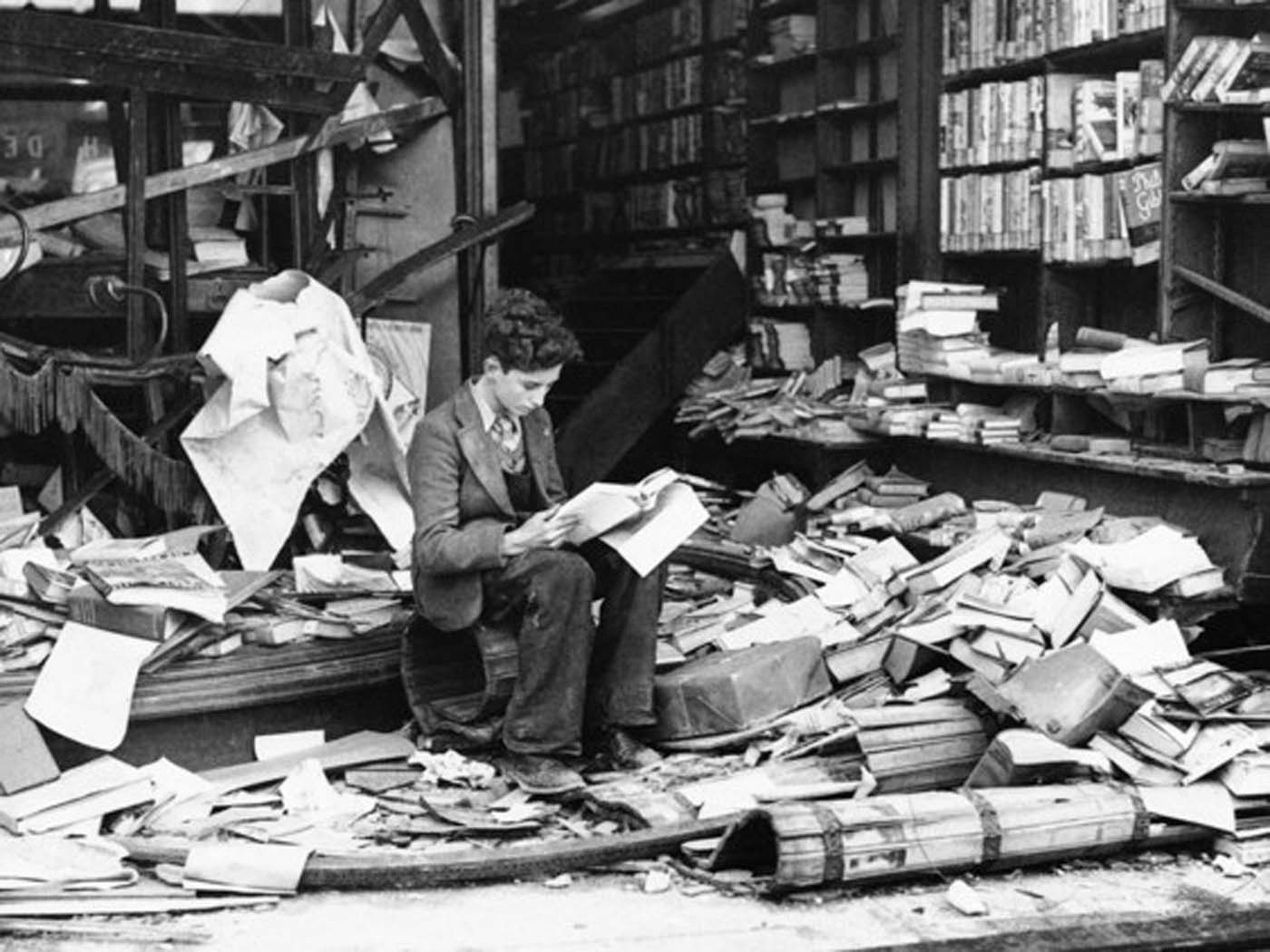
“The most common voluntary activity….is, by a long shot, participating in experiences that we know are not real. When we are free to do whatever we want, we retreat to the imagination—to worlds created by others, as with books, movies, video games, and television…or to worlds we ourselves create, as when daydreaming and fantasizing….This is a strange way for an animal to spend its days.”
—Paul Bloom, “The Pleasures of Imagination” (2010) (source)
Image: London bookshop after German bombing, 1940 (AP photo)

In 1915, Sigmund Freud published a short essay, “On Transience,” in which he addresses in a succinct and poetic way the ideas he had developed for his book Mourning and Melancholia (1917). For Freud, these two states—mourning and melancholia—are different psychological responses to traumatic loss, something the whole world seemed to be dealing with following the First World War.
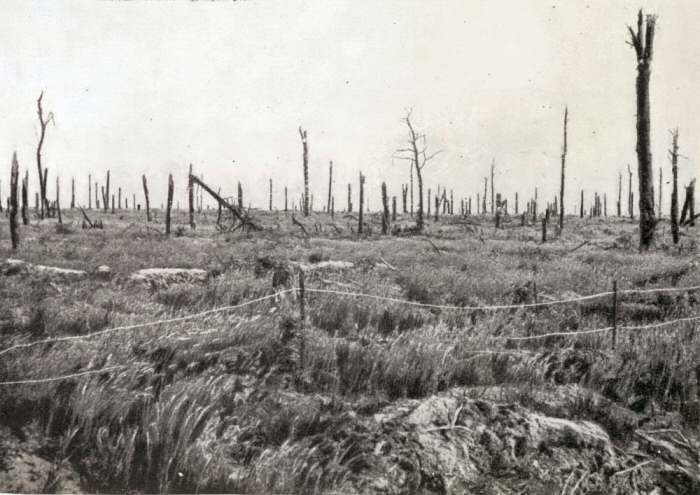 For Freud, mourning is a conscious and natural reaction to a profound loss—someone or something I loved has disappeared from the world—while melancholia (what we would now call clinical depression) is an unconscious and debilitating dynamic in which loss is turned inward: the psyche creates a kind of shadow of the lost loved one or thing, which then takes up residence in and attaches itself to the self. In mourning, the world seems barren and bleak for a time, but eventually reality returns: there are other beautiful things to love in the world; the melancholic, however, is prevented from turning outward to the world. They become fixed on the shadow, the emptiness that has now attached itself internally—and thus seems immortal. When the melancholic looks out onto the world, they can see only the never-changing dead landscape of the self. The lush valleys of self-worth appear as the bombed and burnt fields of self-hatred and misery.
The “taciturn friend” and “young but already famous poet” in Freud’s essay have been identified as Lou Andreas-Salomé, one of the first women psychoanalysts, and her sometime lover Rainer Maria Rilke.
On Transience
By Sigmund Freud
Translation by James StracheyNot long ago I went on a summer walk through a smiling countryside in the company of a taciturn friend and of a young but already famous poet. The poet admired the beauty of the scene around us but felt no joy in it. He was disturbed by the thought that all this beauty was fated to extinction, that it would vanish when winter came, like all human beauty and all the beauty and splendour that men have created or may create. All that he would otherwise have loved and admired seemed to him to be shorn of its worth by the transience which was its doom.
The proneness to decay of all that is beautiful and perfect can, as we know, give rise to two different impulses in the mind. The one leads to the aching despondency felt by the young poet, while the other leads to rebellion against the fact asserted. No! it is impossible that all this loveliness of Nature and Art, of the world of our sensations and of the world outside, will really fade away into nothing. It would be too senseless and too presumptuous to believe it. Somehow or other this loveliness must be able to persist and to escape all the powers of destruction.


