1963: A Tumultuous Day

Screen Shot 05-24-17 at 12.00 PM

Front and back of New York Times file photo of Martin Luther King, Jr. From a collection entitled “Unpublished Black History,” online here. Here is the story behind the King portrait:

Consider the close-up of Dr. King above. It is the only photo in this project that has been previously published; it has appeared many times over the past 50 years, as the backside of the print clearly shows, and it looks as if it might have been taken during a formal sitting.

But it was shot during the summer of 1963 on a day when black protesters hurled eggs at Dr. King as he arrived at a church in Harlem. Earlier that day, he criticized black nationalists, saying that those who called for a separate black state were “wrong.” Some believed that those remarks inspired the attack that night.

Our photographer snapped Dr. King’s picture as he participated in a round table that was broadcast on NBC….Sometime later, an editor cropped one of those images from the NBC appearance to create the head shot of Dr. King that is now so familiar and so disconnected from the tumultuous events of that day.

Posted in Uncategorized | Tagged , , , , , | Leave a comment

1750: Falsos silogismos de colores

Sor_Juana_by_Miguel_Cabrera

The Mexican feminist, philosopher, and poet Sor Juana Inés de la Cruz (1651 – 1695) wrote in Latin, Spanish, and Nahuatl. While a nun, she wrote prose, poetry, and drama on love, the status of women, and religion. When her writing was condemned by the Bishop of Puebla in 1694, she was forced to sell her library and focus exclusively on charity towards the poor. She died the following year.

This poem is one of her most famous:

A Su Retrato

Este, que ves, engaño colorido,
que del arte ostentando los primores,
con falsos silogismos de colores
es cauteloso engaño del sentido:
éste, en quien la lisonja ha pretendido
excusar de los años los horrores,
y venciendo del tiempo los rigores,
triunfar de la vejez y del olvido,
es un vano artificio del cuidado,
es una flor al viento delicada,
es un resguardo inútil para el hado:
es una necia diligencia errada,
es un afán caduco y, bien mirado,
es cadáver, es polvo, es sombra, es nada.

In 1950, Samuel Beckett translated an entire anthology of Mexican poetry compiled by Octavio Paz — despite the fact that his Spanish was inadequate to the task. He needed the money, though, and split the payment with a fluent friend for furnishing him with literal translations of the works, which he then fashioned into poetry: here is his version of Sor Juana’s sonnet:

To Her Portrait

This coloured counterfeit that thou beholdest,
vainglorious with excellencies of art,
is, in fallacious syllogisms of colour,
nought but a cunning dupery of sense;
this in which flattery has undertaken
to extenuate the hideousness of years,
and, vanquishing the outrages of time,
to triumph o’er oblivion and old age,
is an empty artifice of care,
is a fragile flower in the wind,
is a paltry sanctuary from fate,
is a foolish sorry labour lost,
is conquest doomed to perish and, well taken,
is corpse and dust, shadow and nothingness.

Paz has written a wonderful biography of Sor Juana.

Miguel Cabrera: Portrait of Sor Juana (c. 1750)
(source)

Posted in Uncategorized | Tagged , , , , , , , , , , | Leave a comment

1685: Lift Up Thine Eyes

trompe_l_oeil__full_hd__by_icarus_ica-d97h42r

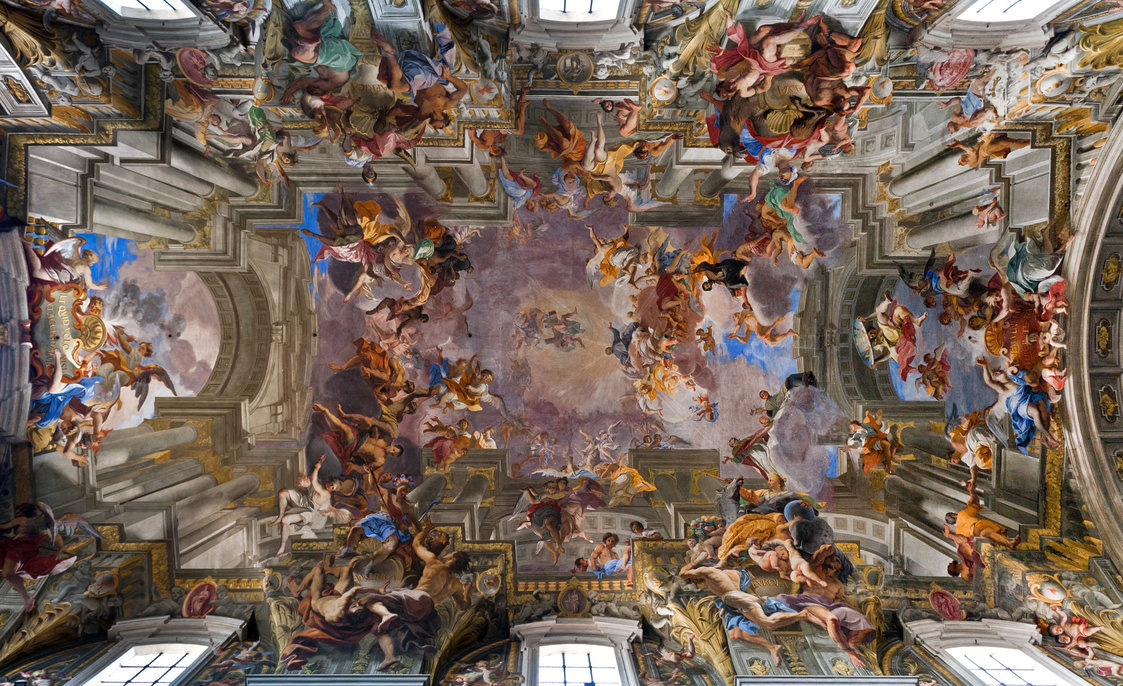
Coupole-Sant-IgnazioThe masterful trompe l’oeil frescos on the (flat) ceilings of the Church of Sant’ Ignazio di Loyola in Rome were painted by Andrea Pozzo in 1685. One depicts the apotheosis of St Ignatius—he rises up out of the ceiling into the clouds above. The other presents the illusion of an elegant dome; sunlight shines through a ring of small windows in the cupola. Pozzo likely painted the second one after money ran out for an actual dome.

Image sources: here and here.

Posted in Uncategorized | Tagged , , , , , , , , | Leave a comment

1991: Won’t Get Off the Ground

canvas

Anselm Kiefer: Melancholia (1990-1991).  Made of lead, glass, steel, and ash.

Found here.

Posted in Uncategorized | Tagged , , , , , | Leave a comment

1505: The Dog Hidden Under the Hidden Unicorn

Raffael_046

In 1934, restoration work on this early 16th-centruy portrait by Raphael revealed that sometime in the mid-17th century, an anonymous artist had painted over it in places, transforming it into a representation of Saint Catherine of Alexandria holding a spiked torture wheel and a palm frond. (According to traditional narrative, the converted Catherine, after refuting  the arguments of fifty pagan philosophers chosen by Emperor Maxentius and converting hundreds to Christianity while imprisoned, was condemned to death on a spiked breaking wheel; it shattered at her touch and she was beheaded, becoming a martyr.)

When this layer of overpainting was removed, a little unicorn was revealed—a traditional medieval symbol of purity. Later, in 1959, further restoration work revealed that a dog was hidden under the unicorn; in this case, the overpainting had been done by Raphael himself.


However, you can still see—and now won’t be able to unsee—the two floppy puppy-dog ears on either side of the unicorn’s head.

Raphael: Portrait of Young Woman with Unicorn (circa 1505 – 1506).

(source)

Posted in Uncategorized | Tagged , , , , , , , , , , | 1 Comment

5th Century AD: Wings of Parchment

13332884_10209815031512162_2910062730254483772_n

Two pages from the Cologne Mani Codex, “a lump of parchment fragments the size of a matchbox,” that tells the story of the early life of Mani, the Persian prophet and the founder of Manichaeism.

The work—made in 5th century Egypt— “bears the somewhat puzzling title Perì tês génnēs toû sṓmatos autoû (On the origin of his body),” which scholars now believe refers to the idea of Mani as a spiritual being who only temporarily took on a physical existence. It tells the story of his early life up to his maturation and the beginning of his mission to spread his faith throughout the world.

Manichaeism itself was a major religion that thrived between the third and seventh centuries from the Roman Empire to China. It rivaled Christianity for a time as a contender to replace classical paganism, its most famous adherent being St. Augustine, who embraced the religion for nine years prior to his final conversion to Catholicism.

Seen as a Gnostic religion—Mani was recognized not only as an apostle of Christ but as a reincarnation of Zoroaster and Buddha—Manichaeism preached a complex dualistic cosmology: a universal struggle between good and evil. It taught that God was powerful and good, yet not omnipotent. In the clash between Good and a separately existing Evil, the world and humanity come into being as a battleground for this epic struggle. A large array of deities, demons, and other cosmic figures take part in the religion’s intricate cosmogony and mythos.

The codex at the University of Cologne is here.
Source: entry on the codex from the Encyclopaedia Iranica.

Posted in Uncategorized | Tagged , , , , , , | Leave a comment

1921: Green Lightning on the Sea

spilliaert_lon_l_eclair_vert_sur_abstract_sotheby_s_l11104lot63t2ten_-_2016-10-16_12.02.00

Léon Spilliaert: L’éclair vert sur la mer [Green Lightning on the Sea] (1921)
From a listing at Sotheby’s, although there titled L’eclair vert sur la mer—“the green eclair on the sea.”
Posted in Uncategorized | Tagged , , , , , | 1 Comment

1943: Lena Horne Doesn’t Entertain Racism

Screen Shot 05-21-17 at 05.34 PM

From Bartlett’s Book of Anecdotes (2000):

Al Duckett, a freelance journalist during World War II, recounts the following story about Lena Horne:

“She had been sent to a camp in the south to entertain the troops. She was scheduled to do a performance for the white troops and a separate performance for the black troops and the German prisoners of war. When I was in the service in Fort Dix, the German prisoners would be in the mess line with black troops and you’d have a separate line for white troops. Lena entertained the blacks and the German prisoners and then she left.”

photo source

Posted in Uncategorized | Tagged , , , , , | Leave a comment

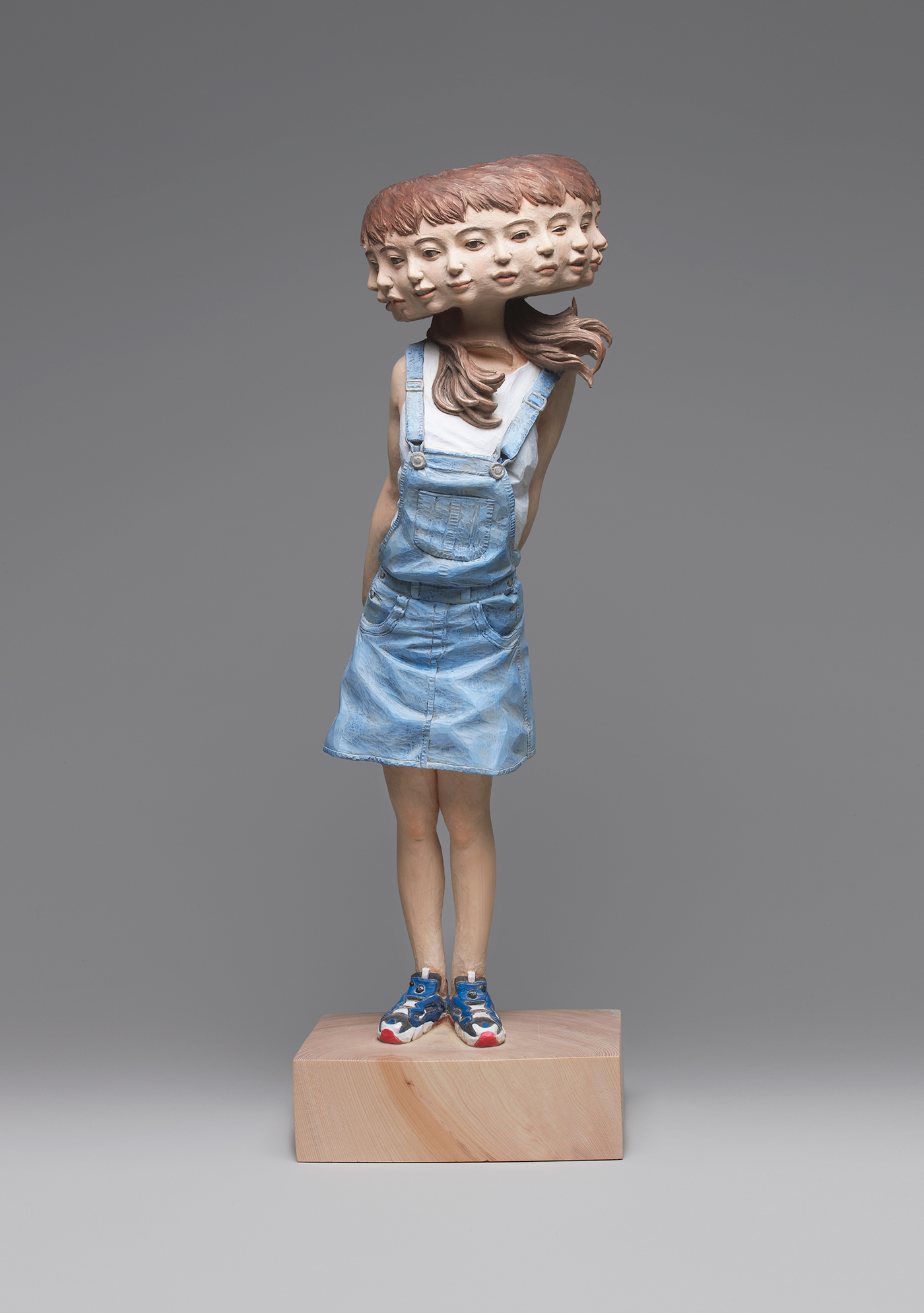
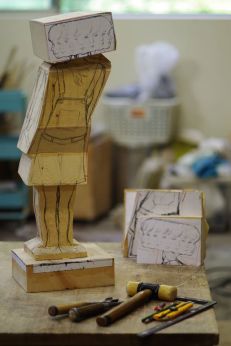
2016: 揺・カプリス

Sculpture by Yoshitoshi Kanemaki:

60593044976649.5823d399ab3dd

揺・カプリス [Shaking ・ Caprice] (2016)

15874931_10211960998159987_219527461583438416_o
See more here.


Posted in Uncategorized | Tagged , , , , , | Leave a comment

1900: The Magician Entertains the Queen

800px-Glindoni_John_Dee_performing_an_experiment_before_Queen_Elizabeth_IHenry Gillard Glindoni: John Dee Performing an Experiment before Elizabeth I (c. 1900) (source)

The enigmatic John Dee was one of the most learned men of the Elizabethan period. Having amassed one of the largest libraries in England, he was a mathematician, astronomer, and adviser to the queen. He was also devoted to the study of magic, astronomy, alchemy, divination, and Hermetic philosophy. Most of his magical works concern efforts to summon and commune with angels “in order to learn the universal language of creation and bring about the pre-apocalyptic unity of mankind.” (Wikipedia)

13567034_10210029509313973_209978248454209028_n

Perhaps the title of this painting should be revised to say “invocation” instead of “experiment”; in 2016, the Guardian reported that “X-ray imaging of the stately Victorian artwork has revealed that Dee was originally surrounded by human skulls before the ghoulish image was painted over, probably because it was too odd for the buyer.”

Continue reading

Posted in Uncategorized | Tagged , , , , , , , , | Leave a comment