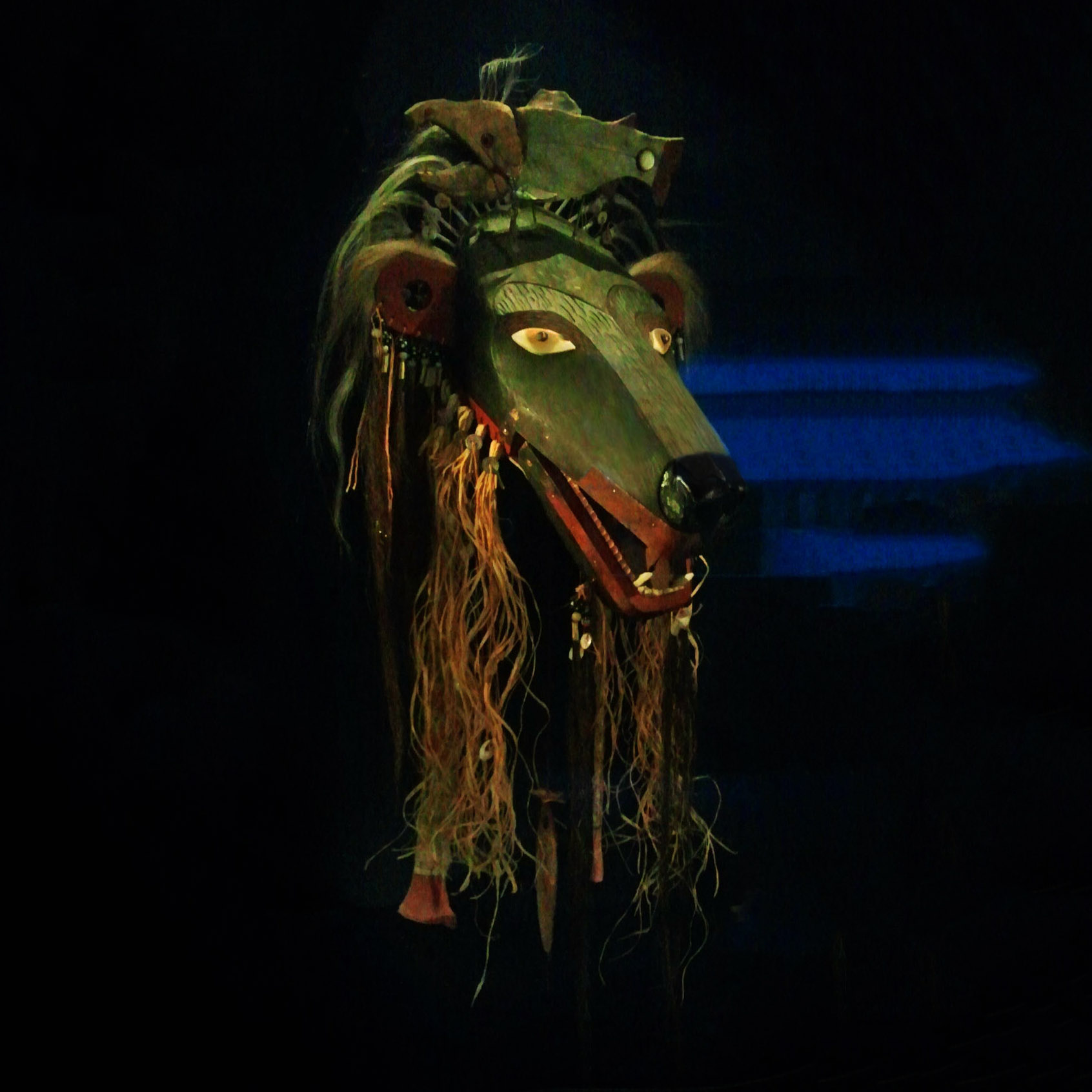
Rick Bartow (Mad River Wiyot): Bear Mask (1990)
Photo taken at the National Museum of the American Indian
The Wiyot word for “bear” is bókw. (source)
Rick Bartow (Mad River Wiyot): Bear Mask (1990)
Photo taken at the National Museum of the American Indian
The Wiyot word for “bear” is bókw. (source)
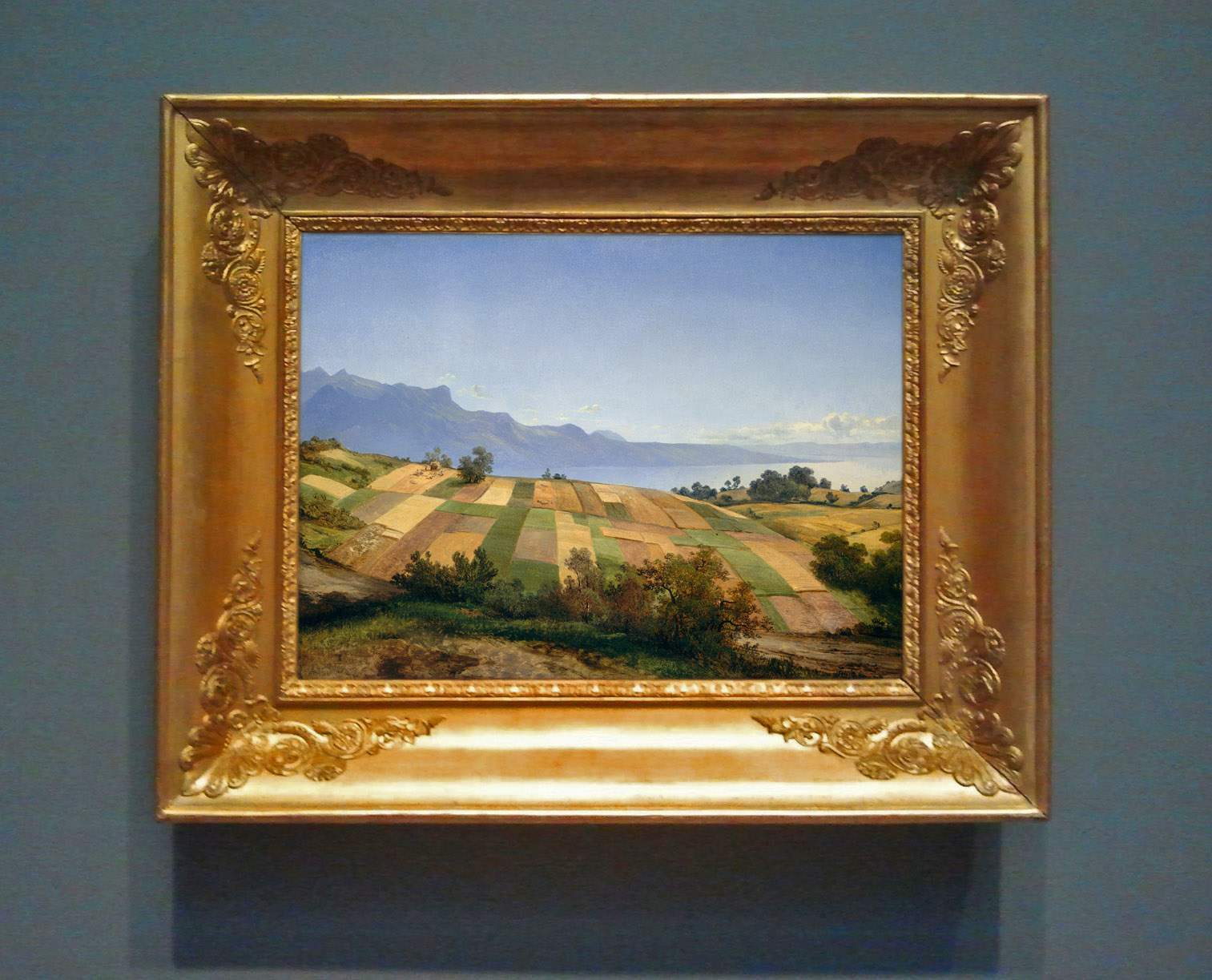
Alexandre Calame: Swiss Landscape (c. 1830)

“Hang with me. Follow what I’m saying. We live in a world where people pretend money can buy you anything, so money becomes the point, so we all work for money. Money is thought of as value.”
“Okay, I get that. We’re broke and I get that.”
“So good, keep hanging with me. We live by buying things with money, in a market that sets all the prices.”
“The invisible hand.”
“Right. Sellers offer stuff, buyers buy it, and in the flux of supply and demand the price gets determined. It’s crowdsourced, it’s democratic, it’s capitalism, it’s the market.”
“It’s the way of the world.”
“Right. And it’s always, always wrong.”
“What do you mean wrong?”
“The prices are always too low, and so the world is fucked. We’re in a mass extinction event, sea level rise, climate change, food panics, everything you’re not reading in the news.”
“All because of the market.”
“Exactly! It’s not just that there are market failures. It’s that the market is a failure.”
—Kim Stanley Robinson: New York 2140 (2017)
Image: cover art by Stephan Martinière
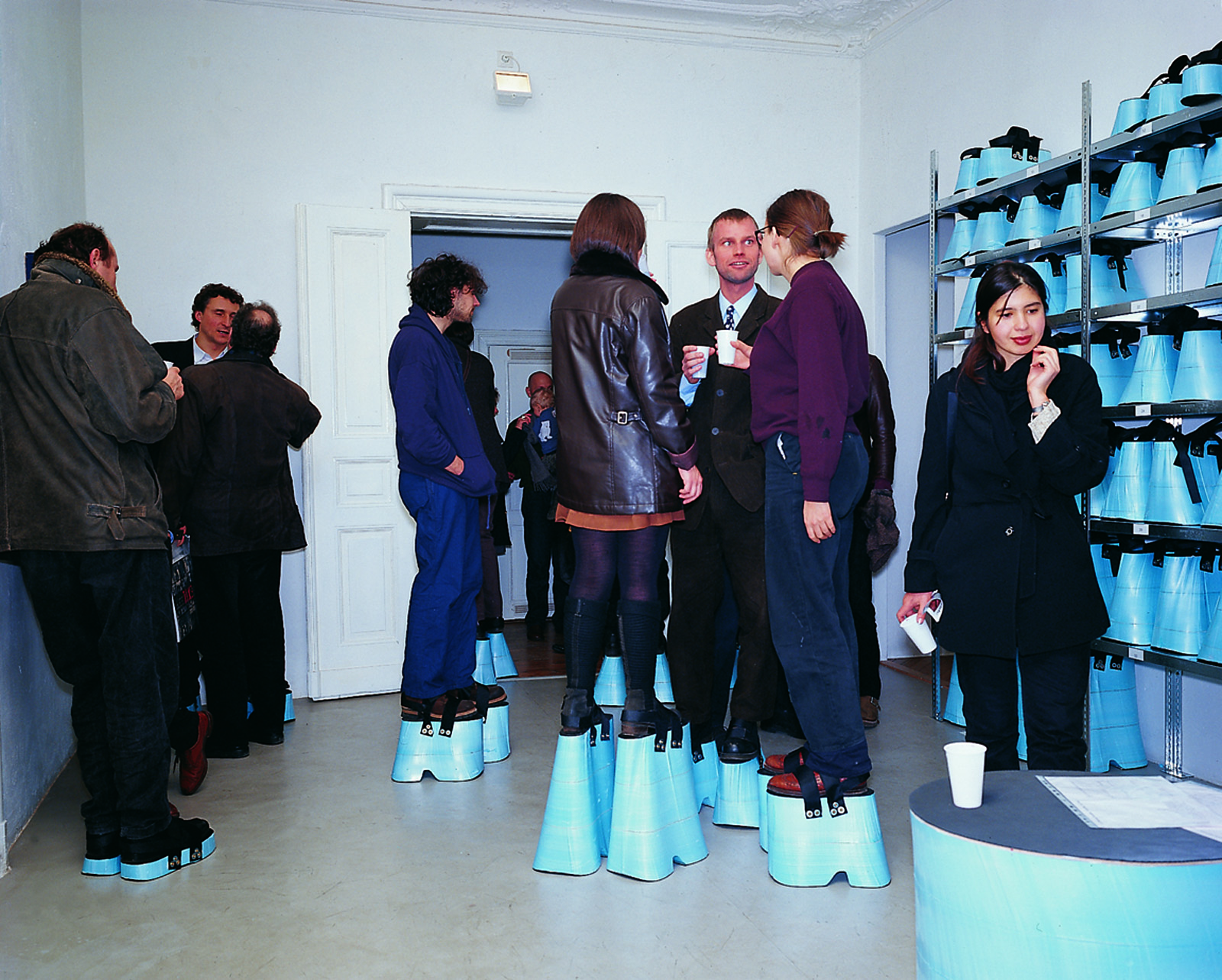
Hans Hemmert’s art installation level (1997) consists of a shelf of platforms that guests attach to their shoes so that everyone is two meters tall (about 6′ 7″).


Diego Rivera writes about the reactions to his murals in the Detroit Institute of Arts:
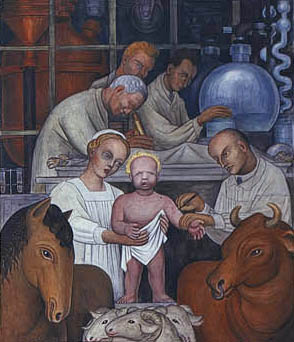
Thoroughly immersed in my labors though I was, I became conscious after a time, that whispers were beginning to circulate through the city concerning certain subjects of my frescoes. On the upper level of one wall, I had painted hands breaking through the surface of the earth to bring up pieces of minerals and metals. Above this portrayal, I had painted two reclining female nudes: one black, representing coal; one red, representing iron. On the wall directly opposite, I had shown hands taking limestone, sand, sulphur, and other light-colored substances from the earth, and directly above, had again represented their human analogues in white and yellow female nudes.
The females, who also represented the races of man, were autochthonous types, hardly “pretty.” The gossip spread that I was painting a poem to ugliness, that this was what the figures symbolized, standing above the roar and glint of steel machinery. I who knew better, merely worked on. What I did not understand was that certain people in Detroit were looking for a pretext to attack me and my mural.
In a pharmacological panel, they found it at last. In front of three men at work in a modern biochemical plant, I had pictured a child in the arms of a nurse, being vaccinated by a white-gowned physician. Directly before them stood a horse, a cow, and some sheep—animals from whose tissues many vaccines are prepared. The panel was intended to celebrate the noble work of men of science fighting against disease. To some people, the panel seemed to be a portrayal of the Holy Family in modern dress, the thee laboratory workers standing for the three kings and the animals the animals of the manger. To my enemies, because it had sprung from my conception, the painting was sacrilegious.
One day, from my scaffold, I observed a ….visitor, presented to me as a columnist for one of the big Detroit newspapers, came to see me at work…. He wore his hat pulled down over his eyes, which, when he lifted his head, were obscured by lenses as thick as bottle glass.
After watching me for a time, he shouted up, “Don’t you think the perspective is wrong?”
I peered down, and suddenly I found the sight of this terribly myopic, hat-blinded man so amusing that I could not control myself and burst out laughing.
The columnist squinted back at me in an uncomprehending and embarrassed manner. Finally, he asked where the lavatory was. Between gasps for breath, I gave him directions. Needless to say, he did not return.
But the following day he officially opened the campaign against me in his column. The basis of his condemnation was the alleged immorality of my frescoes. How, in such a beautiful museum, he asked, could I be permitted to paint such filth! He had been informed, he said, by trustworthy authorities, that I was dishonoring the walls of the Institute with pornographic paintings. If I was not stopped now …
But he was only the first of the crackpots who now set upon me.

You’ll remember from your Greek mythology that the Titans were the sons and daughters of the primordial gods Gaia and Uranus. They were thus gods themselves, ruling (after one of them, Kronos, overthrew Uranus with Gaia’s help) during the peaceful and idyllic Golden Age—when humans lived “without sorrow of heart, remote and free from toil and grief.” This second generation of gods gave birth to a third, among whom were Kronos’ children—Zeus, Hades, Poseidon, Hestia, Hera and Demeter—who eventually decide to challenge Kronos and all the other gods for control of the cosmos. The ten-year battle that ensues is called the Titanomachy.
Kronos sees it coming; Uranus and Gaia prophesied that one of his children would overthrow him, so he swallows all of his children—but Zeus’s mother Rhea tricks him by giving him a stone wrapped in a blanket and saying it’s Zeus; she also somehow tricks him into regurgitating all the others.
Hesiod tells the story in his Theogony; after ten years of fighting with the sides evenly matched, Zeus calls a war council, and says, after serving his siblings some nectar and ambrosia:
“Hear me, bright children of Earth and Heaven, that I may say what my heart within me bids. A long while now have we, who are sprung from Cronos and the Titan gods, fought with each other every day to get victory and to prevail. But show your great might and unconquerable strength, and face the Titans in bitter strife; for remember our friendly kindness, and from what sufferings you are come back to the light from your cruel bondage under misty gloom through our counsels.”
So he said. And blameless Cottus answered him again: “Divine one, you speak that which we know well: no, even of ourselves we know that your wisdom and understanding is exceeding, and that you became a defender of the deathless ones from chill doom. And through your devising we have come back again from the murky gloom and from our merciless bonds, enjoying what we looked not for, O lord, son of Cronos. And so now with fixed purpose and deliberate counsel we will aid your power in dreadful strife and will fight against the Titans in hard battle.”
So he said: and the gods, givers of good things, applauded when they heard his word, and their spirit longed for war even more than before, and they all, both male and female, stirred up hated battle that day, the Titan gods, and all that were born of Cronos together with those dread, mighty ones of overwhelming strength whom Zeus brought up to the light from Erebus beneath the earth. A hundred arms sprang from the shoulders of all alike, and each had fifty heads growing from his shoulders upon stout limbs. These, then, stood against the Titans in grim strife, holding huge rocks in their strong hands. And on the other part the Titans eagerly strengthened their ranks, and both sides at one time showed the work of their hands and their might.
The boundless sea rang terribly around, and the earth crashed loudly: wide Heaven was shaken and groaned, and high Olympus reeled from its foundation under the charge of the undying gods, and a heavy quaking reached dim Tartarus and the deep sound of their feet in the fearful onset and of their hard missiles. So, then, they launched their grievous shafts upon one another, and the cry of both armies as they shouted reached to starry heaven; and they met together with a great battle-cry.
Then Zeus no longer held back his might; but straight his heart was filled with fury and he showed forth all his strength. From Heaven and from Olympus he came immediately, hurling his lightning: the bolts flew thick and fast from his strong hand together with thunder and lightning, whirling an awesome flame. The life-giving earth crashed around in burning, and the vast wood crackled loud with fire all about. All the land seethed, and Ocean’s streams and the unfruitful sea. The hot vapor lapped round the earthborn Titans: flame unspeakable rose to the bright upper air: the flashing glare of the thunderstone and lightning blinded their eyes for all that they were strong.
Astounding heat seized Chaos: and to see with eyes and to hear the sound with ears it seemed even as if Earth and wide Heaven above came together; for such a mighty crash would have arisen if Earth were being hurled to ruin, and Heaven from on high were hurling her down; so great a crash was there while the gods were meeting together in strife. Also the winds brought rumbling earthquake and duststorm, thunder and lightning and the lurid thunderbolt, which are the shafts of great Zeus, and carried the clangor and the warcry into the midst of the two hosts.
A horrible uproar of terrible strife arose: mighty deeds were shown and the battle inclined. But until then, they kept at one another and fought continually in cruel war. And amongst the foremost Cottus and Briareos and Gyes insatiate for war raised fierce fighting: three hundred rocks, one upon another, they launched from their strong hands and overshadowed the Titans with their missiles, and hurled them beneath the wide-pathed earth, and bound them in bitter chains when they had conquered them by their strength for all their great spirit, as far beneath the earth as heaven is above earth; for so far is it from earth to Tartarus. For a brazen anvil falling down from heaven nine nights and days would reach the earth upon the tenth: and again, a brazen anvil falling from earth nine nights and days would reach Tartarus upon the tenth. Round it runs a fence of bronze, and night spreads in triple line all about it like a neck-circlet, while above grow the roots of the earth and unfruitful sea. (Hugh G. Evelyn-White, trans. Full text here.)
Image: Cornelis Cornelisz van Haarlem: The Fall of the Titans (1596-98)
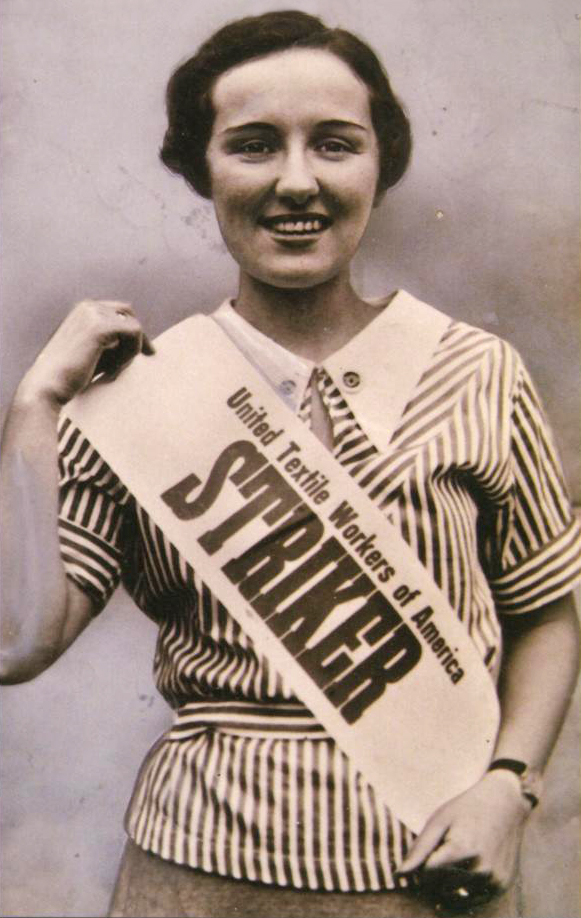
Virginia Matthews, secretary of the Philadelphia branch of the United Textile Workers of America (1934) (source)
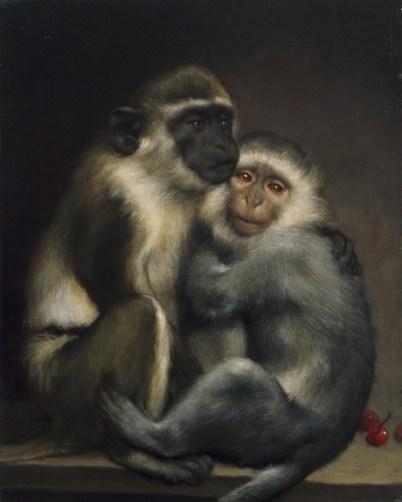
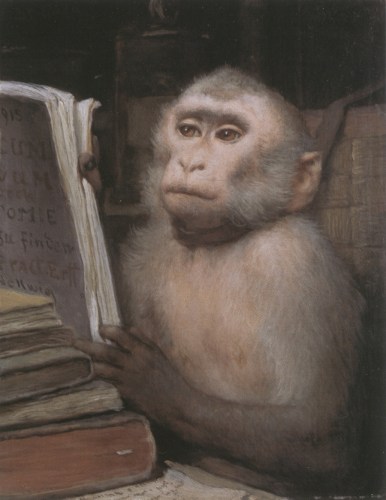
Gabriel von Max: Abelard and Heloise (after 1900).
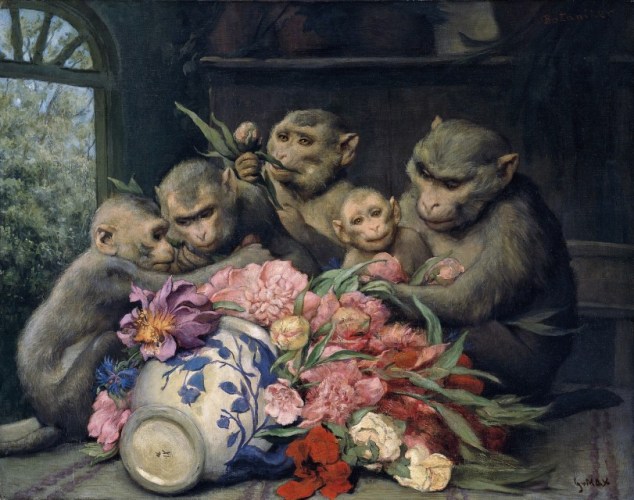
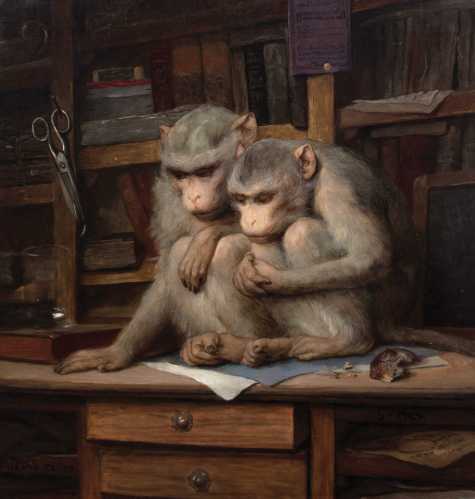
Max and his wife lived with as many as 14 monkeys. Here are some more examples of his work:






When Einstein was teaching at the California Institute of Technology in the early 1930’s, he attended a puppet show at the Teatro Torito in nearby Hollywood that featured this puppet of himself. According to Retronaut, after the show “he reached into his jacket’s breast pocket, pulled out a letter and crumpled it up. Speaking in German, he said, ‘The puppet wasn’t fat enough!’ He laughed and stuffed the crumpled letter up under the smock to give the puppet a fatter belly.”

Thomas Wilmer Dewing: The Song (1891)
More: