300-600 AD: Double-Faced Head Fragment

Double-Face

This earthenware fragment dates from 300-600 AD and was produced by an artist of the Remojadas culturewhich flourished on Mexico’s Veracruz Gulf Coast from about 100 BC to 800 AD and is considered to be part of the larger Classic Veracruz culture. Little is know about the civilization, largely because almost no archaeological research has been done since the site was uncovered in 1949. The fragment measures 26.3 cm (10½ inches) in height and was likely part of an almost life-sized human figure.

Archaeologists believe the double faced image arises from a dualistic concept related to human nature (such as male-female, youth-old age, or life-death) as figures with similar faces have  been found in other sites in the region, dating from over a span of about a thousand years.

The piece belongs to Wally Zollman, a plastic surgeon from Indianapolis, and his wife Brenda; this image is taken from the catalog of an exhibition held at the Indianapolis Museum of Art in 1989. It is therefore part of a private collection of Native American art that at least one reviewer has called “anachronistic” at time when many such objects have been returned to the descendants of the cultures from which they originate.

Posted in Uncategorized | Tagged , , , , , | Leave a comment

1912: English Lessons

The_Commercial_Telegraphers_Journal-430

NEW WORLD LESSONS FOR OLD WORLD PEOPLES.
Lessons in English for Foreign Girls.

Thousands of immigrants come to America every year. Some of them have belonged to labor organizations in the old country, many of them have not.

Most of the girl and women workers do not know much about factory life. They do not understand the high cost of living in America. They have never heard of labor unions. And because they do not speak English, a wall separates them from their fellow workers who might explain things to them.

There are now many private agencies for teaching foreigners English. The funds for these schools come largely from the pockets of manufacturers. The text-books used do not tell the girl worker the things she really wants to know. They do not suggest that $5.00 a week is not a living wage. They tell her to be respectful and obedient to her employer. They never mention labor unions.

The labor movement will suffer if these girls are taught by the capitalists to become scabs and strike-breakers. But if we teach them, they will fight on our side. They will become the staunchest supporters of the labor movement.

The Women’s Trade Union League, 43 East Twenty-second street, New York City, has published the right kind of English lessons for foreign girls. They are called “New World Lessons.” They teach the simplest principles of trade unionism. They tell what the factory laws are, and how the workers, through organization, can enforce them. The titles of the lessons are:

LOOKING FOR WORK.
LEARNING A TRADE.
HOME WORK.
A TRADE WITHOUT A UNION.
A TRADE WITH A UNION.
JOINING THE UNION.
FIRE!!!
FACTORY LAWS.

The following is a sample of the lessons:

Lesson V. A Trade With a Union.

I met a friend yesterday.
She works at a good trade.
She goes home at five o’clock.
She goes home at twelve o’clock on Saturday.
She has one hour for lunch every day.
She earns twelve dollars a week.
Sometimes she works overtime in the busy season.
She gets extra pay for overtime.
She belongs to the Union in her trade.
She says: Our trade was once a bad trade. Then we girls formed a Union.
We wanted to make our trade a good trade for the workers.
It took a long time.
It took a great deal of hard work.
But now our Union is strong.
We girls are proud of it because we made it.
It was worth the hard work.

No union or labor organization in a trade where there are foreign girl workers can carry on better propaganda than to teach the workers English by means of these lessons. They were written by a trade union member who has taught in a night school for two years. They are good both as lessons and as propaganda.

Four stories in simple English go with the lessons. The lessons and stories are printed on separate sheets and come in an attractive blue folder. They cost ten cents for a set of eight lessons and four stories.

They are worth seeing. Send ten cents for a copy to the Woman’s Trade Union League, 43 East Twenty-second street, New York.

The Commercial Telegraphers Union Journal, Vol. X, No. 11 (November, 1912)

Posted in Uncategorized | Tagged , , , , | Leave a comment

1925: Instead All Joy is Snatched Away

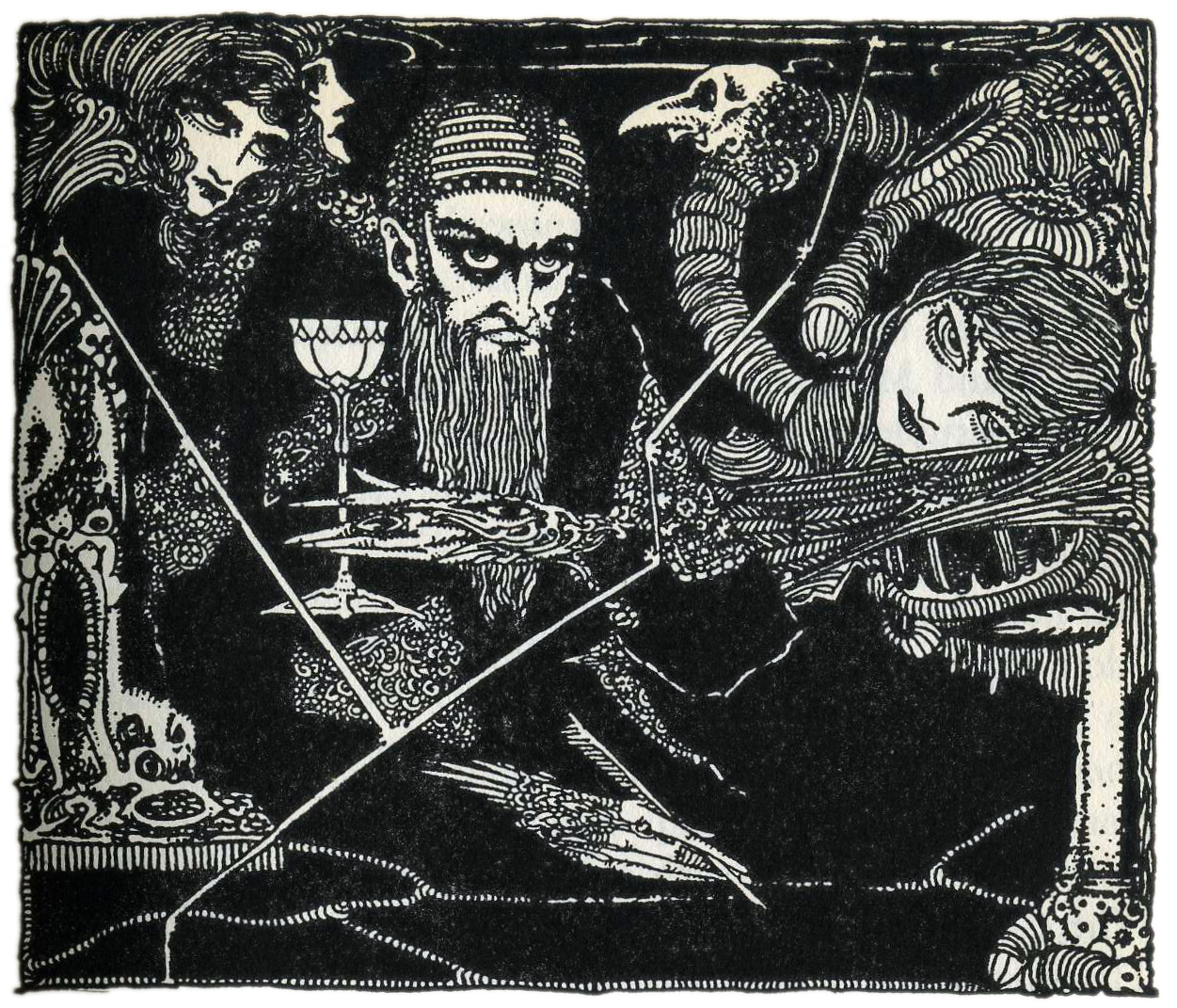
Clarke

Harry Clarke: Illustration for Goethe’s Faust (1925)

Faust: Ah! Now I’ve done Philosophy,
I’ve finished Law and Medicine,
And sadly even Theology:
Taken fierce pains, from end to end.
Now here I am, a fool for sure!
No wiser than I was before:
Master, Doctor’s what they call me,
And I’ve been ten years, already,
Crosswise, arcing, to and fro,
Leading my students by the nose,
And see that we can know – nothing!
It almost sets my heart burning.
I’m cleverer than all these teachers,
Doctors, Masters, scribes, preachers:
I’m not plagued by doubt or scruple,
Scared by neither Hell nor Devil –
Instead all Joy is snatched away,
What’s worth knowing, I can’t say,
I can’t say what I should teach
To make men better or convert each.
And then I’ve neither goods nor gold,
No worldly honour, or splendour hold:
Not even a dog would play this part!

(Translation by A. S. Kline.)

Posted in Uncategorized | Tagged , , , , , , , , , | Leave a comment

2017: The Sky

2017-07-13-21

New additions to the gallery.

Posted in Uncategorized | Tagged , , | Leave a comment

2012: Moving

Erlich_02

Leandro Erlich: Monte-Meubles. L’Ultime Déménagement (2012)
Installation in Nantes, France (source)

The translation is hard to do nicely. Literally, the title means “Furniture Elevator: The Final Move,” where “move” has the specific sense of moving to a new house or apartment.

Posted in Uncategorized | Tagged , , , , , | Leave a comment

1850: The Ninth Wave

Aivazovsky,_Ivan_-_The_Ninth_Wave 1850

Ivan Aivazovsky: The Ninth Wave (1850)

The title is a reference to a traditional belief among sailors that waves grow larger and larger in a sequence up to the ninth wavethe largestand then the sequence begins again.

Posted in Uncategorized | Tagged , , , , , , , | Leave a comment

3,000 BC: Map

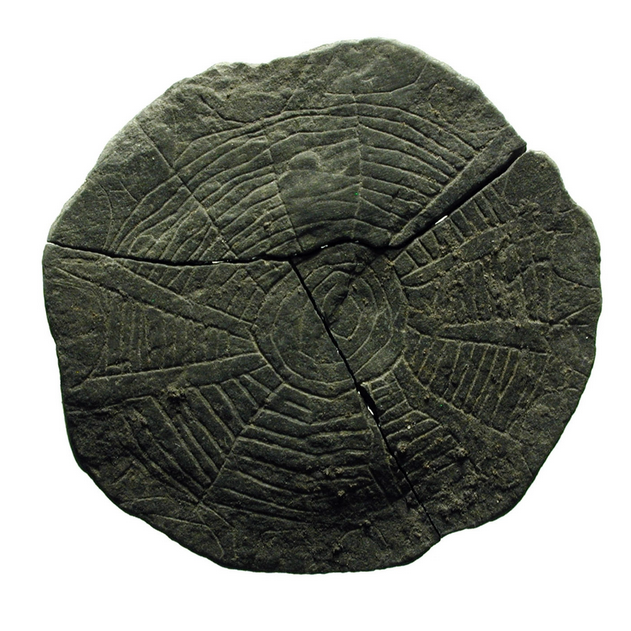
Screen Shot 11-05-16 at 05.31 PMThis etched stone, found in 2016 with nine others at a 5,000-year-old sacred site in Denmark, may be a map. Archaeologists believe it is a symbolic representation of a local area, showing fields, fences and plants, and that it may have been used in Neolithic magic rituals designed to influence the sun and increase the fertility of crops. See more here.

Posted in Uncategorized | Tagged , , , | 2 Comments

1974: I Like America and America Likes Me

Beuys - I Like America and America Likes Me - 1974

For his 1974 conceptual art piece I Like America and America Likes Me, the German artist Joseph Beuys flew to New York City and, wrapped in felt, was driven in an ambulance to the Rene Block Gallery. There, he spent three days (eight hours each day) in a small room with a wild coyote. (The room also contained a pile of straw.) On the last day, the coyote, who had come to trust the artist, allowed Beuys to give him a hug. Beuys was then driven back to the airport, again in an ambulance, and flew back to Germany. He had seen nothing of the United States except the room and the coyote.

Posted in Uncategorized | Tagged , , , , , , | Leave a comment

1887: Der Nöck

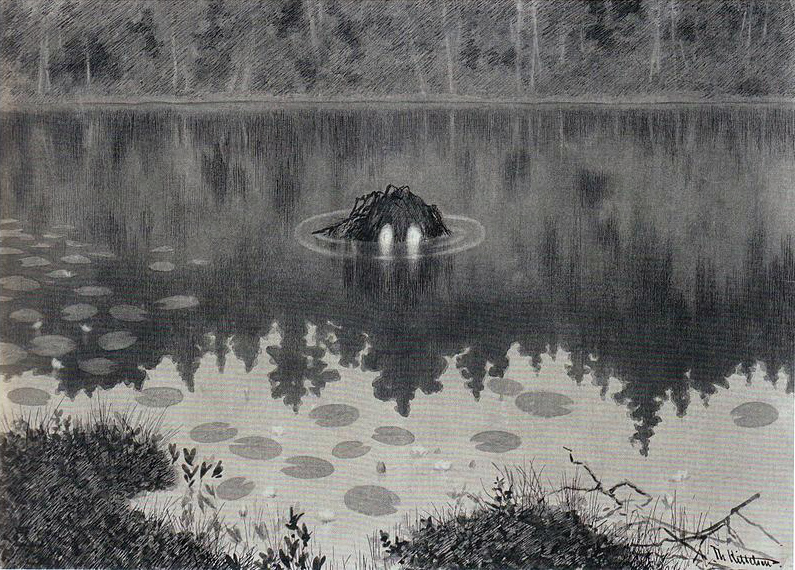
Theodor Kittelsen - Der Nöck - 1887

The Nöck (or Nix, Neck, Näck, or Nickert) is a protective water spirit who lives in lakes, ponds, springs, wells and even drops of water.  The word is likely derived from Old High German nihhus , niccus or nichessa (“water spirit”), although an alternate theory traces its origin to the Latin necare (“killing”) or the Old English nicor (“water demon”).

Image:
Theodor Kittelsen: Der Nöck (1887)

Posted in Uncategorized | Tagged , , , , | Leave a comment

1942: Battlefields

0-005

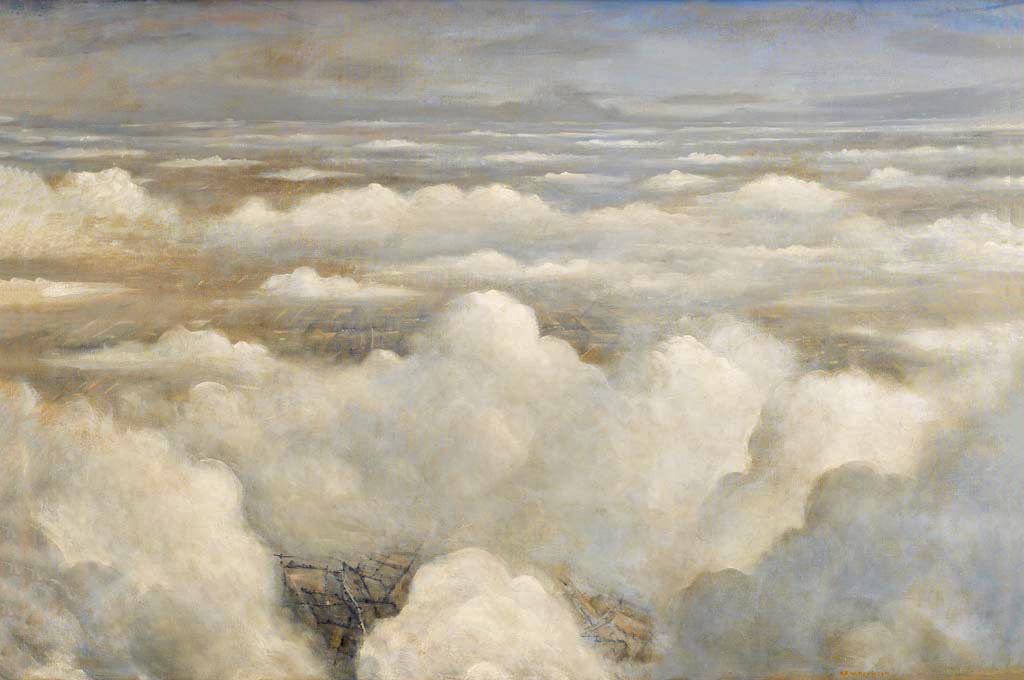
Christopher R. W. Nevinson: Battlefields of Britain (1942)

During the First World War, the painter and printmaker Christopher R. W. Nevinson served in Flanders and France as an ambulance driver with the Royal Army Medical Corps. He was granted leave from the army as an invalid in 1916, and was appointed an Official War Artist the following year. He was the first artist to accompany aerial missions, representing the experience on airplanes, balloons and dirigibles.

The painting above, composed in an airplane cockpit, was inspired by a line from a sonnet by the American pilot John Gillepsie Magee, who had died in the war in 1941:

Up, up the long, delirious burning blue
I’ve topped the wind-swept heights with easy grace
Where never lark nor even eagle flew –
And, while with silent lifting mind I’ve trod
The high, untrespassed sanctity of space
Put out my hand and touched the face of God.

Nevinson suffered from depression at the outbreak of the Second World War and his health declined dramatically. He died in 1946 at the age of fifty-seven.

Sources here and here.

Posted in Uncategorized | Tagged , , , , , , , , , , | Leave a comment