

Martin Johnson Heade: Sunlight and Shadow: The Newbury Marshes (c. 1871-1875)
Martin Johnson Heade: Sunlight and Shadow: The Newbury Marshes (c. 1871-1875)

Yan Cong: Landscape #6 (2013)
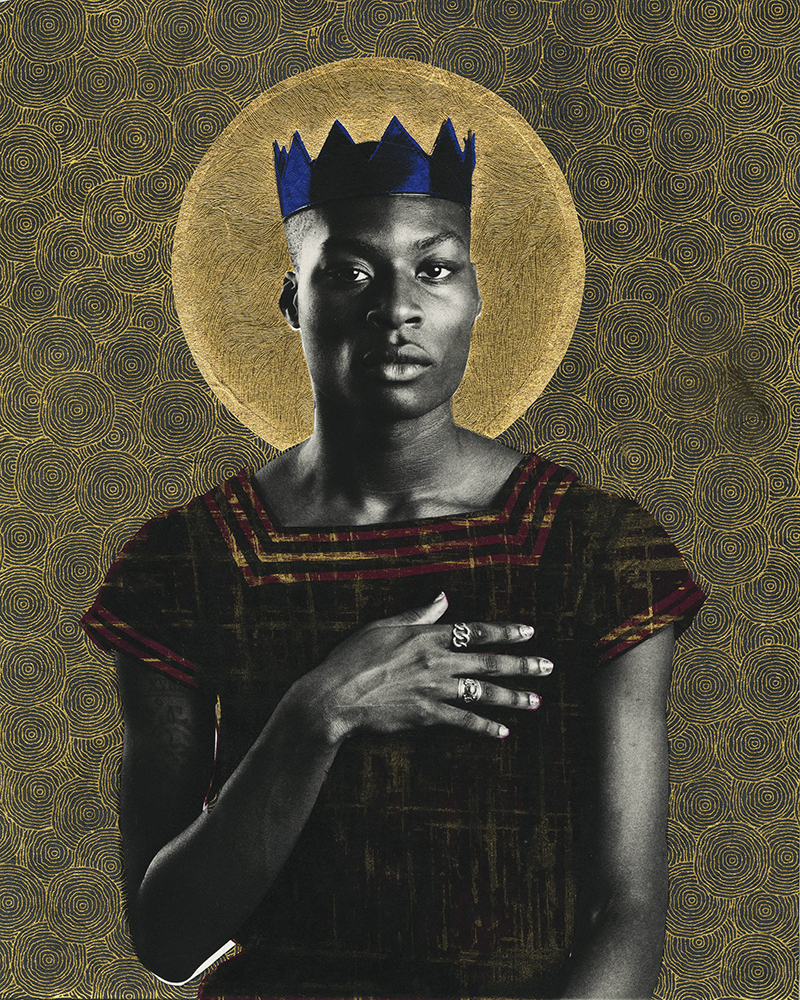
Gabriel Garcia Roman: Jahmal (2014);
from a series, Queer Icons
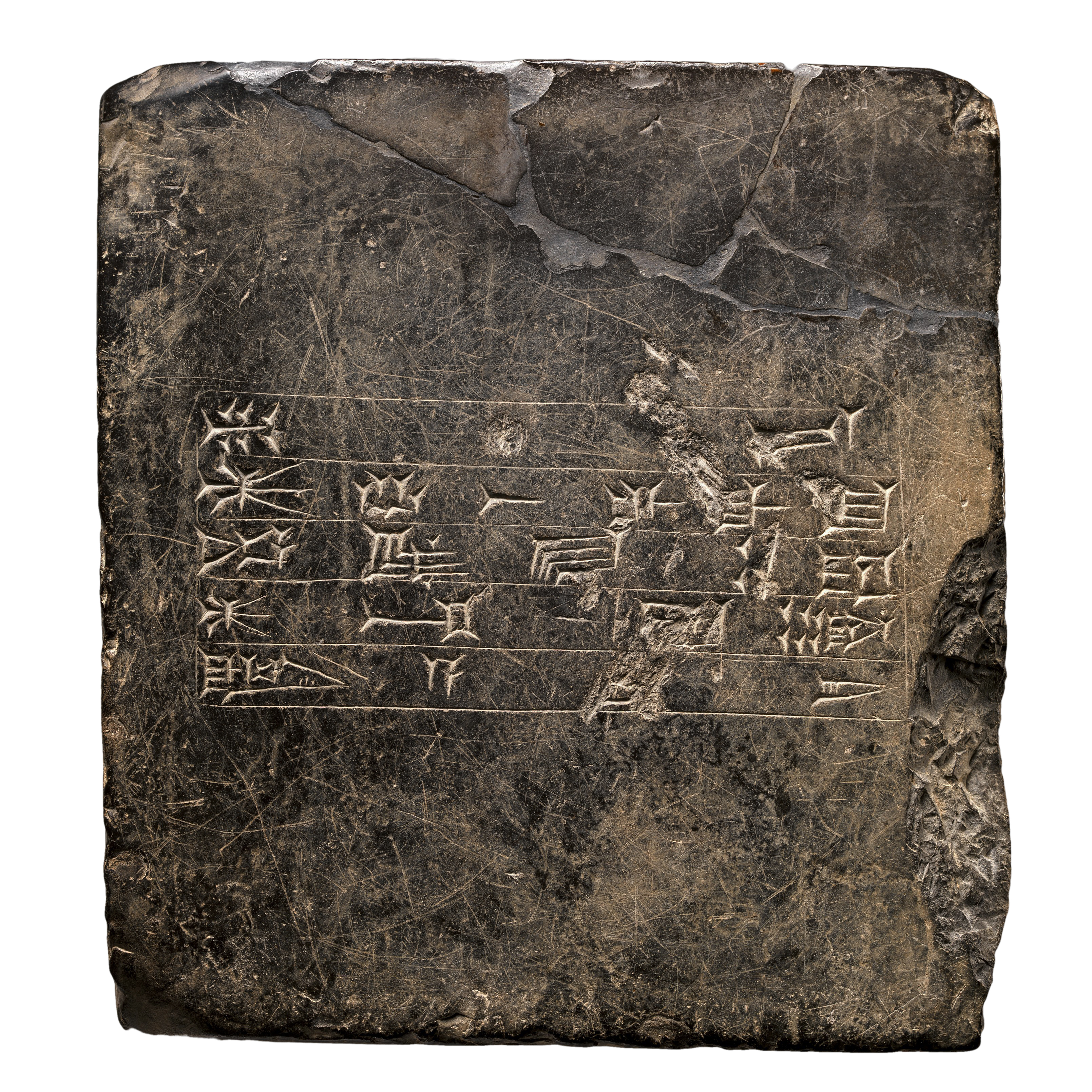
In one of the oldest surviving creation myths, humankind originates from a labor action. The story, told in the Babylonian Atrahasis Epic, goes like this: long before humankind, only gods exist, with some more powerful than others. These greater gods—the Anunnaki—including the primary deity Ellil, wisdom god Ea, and mother/birth goddess Belet-ili, force the lesser ones—the Igigi —to perform all the necessary labor of producing food and building canals. This goes on for 3,600 years, until the lesser gods get fed up—so they go on strike, burn their tools, and march on boss Ellil to demand a change.
The solution is mixed: After a council with the other Anunnaki, Ellil does agree that the situation merits redress, and Ea comes up with the idea of having Belet-ili create human beings to perform the menial labor—a tidy solution—but also the leader of the strike is killed to help make the new creature. Belet-ili mixes his flesh, blood, and spirit with clay to make the first humans. They will forever feel his spirit in the rhythm of their heartbeat, but will never be powerful enough to rebel themselves.
Here is the text:
When the gods instead of man
Did the work, bore the loads,
The gods’ load was too great,
The work too hard, the trouble too much
The great Anunnaki made the Igigi
Carry the workload sevenfold.
Anu their father was king,
Their counsellor warrior Ellil,
Their chamberlain was Ninurta,
Their canal-controller Ennugi.
They took the box (of lots) … ,
Cast the lots; the gods made the division.
Anu went up to the sky,
[And Ellil (?)] took the earth for his people (?).
The bolt which bars the sea
Was assigned to far-sighted Enki.
When Anu had gone up to the sky,
[And the gods of] the Apsu had gone below,
The Anunnaki of the sky
Made the Igigi bear the workload.
The gods had to dig out canals,
Had to clear channels, the lifelines of the land,
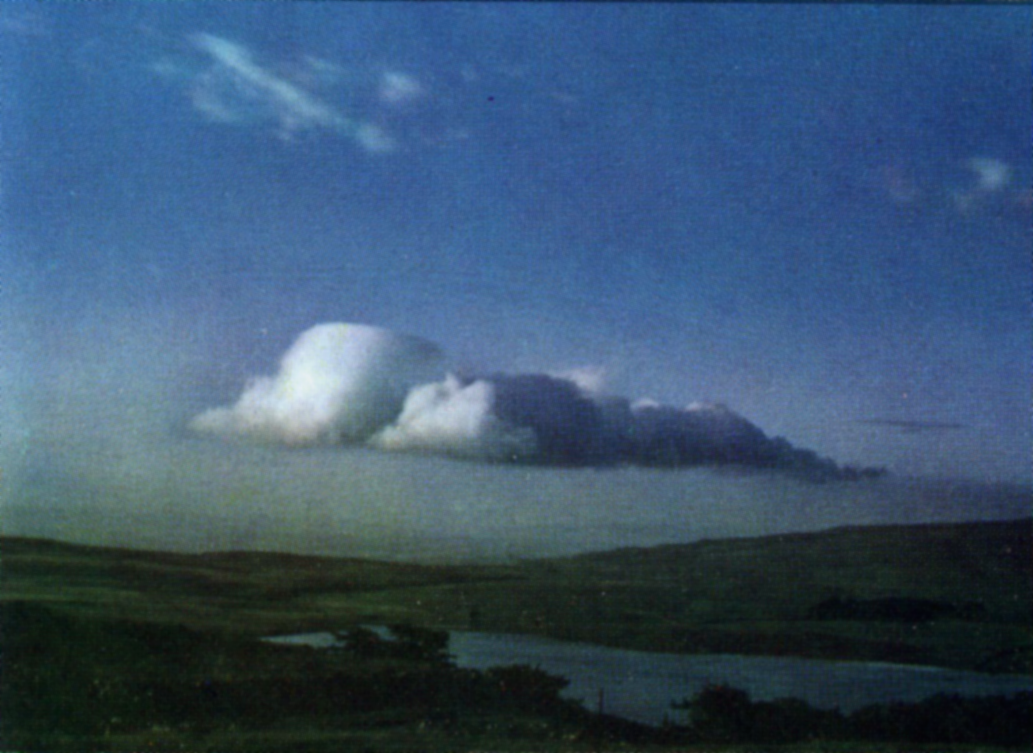
Each time you look at the sky, try to identify the clouds in it and test whether the explanations given in the book could be true for them. Gradually you will come to know the important clouds and the circumstances in which they occur….The pictures are a selection of about one in nine from our Colour Encyclopaedia of Clouds, and it is intended to serve as an introduction to a subject which can be of absorbing interest to physicists, mathematicians, naturalists, geographers, and artists, and also to those with only an amateur interest in the sky. There are some challenging suggestions at the end about how the subject may be developed….Above all the book should be used—taken out on all trips along with maps and binoculars, and carried to the office, workshop, or school because this part of the study of nature can be continued even in the centre of cities.
—Richard Scorer and Harry Wexler: A Colour Guide to Clouds (1963)


From top to bottom: Pileus, Cumulonimbus, and Cirrostratus halo.

Michaël Borremans: Trickland (2002)
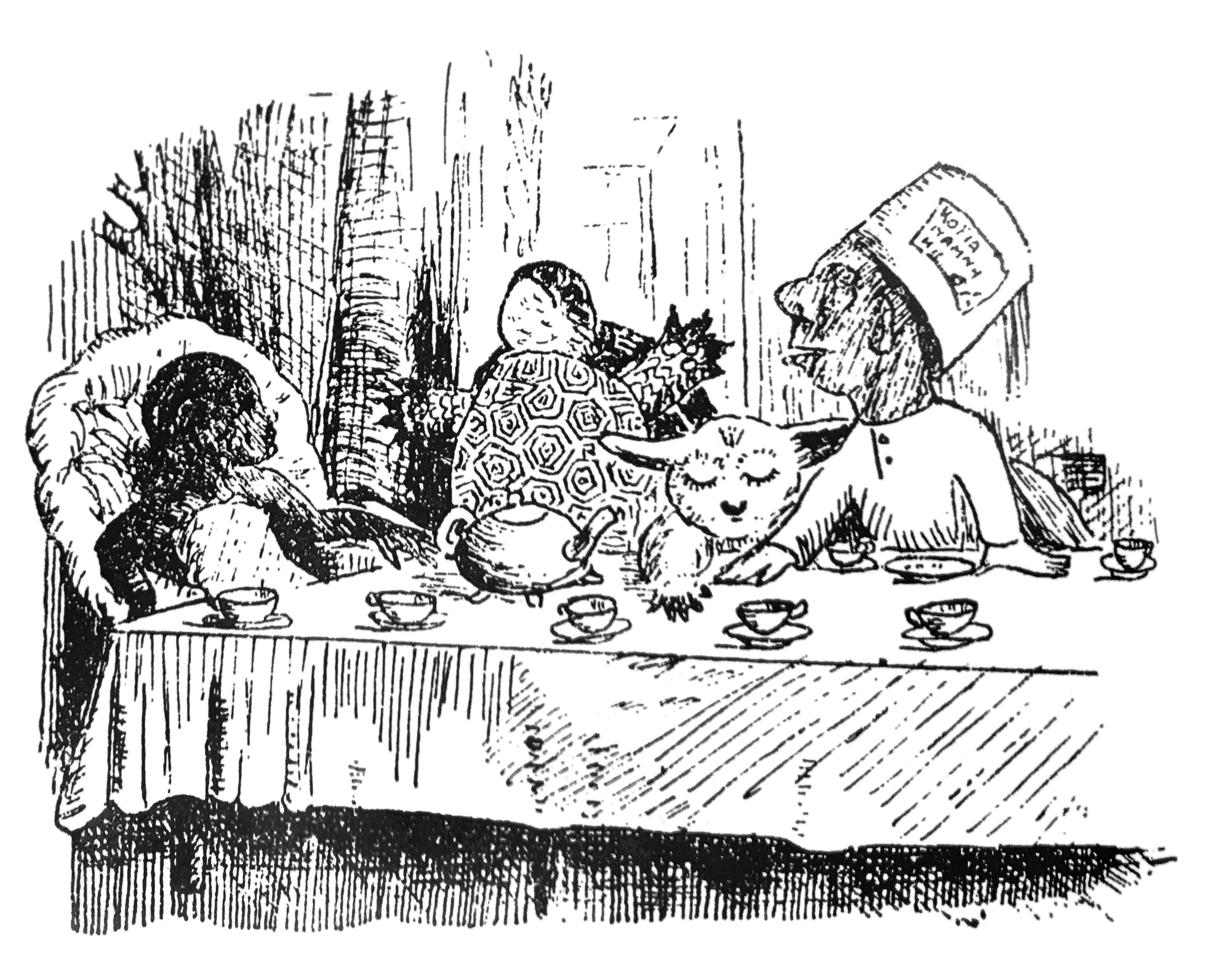 In his book Alice in Many Tongues (1964), Warren Weaver spends the last chapter using a curious method to evaluate various translations of Alice in Wonderland. He takes the same passage from each translation—a portion of the Mad Tea-Party—and asks a fluent speaker in each language to “re-translate” it back into English so he can compare them.
In the section, Alice has just arrived at the tea-party and discovered the March Hare, the Hatter, and the sleepy Dormouse.
The Hatter shook his head mournfully…. “We quarreled last March–just before HE went mad, you know–” (pointing with his tea spoon at the March Hare,) “–it was at the great concert given by the Queen of Hearts, and I had to sing
‘Twinkle, twinkle, little bat!
How I wonder what you’re at!’You know the song, perhaps?”
“I’ve heard something like it,” said Alice.
“It goes on, you know,” the Hatter continued, “in this way:–
‘Up above the world you fly,
Like a tea-tray in the sky.
Twinkle, twinkle–'”Here the Dormouse shook itself, and began singing in its sleep “Twinkle, twinkle, twinkle, twinkle–” and went on so long that they had to pinch it to make it stop.
The song, of course, is a mixed-up version of the English lullaby “Twinkle, Twinkle, Little Star”:
Twinkle, twinkle, little star,
How I wonder what you are!
Up above the world so high,
Like a diamond in the sky.
Translators have three options when faced with this kind of parody, Weaver concludes. The first is to invent a parody of a similar well-known children’s verse in the translation language. (This is the superior method in his opinion.) The second is to translate the song as is—perhaps because the translator does not recognize that the parody is a parody—leaving the reader with just a strange song about a bat and tea-trays. The third method is to substitute an unrelated bit of nonsense verse for the original.
A number of translations employ the first method:
The Danish version mimics a children’s song:
Fly, oh fly, my owl,
Fairest of all fowl!
Up to the clouds, fly away
Like tea-things in a bag.
Fly, oh fly—
The French version “is a confused (and it seems to me not very clever) modification of a rhyme apparently well known to French children a century ago”:
Ah, I will tell you my sister,
What causes my pain.
It is that I had some candied almonds,
And that I ate them.

Wilhelm Bernatzik: Entrance to Paradise (1906)

Teresita Fernández: Fire (2005)
Fire and heat provide modes of explanation in the most varied domains, because they have been for us the occasion for unforgettable memories, for simple and decisive personal experiences. Fire is thus a privileged phenomenon which can explain anything. If all that changes slowly may be explained by life, all that changes quickly is explained by fire. Fire is the ultra-living element. It is intimate and it is universal. It lives in our heart. It lives in the sky. It rises from the depths of the substance and offers itself with the warmth of love. Or it can go back down into the substance and hide there, latent and pent-up, like hate and vengeance. Among all phenomena, it is really the only one to which there can be so definitely attributed the opposing values of good and evil. It shines in Paradise. It burns in Hell. It is gentleness and torture. It is cookery and it is apocalypse. It is a pleasure for the good child sitting prudently by the hearth; yet it punishes any disobedience when the child wishes to play too close to its flames. It is well-being and it is respect. It is a tutelary and a terrible divinity, both good and bad. It can contradict itself; thus it is one of the principles of universal explanation.
—Gaston Bachelard: The Psychoanalysis of Fire (1938) (Alan C. M. Ross, trans.)
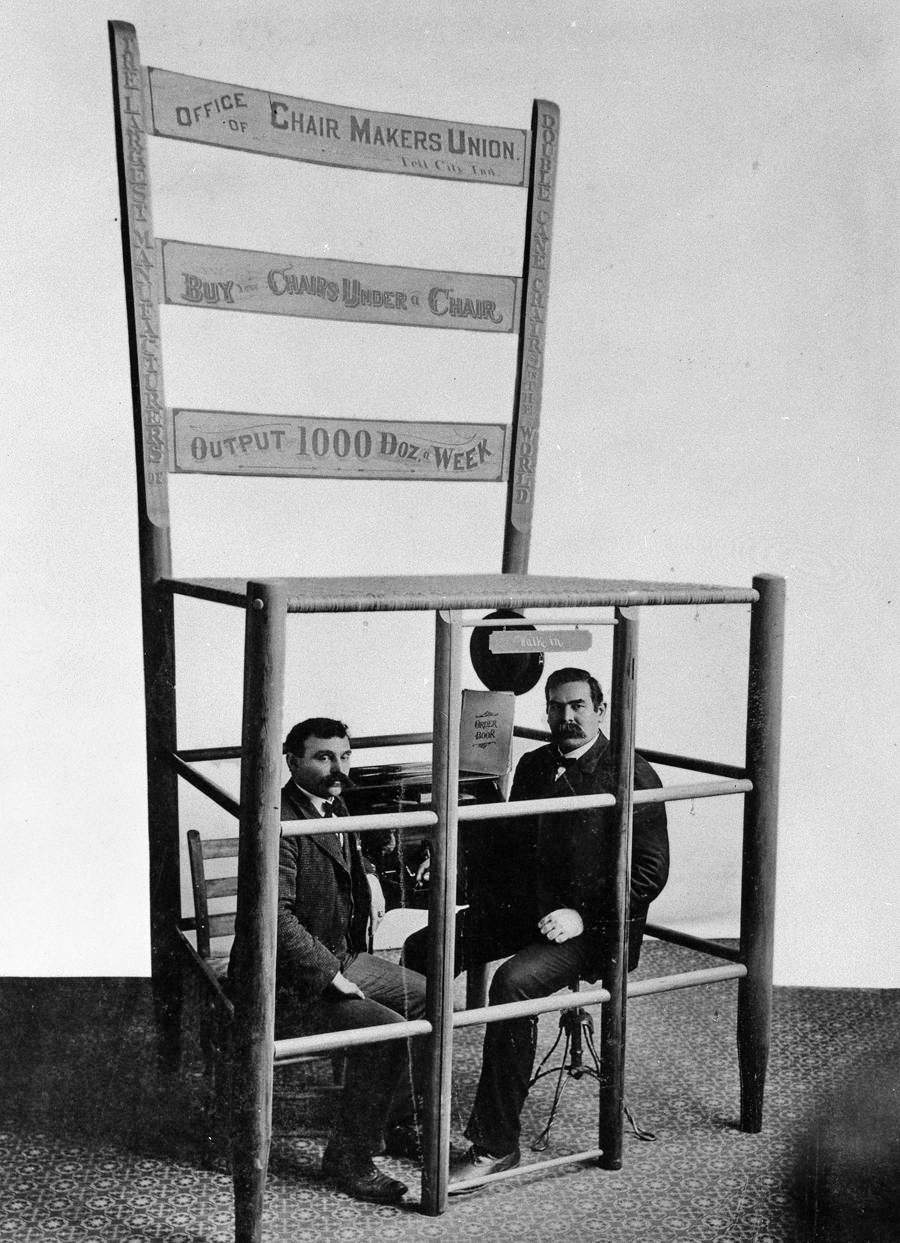
Founded in the 1850’s by Swiss immigrants from Cincinnati, Tell City, Indiana was originally a planned community in which land was distributed by lottery and everyone was guaranteed a job. One of the first businesses in the town was the Chair Makers Union, a cooperative organized by 11 men; all were equal owners and the constitution required every member to work in the factory. The company retained the name even after the cooperative structure fell apart—but eventually became the Tell City Chair Company in 1924.
The photo shows representatives Jacob Zoercher (left) and A.P. Fenn taking orders at the 1904 St. Louis World’s Fair.


 corvusfugit.com