

Stuart Pearson Wright: Diane Abbott MP (2004); in 1987, Diane Abbott became the first black woman elected to the British Parliament. See a video of her talking about this portrait here.
Stuart Pearson Wright: Diane Abbott MP (2004); in 1987, Diane Abbott became the first black woman elected to the British Parliament. See a video of her talking about this portrait here.

Yang Jiechang: Crying Landscape: Three Gorges Dam (2002)
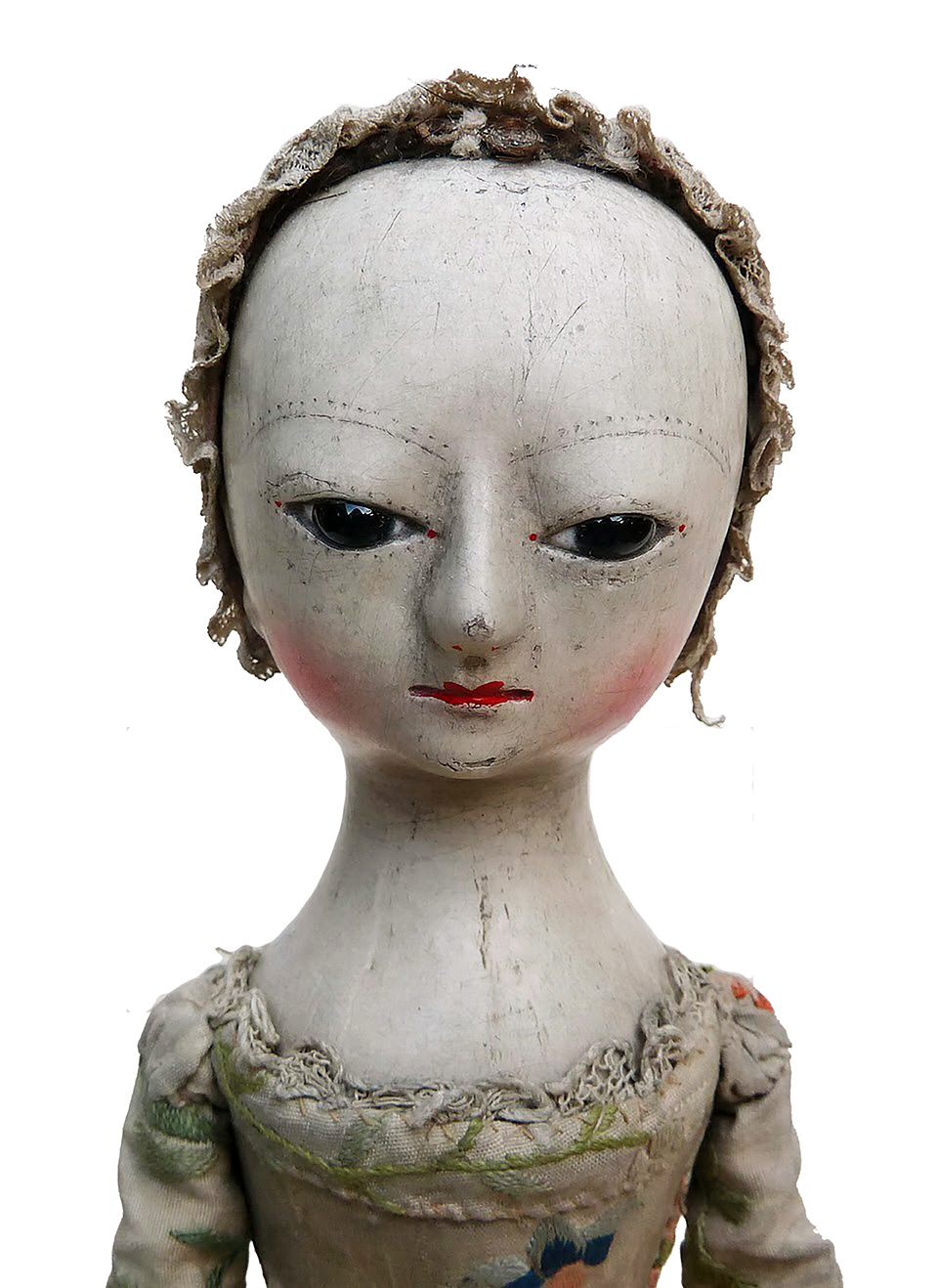
When Descartes resided in Holland, with great labour and industry he made a female Automaton—which occasioned some wicked wits to publish that he had an illegitimate daughter, named Franchine—to prove demonstratively that beasts have no souls, and that they are but machines nicely composed, and moves whenever another body strikes them, and communicates to them a portion of their motions. Having put this singular machine into a case on board a vessel, the Dutch captain, who sometimes heard it move, had the curiosity to open the box. Astonished to see a little human form extremely animated, yet, when touched, appearing to be nothing but wood; little versed in science, but greatly addicted to superstition, he took the ingenious labour of the philosopher for a little devil, and terminated the experiment of Descartes by throwing his Wooden Daughter into the sea.
—Isaac Disraeli: Curiosities of Literature Consisting of Anecdotes, Characters, Sketches and Observations Literary, Critical, and Historical (1792)
No one knows if this story is true. (The version here is not much different from its earliest appearance in 1699.) What is true is that Descartes did have an illegitimate daughter named Francine, who was born in 1635. Her mother was a servant named Hélène Jans. Francine did live for some time with her father, but died of scarlet fever when she was five. Descartes said that her death was the greatest sorrow of his life, and some versions of the story make it clear that the automaton was a grief-ridden father’s replacement for a lost child; he sleeps with his arm around her coffin-like box. The story of the ship captain tossing her overboard is sometimes dated to the early 1640’s, but in some versions takes place on the philosopher’s ill-fated trip to Sweden in 1649.
It’s also true that the story fits—somehow—into the philosophical debates of the time. Maybe Descartes did make an automaton to prove a point—but what point? Why make a human automaton to prove that animals don’t have souls? While Descartes did believe that “beasts have no souls, and that they are but machines nicely composed,” he contented that human beings do have souls, and that this is what set them apart from animals. Others—notably and notoriously Julien La Mettrie in L’homme Machine [Man: a Machine] (1747)—pushed Descartes’s conclusions about animals to the next step, arguing for a purely materialist conception of human existence: “The human body is a machine which winds its own springs.”
Image: Facsimile 18th century doll by Old Pretenders Studio (source).

Constantin Westchiloff: Rolling Waves. The painting is undated; Westchiloff immigrated to the United States in 1935 and lived in New York City
In a 2014 study, Tanya Luhrmann found that when people hear voices in their heads, the personae and tone of those voices are shaped by culture; in the United States, the voices are threatening and severe, but in Africa and India, they tend to be more playful or even reassuring:
While many of the African and Indian subjects registered predominantly positive experiences with their voices, not one American did. Rather, the….Americans experienced voices as bombardment and as symptoms of a brain disease caused by genes or trauma….Among the Indians in Chennai, more than half…heard voices of kin or family members commanding them to do tasks. “They talk as if elder people advising younger people,” one subject said….[S]everal heard the voices as playful, as manifesting spirits or magic, and even as entertaining….In Accra, Ghana, where the culture accepts that disembodied spirits can talk, few subjects described voices in brain disease terms. When people talked about their voices, 10 of them called the experience predominantly positive; 16 of them reported hearing God audibly.
Why the difference? Luhrmann offered an explanation: Europeans and Americans tend to see themselves as individuals motivated by a sense of self identity, whereas outside the West, people imagine the mind and self interwoven with others and defined through relationships. (source)
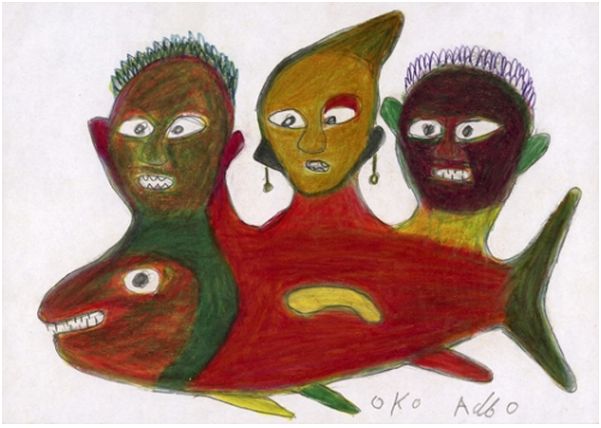
Art by Ghanaian artist Ataa Oko. See a video about him and his work here.
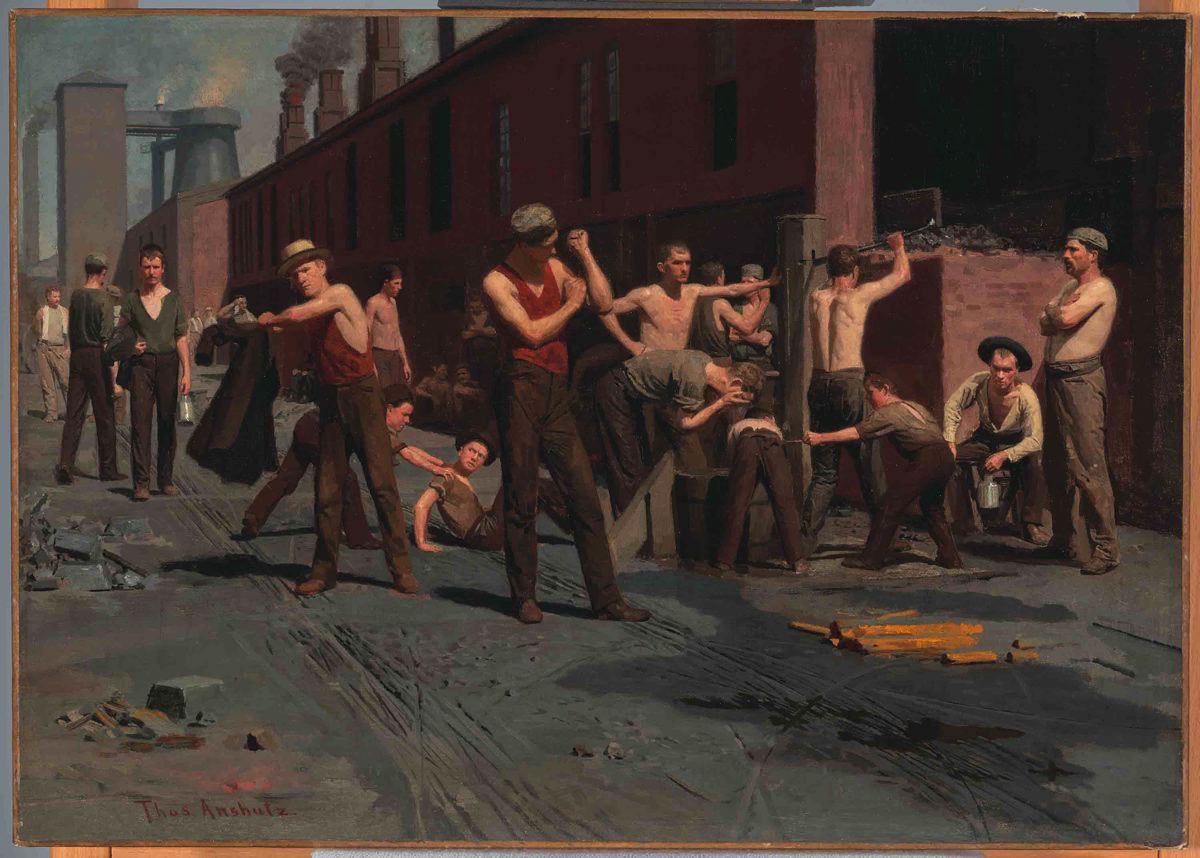
Thomas Anshutz: The Ironworkers’ Noontime (1880)
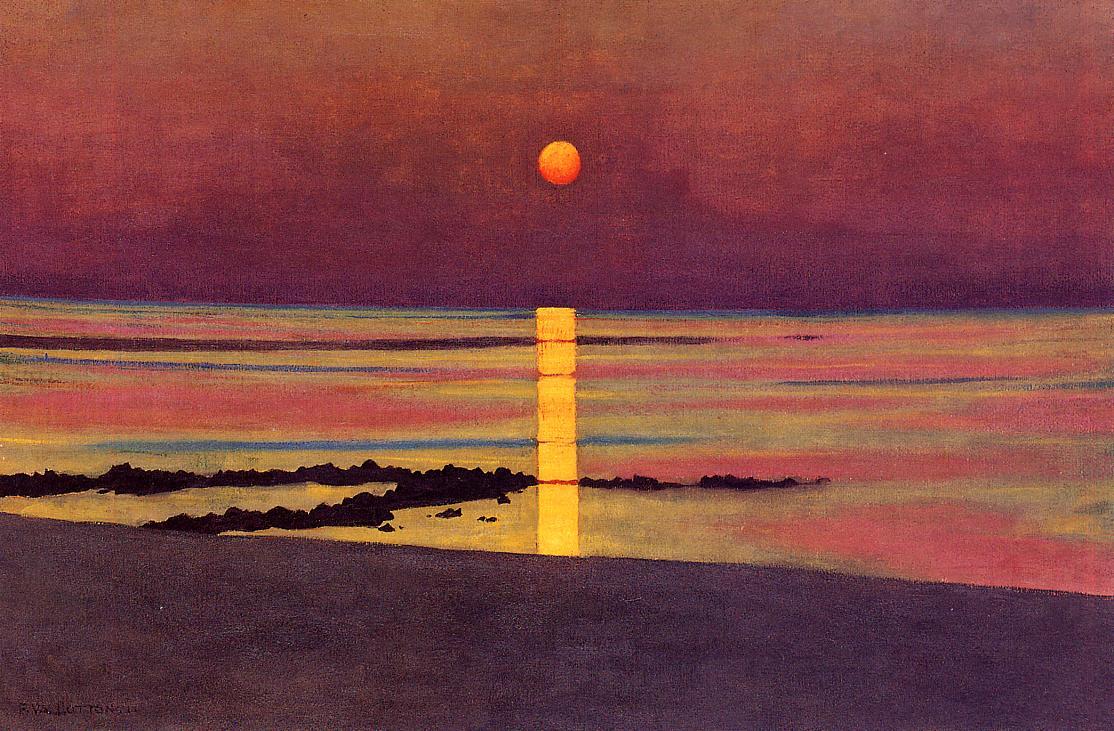
Félix Vallotton: Sunset (1913)

From John Fanning Watson’s Annals of Philadelphia, being a collection of memoirs, anecdotes, and incidents of the city and its inhabitants, from the days of the Pilgrim founders (1830):
The good people of Caledonia [Scotland] have so long and exclusively engrossed the faculty of “second sight,” that it may justly surprise many to learn that we also have been favoured with at least one case as well attested as their own! I refer to the instance of Eli Yarnall of Frankford. Whatever were his first peculiarities he in time lost them. He fell into intemperate habits, became a wanderer, and died in Virginia, a young man. He was born in Bucks county, and with his family emigrated to the neighbourhood of Pittsburg. There, when a child of seven years of age, he suddenly burst into a fit of laughter in the house, saying he then saw his father (then at a distance) running down the mountain side trying to catch a jug of whiskey which he had let fall. He saw him over-take it, &c. When the father came in, he confirmed the whole story, to the great surprise of all. The boy after this excited much wonder and talk in the neighbourhood. Two or three years after this, the family was visited by Robert Verreé, a public Friend, with other visiting Friends from Bucks county. I have heard, in a very direct manner, from those who heard Verreé’s narrative, that he, to try the lad, asked him various questions about circumstances then occurring at his own house in Bucks county ; all of which he afterwards ascertained to have been really so at that precise time! Some of the things mentioned were these, viz: “I see your house is made partly of log and partly of stone; before the house is a pond which in now let out; on the porch sits a woman, and a man with gray hairs; in the house are several men,” &c. When Verreé returned home he ascertained that his mill-pond before his house had just been let out to catch muskrats; that the man in the porch was his wife’s brother Jonathan; that the men in the house were his mowers, who had all come in because of a shower of rain. In short. he said every iota was exactly realized.
The habits of the boy, when he sought for such facts, was to sit down and hold his head downward—his eyes often shut; and after some waiting declared what he saw in his visions. He has been found abroad in the fields, sitting on a stump, crying—on being asked the reasons, he said he saw great destruction of human life by men in mutual combat. His descriptions answered exactly to sea-fights and army battles, although he had never seen the sea, nor ships, nor cannon all of which he fully described as an actual looker-on. Some of the Friends who saw him became anxious for his future welfare, and deeming him possessed of a peculiar gift and a good spirit, desired to have the bringing of him up. He was therefore committed to the mastery of Nathan Harper, a Friend, engaged in the business of tanning in Frankford. There he excited considerable conversation; and so many began to visit him as to be troublesome to his master, who did what he could to discourage the calls. Questions on his part were therefore shunned as much as he could. He lost his faculty by degrees, and fell into loose company. which of itself prevented serious people from having any further wish to interrogate him.
To instance the kind of inquiries which were usually presented to him it may be stated, that wives who had missed their husbands long, supposed by shipwreck for instance, would go to him and inquire. He would tell them (it is said) of some still alive, what they were then about, &c. Another case was a man, for banter, went to him to inquire who stole his pocket-book, and he was answered—no one; but you stole one out of a man’s pocket when at the vendue—and it was so!
His mother would not allow him “to divine for money,” lest he should thereby lose the gift, which she deemed heaven-derived. The idea is not novel, as may be seen in John Woolman’s life, where he speaks of a rare gift of healing, which was lost by taking a reward.
These are strange things, evidencing matters “not dreamed of in our philosophy.” I give these facts as I heard them—I “nothing extenuate, nor aught set down in malice.”
Image: Peter Vanderlyn: Portrait of Adam Winne (1730)
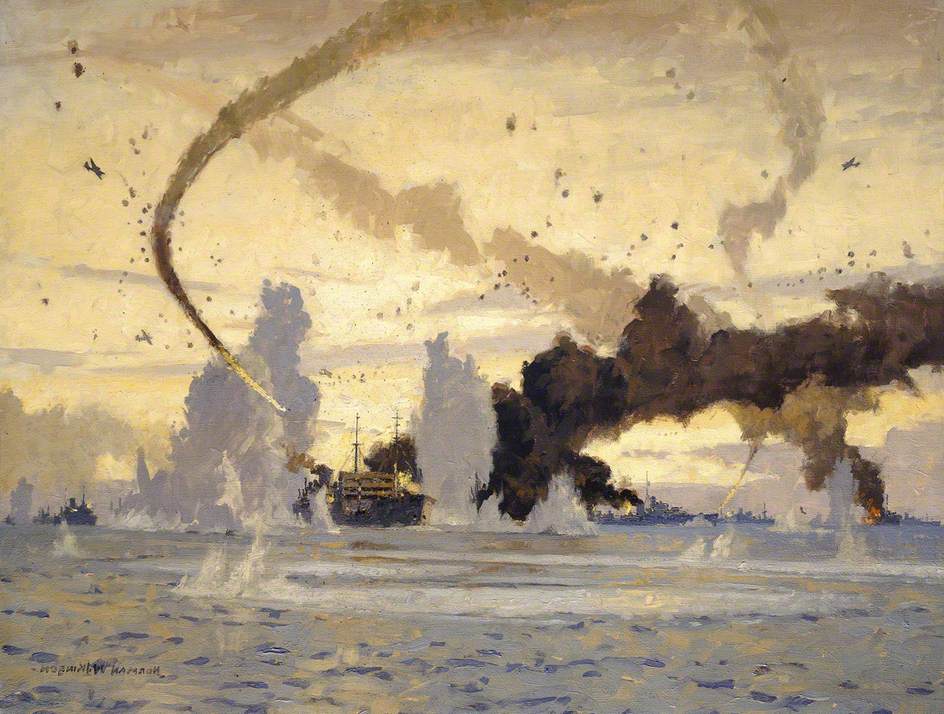
Norman Wilkinson: The “Ohio” in the Malta Convoy (1942)
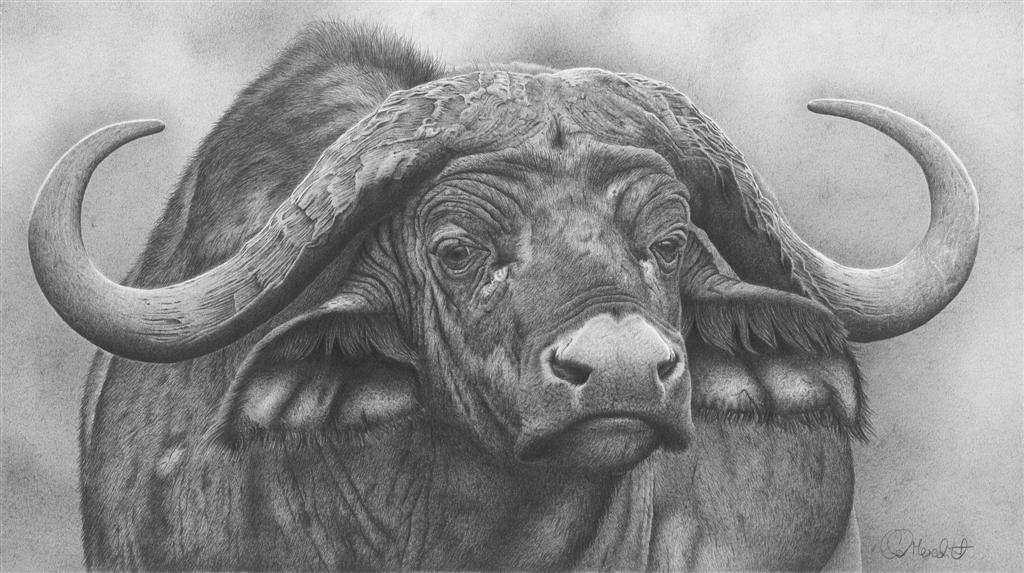
Dutch ecologist H. H. T. Prins describes how he first came to realize that buffalo vote to determine which direction the herd should move to find grazing land:
Let me first describe what takes place when a buffalo herd in Manyara starts grazing in the evening. Before they start, they are resting in the afternoon. This nearly always means that the herd is lying down some-where on the mudflats along the lake shore. Typically it is about 28 to 30°C, and there is a slight breeze from the lake towards the escarpment (that is from the east to southeast). Most animals have stopped chewing the cud (about 70%), a few buffalo are standing (1%), and some are lying on their sides and using their horns as a neck-rest (5%). Adult bulls are not searching for adult cows in oestrus and calves are not pestering their mother for milk. It is normally completely quiet and it seems that nothing is happening. However, this is not the case.
Around 17.00 to 17.30 hours a subtle change takes place. It also occurs in less pronounced form in the morning before the midday grazing bout. It took me 2 years of observation to notice this change of behaviour: some buffalo cows arise, shuffle around a bit and bed down again. At first I interpreted this as “stretching the legs,” but one day I noticed that the cows adopt a particular stance after the shuffling and before lying down again. They seem to gaze in one direction and keep their head higher than the normal resting position but lower than the alert. This they do for about 1 minute only. That day I also noticed that most of these cows “gazed,” sequentially, in the same direction: sequentially, because only very few cows are standing at the same time — in the large Central Herd (about 950 animals) one will see at most 15 animals standing but normally only about five. This standing up, gazing and lying down behaviour continues for about an hour, but the overall impression remains that of a herd totally at rest.
Then at about 18.00 hours there is a sudden energizing of the herd. This nearly always occurs when the sun hits the escarpment to the west of them; when the shadow of the escarpment moves over the herd, everywhere in the herd animals become active. Animals that sleep on their side (mostly subadult and adult bulls) suddenly lift their head, calves rise and start nudging their mothers to rise, many buffalo literally stretch their legs when standing and many animals defecate or urinate. The sun hitting the escarpment appears to work as a Zeitgeber for the buffalo, indicating that they have to go “back to work.” Within a few minutes, here and there in the herd some subadult bulls start sparring, adult bulls look around for oestrus cows and adult cows allow their calves to suckle, but grazing rarely takes place. A few moments later, everywhere in the herd buffalo start trekking. The exciting thing is that they start trekking, at the beginning independently of each other, in the same direction. Within seconds, the animals that initiate these movements are followed by other individuals, dusters of movement arise, and within about 3-5 minutes the whole herd of hundreds of individuals moves as if conducted by one master. They totally give the impression that they know where they are going to: apparently, some decision has been taken in the group.
Prins reports that the final movement of the herd differs from the average direction of the individual gazes within an average deviation of only 3°; if there is a strong difference of opinion among the cows, the herd tends to split and graze in separate areas. Only the female buffalo vote and Prins finds no evidence for individual leadership.
Source: Ecology and Behaviour of the African Buffalo: Social Inequality and Decision-Making (1996)
Image: Clive Meredith: Cape Buffalo

 corvusfugit.com