
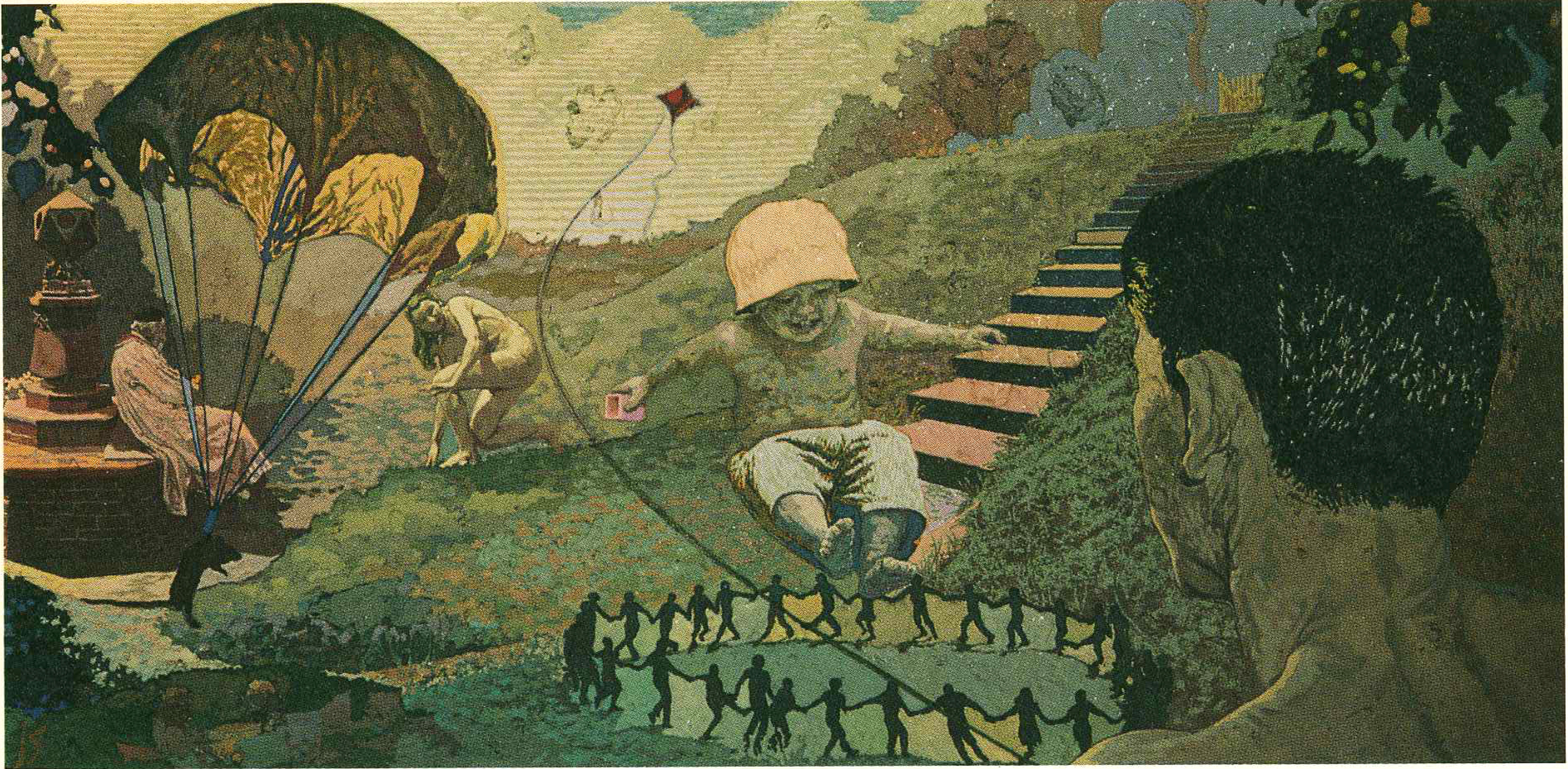
Jess: “…For Want of Stairs…”: Salvages V (1964/1974)
Jess: “…For Want of Stairs…”: Salvages V (1964/1974)
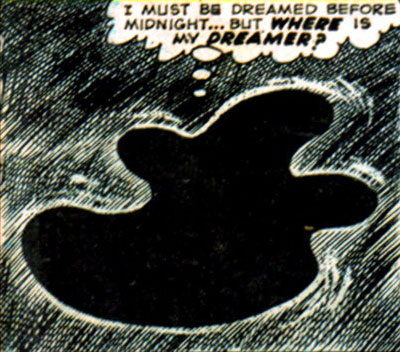
“Nightmare at Midnight,” World of Fantasy Vol. 1 #11 (April, 1958)

Yesterday’s sky. See more here.

Leslie Carr: D-Type Jaguar at Le Mans 1957 (1957)

Harry Epworth Allen: Industrial Landscape, Hope Valley, Derbyshire (c. 1958)

The river-of-time metaphor symbolises the flow of time as the steady movement of a current along with all the flotsam it carries—and the events we experience are depicted by the particular pieces of flotsam being carried along past us by this current. Unfortunately, the movement of such a current can be understood only as a process which itself takes time to happen in; a certain movement of a piece of flotsam which has moved from a particular position to a new position somewhat further downstream can be understood only as a change of position plotted against time. That is, the supposed movement of the current and the flotsam it bears can only be understood as movement if it is given time in which to take place. The flow of the river of time cannot he conceived at all unless we introduce a second-order time against which the flow can be measured. If we introduce a second-order time, to be consistent we must picture this new time on the model of a flowing river, and if we do this, the same problem arises in that the movement of flotsam down this second river can he conceived only if we supply still another time in which it occurs. And of course, maintaining consistency dictates that this third time be interpreted as the flow of a river. Clearly the regress is vicious, and the only way to avoid it is to give up the belief that time flows like a river.
—Keith Seddon: Time: A Philosophical Treatment (1987)
Image:
Snapshot, likely of Long Beach Boulevard in Long Beach, California, completely submerged by floodwaters in February, 1916. (source)

TWU members at a civil rights event in New York City, 1941
“The salvation of our world lies in the hands of the maladjusted.” MLK speaks at the 1961 Transportation Workers Union convention:
TWU President Mike Quill shakes hands with Rev. Dr. Martin Luther King, Jr at the 1961 TWU National Convention
There are certain words in every academic discipline which soon become stereotypes and clichés. Every [academic] discipline has its technical nomenclature. Modern psychology has a word that is probably used more than any other word in modern environment. It is the word, “maladjustment.” Certainly, we all want to live the well-adjusted life in order to avoid neurotic and schizophrenic personalities. As I come to my conclusion, I say to you, today, that there are some things in our social order toward which I am glad to be “maladjusted,” and I call upon you to be “maladjusted.”
I never intend to adjust myself to slavery and segregation.
I never intend to adjust myself to religious bigotry.
I never intend to become adjusted to economic conditions that will take necessities from the many to give luxuries to the few.
I never intend to become adjusted to the madness of militarism, for in a day when sputniks and explorers are dashing through outer space, and guided ballistic missiles are carving highways of death through the stratosphere, no nation can win a war. It is no longer a choice between violence and non-violence. It is now either non-violence or non-existence.
And I never intend to adjust to the madness of militarism and the self-defeating effects of physical violence.
And so I call upon you to be “maladjusted” and continue in the maladjustment that you have already demonstrated, for it may well be that the salvation of our world lies in the hands of the “maladjusted.” And so, let us be maladjusted.
If you will allow the preacher in me to come out now, let us be as “maladjusted” as the Prophet Amos, who, in the midst of the injustices of his day, cried out in words that echo across the centuries: “Let justice run down like waters, and righteousness like a mighty stream.”
Full text here (PDF). For more on MLK’s struggle with mental health issues, see this article.

[In France], F, her husband, and her daughter, who are preparing to leave a party, are standing in the foyer saying goodbye. As she leaves, F has a “minor accident”: while putting on her coat, her hand brushes against a small painting, which, dislodged by the movement, falls to the ground. The lacquered wooden frame breaks, but the damage is reparable. F says to her host, from whom she was just taking leave: “Oh, sorry, I had a little accident.” Then, suddenly joking: “But what an idea to put a painting in such a place! My word, you must have done it on purpose!” Not knowing what to do with the little painting which she now has in her hands, she turns it over, probably to examine the damage, and cries out joyously, “Oh, you see, it must have already been broken, since it has been glued.” Upon saying this, she points to a piece of sticky paper which appears to have nothing to do with the frame itself. Everyone present clearly sees this, but they all act if they hadn’t noticed, and the host…hurriedly takes the painting from her and says “Don’t worry about it, it’s nothing, I’ll take care of it.” As F attempts to joke some more about the accident, her husband drags her toward the door, saying. “Listen, if you keep this up you’ll never be invited here again.” Everyone laughs. Exeunt all.
While at a party at the home of friends of her friends, D, twenty-two years old, Parisian, spills red wine (a full glass) on the carpet. She grabs a small paper napkin to wipe it up. The friend who had invited her quickly returns from the kitchen with enough paper towels to really soak up the large quantity of wine; someone else brings salt. D, while her friend is cleaning, says, “My God, L (the host) is not going to be happy…but can you imagine…That’s the trouble with light-colored carpeting, it’s so difficult to clean!” D made an effort, although insufficient, to repair the damage. But her commentary is strangely similar to that of F. The “victim” seems to be transformed into the truly responsible party, that is, into the person who is ultimately responsible for the accident: if the painting hadn’t been placed there…if the carpet hadn’t been chosen in such a light color….In other words, when I have a “minor accident,” it is not really my fault. It is because an object was in a bad place (I might almost say “in my way”), because a carpet was too light to hide stains…and so on….I place responsibility where it belongs, on the person who committed the error of poorly placing his painting, [or] of choosing an insane color for a carpet.
[In the USA] A dinner with friends. M spills a glass of wine. His wife quickly runs to the kitchen, returns with the necessary products, and sponges up the wine—in short, does everything to repair the accident. M thanks his wife with a look of gratitude and apologizes for his clumsiness. Note: in this case, M’s wife has repaired his clumsiness because she forms a couple with him and therefore shares responsibility for the accident, takes responsibility for it as well. This does not preclude the possibility that some couples have “sexist” habits, but it gives the the gesture a deeper meaning, as is shown by the fact that the inverse is possible: a woman spills some wine and her husband tries to repair the damage.
An informal evening. Guests are seated on the carpet, their drinks by their sides. An accident quickly occurs: N spills a glass of tomato juice. The same efforts to clean it, as well and as quickly as possible, are made. N asks if his hosts have a carpet cleaning foam. They respond in the negative. N offers to pay the cost of the cleaning. “Thanks, but don’t worry, we’ll take care of it, no problem.” The difficulty seems to be resolved. Yet later in the evening, on several occasions, N makes allusion to his clumsiness (“Don’t give it to me, you know how klutzy I am”; “Oh God, this stain is looking at me”; “I feel so bad, such a beautiful carpet”)
If I have an accident at someone’s home… [or] if I have even slightly damaged a valuable object (an art object or one with sentimental value), I must be grieved by my clumsiness without finding any excuse for myself; I must immediately offer to take the object and to have it repaired (while showing that I know where to go and that I am not going to worsen the damage by leaving the object with nonprofessionals): I must insist on being allowed to do this, if only to relieve my feelings of guilt (“I feel so bad. I wouldn’t be able to sleep”). If my host does not wish to signal the end of our relationship, he or she will, out of kindness, allow me to take the object with me, in order to “let me off the hook.” If the accident is of a common sort and not very serious, I must do everything in my power to repair the damage then and there, but I must be careful not to insult my host by offering to replace a common item or to pay the cost of cleaning a tablecloth, for instance, because in doing so I could be suggesting that I do not think he or she has the means to take care of it. In this case, I show that I take the accident seriously by mentioning it several times, by berating myself for my clumsiness, making fun of myself—in short, by taking total responsibility for the accident.
—Raymonde Carroll, Cultural Misunderstandings: the French-American Experience (1987)
Image:
Georges Mathieu: L’ennui affame (1980s)

Charlie Chaplin: Modern Times (1936)

Levente Baranyai: Tokyo Diptych (2011)


 corvusfugit.com