1956: The Hound of Heaven

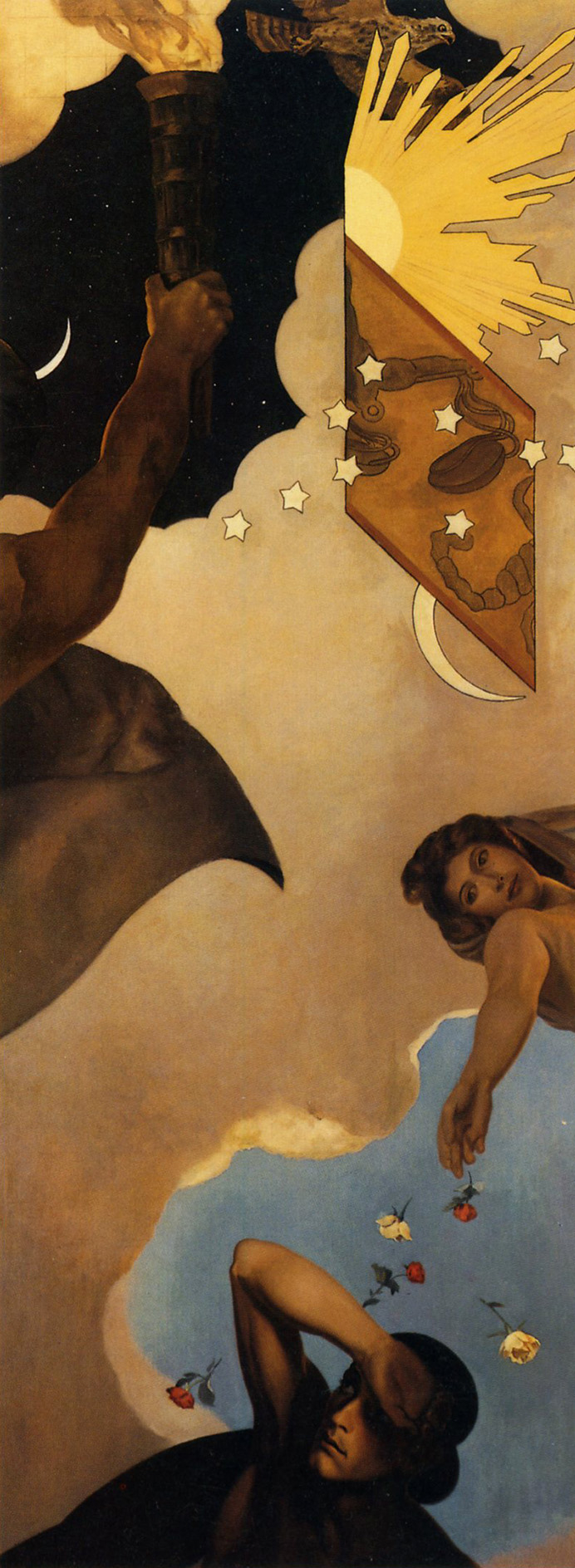
The Hound of Heaven 001 [detail]In 1893, English poet Francis Thompson published a poem called “The Hound of Heaven.” The work is an extended metaphor: as a hound pursues a hare in a hunt, so does God pursue the human soul to restore it to grace. The soul may dart and hide, but God’s love is persistent and unwavering:

I fled Him, down the nights and down the days;
I fled Him, down the arches of the years;
I fled Him, down the labyrinthine ways
Of my own mind; and in the mist of tears
I hid from Him, and under running laughter.
Up vistaed hopes I sped;
And shot, precipitated,
Adown Titanic glooms of chasmèd fears,
From those strong Feet that followed, followed after.
But with unhurrying chase,
And unperturbèd pace,
Deliberate speed, majestic instancy,
They beat—and a Voice beat
More instant than the Feet—
“All things betray thee, who betrayest Me.”
(Full text here)

The American painter Robert Hale Ives Gammell first read Thompson’s poem at the age of sixteen, and it became a lifelong obsession. Following a mental breakdown in the late 1930’s, he began a series of twenty-one paintings inspired by the poem; the sequence was first shown in 1956. In the exhibition catalog, Gammell explained that his paintings do not constitute a literal interpretation:

Eventually I decided that it would involve only a slight change in terminology to consider “The Hound of Heaven” as a history of the experience commonly called emotional breakdown rather than as the story of a specifically religious conversion. The change did not, it seemed to me, traduce the poet’s intention. It suggested, however, a construction capable of conveying the universality of his subject to many persons.


The Hound of Heaven - Introductory Plate

The Hound of Heaven 001  The Hound of Heaven 002  The Hound of Heaven 003The Hound of Heaven 004  The Hound of Heaven 005  The Hound of Heaven 006 Continue reading

Posted in Uncategorized | Tagged , , , , , , , , , , , , , , | Leave a comment

1963: Red and Yellow

Sadamasa Motonaga - Red and Yellow (1963)

Sadamasa Motonaga: Red and Yellow (1963)

Posted in Uncategorized | Tagged , , , , , | Leave a comment

1961: The Disaster of Everyday Life

Pierre Mion -1964 Good Friday Earthquake

The distinction between “disaster” and “normal” conditions is implicit in most treatments of disaster behavior. The everyday, ongoing life of the society is usually equated with the “normal,” and those conditions that result from disaster are viewed as “abnormal” and pathological. However, in our haste to draw this distinction, we often conveniently overlook the many sources of stress, strain, conflict, and dissatisfaction that are imbedded in the nature of everyday life. From the imagined perspective of a subsequent disaster, this everyday life looks rather stable and serene, and we choose descriptive terrns such as “peaceful,” “organized,” and “equilibrated” to contrast it with the presumed disorder and chaos of disaster. The relative invisibility of everyday crises and the high visibility of disaster contributes heavily to the perpetuation of this contrast in human thought. During every single day in the United States, for example, over 4,000 people die from accidents and organic disease. Additional thousands, perhaps millions, are daily experiencing the pain and privation associated with the loss of intimates, with injury or illness, with interpersonal and intergroup conflicts, with social and material deprivation, or with failures to meet social expectations and personal aspirations. Yet these potential stress-producing events have a kind of “random incidence.” They are not sufficiently concentrated in time and place to threaten the basic integrity of the community or society as a whole. This fact, combined with the general tendency for people suffering stress to privatize or “hide” the effects of stress from public view, make the everyday crises of life much less visible to the observer than disasters. No peacetime or wartime disaster in American history has ever produced the aggregate amount of death, destruction, pain, and privation that is experienced in a single day of “normal” life in the United States, but this fact is rarely recognized except by insurance actuarial specialists and other keepers of vital statistics. The traditional contrast between “normal” and “disaster” almost always ignores or minimizes these recurrent and social effects. It also ignores stresses of everyday life and…a historically consistent and continually growing body of political and social analyses that points to the failure of modern societies to fulfill an individual’s basic human needs for community identity.

Charles Fritz: Disasters and Mental Health: Therapeutic Principles Drawn From Disaster Studies (1961)

Image:
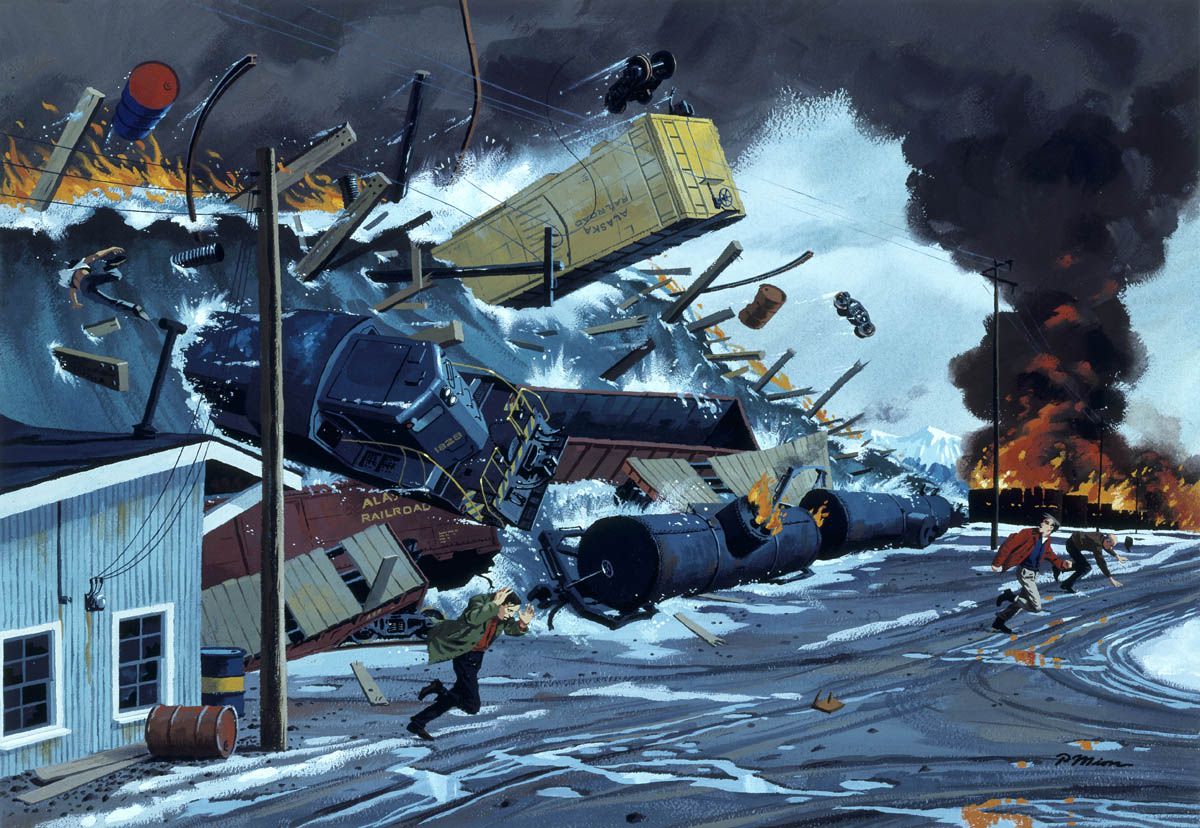
Pierre Mion: illustration of the 1964 Good Friday Earthquake for National Geographic (source)

Posted in Uncategorized | Tagged , , , , , , , , , , , | Leave a comment

2019: Native Land

Adam Sings in the Timber

From a series by photographer Adam Sings in the Timber:

I am currently working on a broader project making a series of portraits of Native Women wearing traditional regalia in metropolitan settings, in order to illustrate that wherever a person goes, they’re on Native land. In order to illustrate that point, I am working to photograph Women who are descended from tribes that originally occupied the land each featured city was built on.

Posted in Uncategorized | Tagged , , , , , , , , | Comments Off on 2019: Native Land

1936: Expectation

Richard Oelze - Expectation (1935-36)

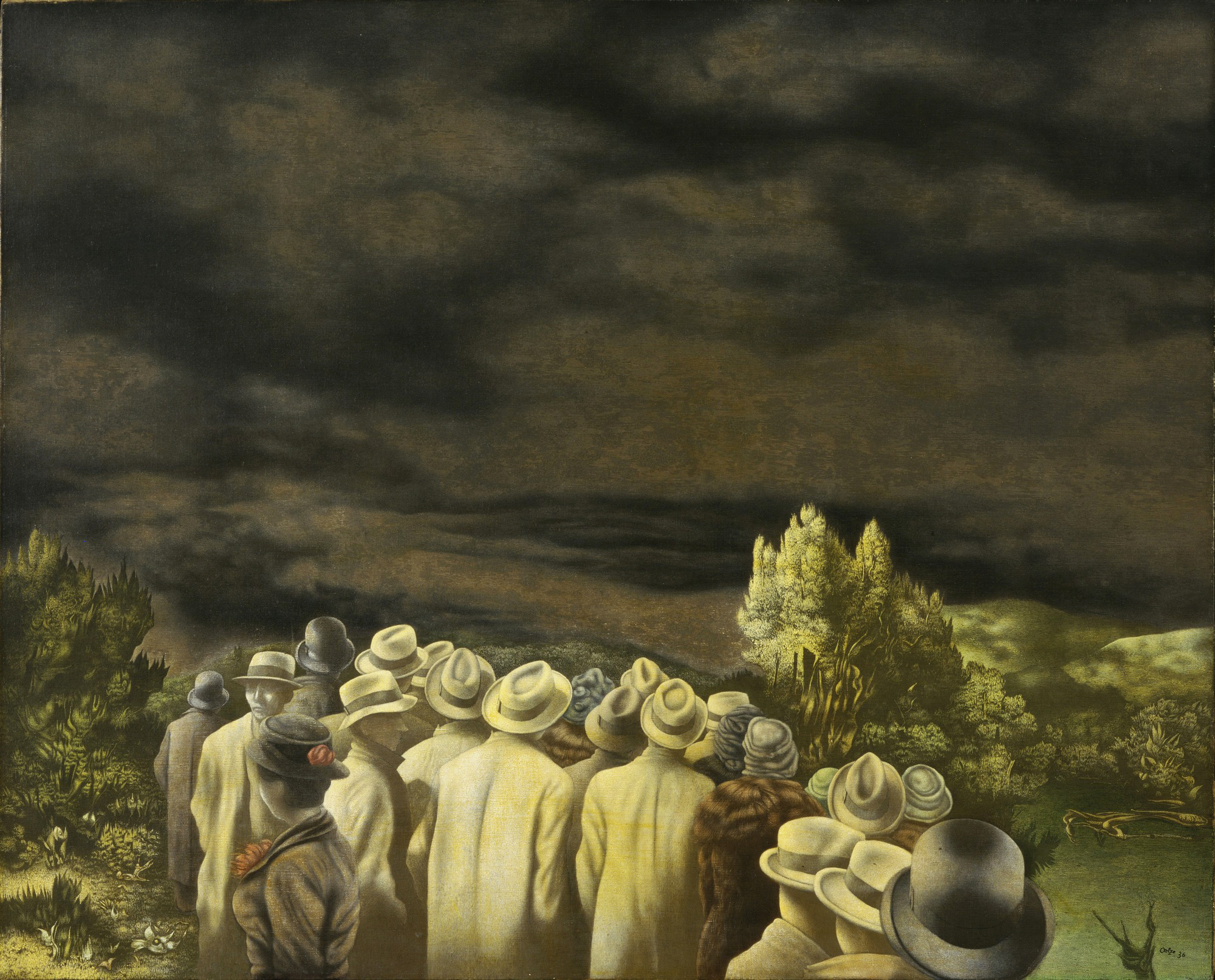
Richard Oelze: Expectation (1935-36)

Posted in Uncategorized | Tagged , , , , , , , | Leave a comment

1938: Signs of Hard Weather

Signs of Hard Weather (1938)

From a collection of folklore gathered by Irish teachers in the 1930’s:

Weather 27-12-1938

Signs of hard weather:

Robin flying into house.
Lapwings seen early in winter.
Wild geese seen flying inland (southwards).
Small birds gathering in large numbers about corn sheds.
Cat turning his back to the fire (frost)

Signs of Rain:

Moon on its back, or Ring round it.
Cap on Kaigeen mountains.
When S[?] is visible.
When train can be heard crossing Holdenstown Bridge (a bridge over the Slaney).
When you can hear church clock strike in Baltinglass.
When motors can be heard plainly moving along Baltinglass road.
Swallows or crows flying low.
Wind blowing from direction of Baltinglass.

Signs of Dry Weather:

White fog lying in a valley.
Hinges squeak on doors.
Gossamer threads on bushes or grass.
Wind at a certain point blowing from Kilranelagh or Kaigeen.
Stones on walls or flooring getting coated with moisture.
Hills near hand appearing far away.
Hens moving out into the open.
Crows flying high.

Posted in Uncategorized | Tagged , , , , , , | Leave a comment

1955: 憶西環

Fan Ho - Surreal Sai Wan (c 1950-1960)

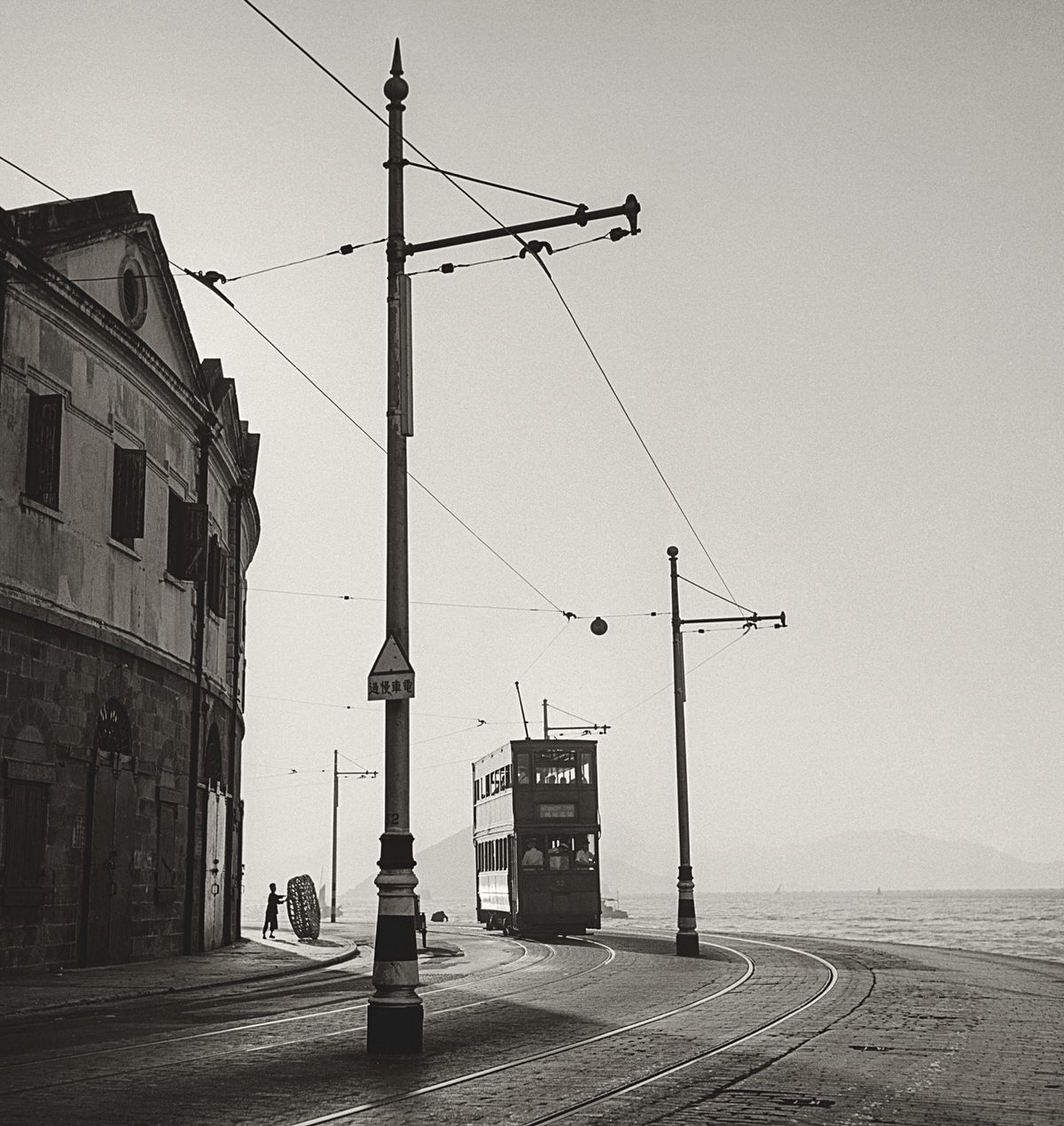
Fan Ho: Surreal Sai Wan (c 1950-1960)

Posted in Uncategorized | Tagged , , , , , , , , | Leave a comment

1784: Whimsical Associations

NG 1651

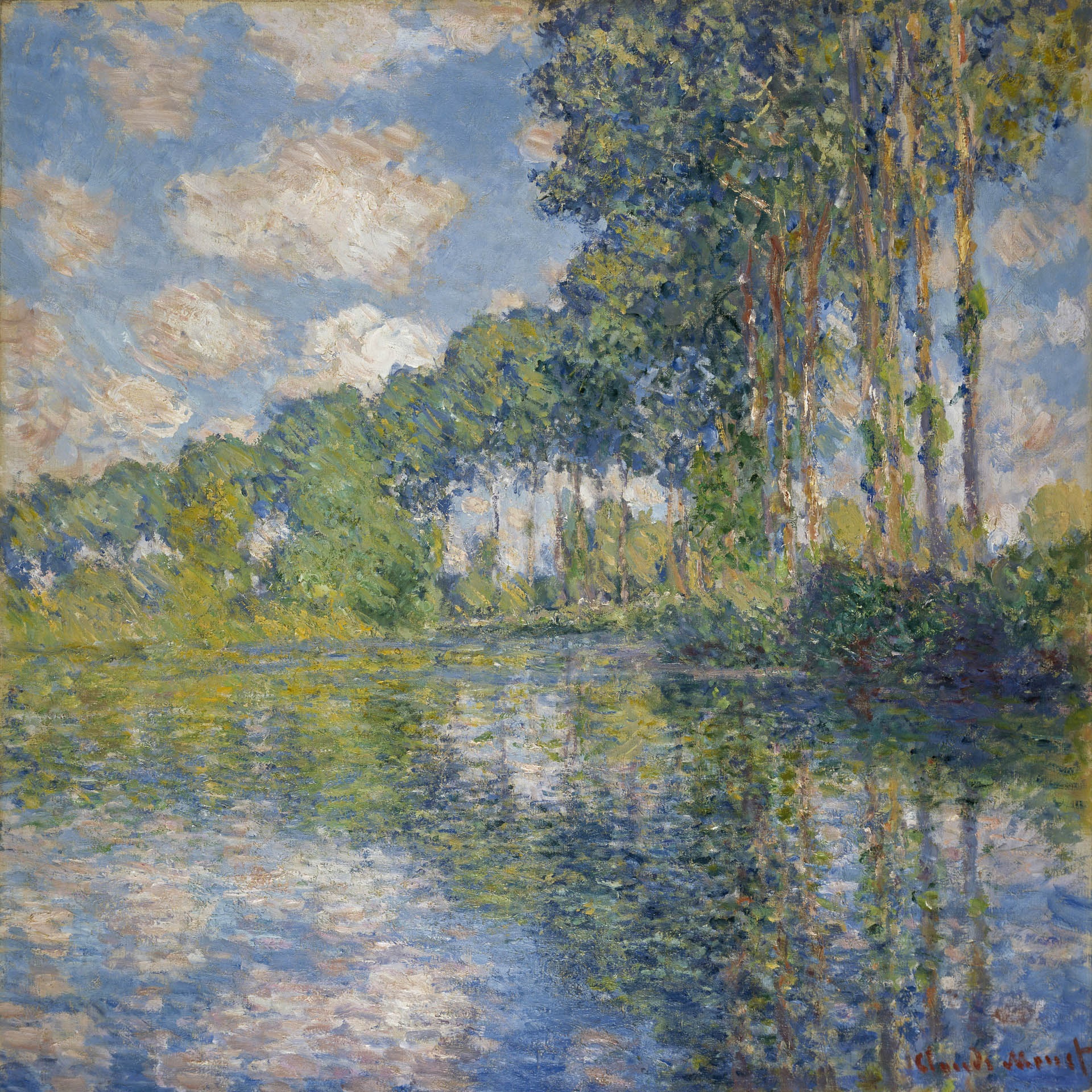
From Paul Fussell’s Poetic Meter and Poetic Form (1965): “In ‘The Poplar Field’ …William Cowper…unwittingly allows the whimsical associations of triple meter to work against him.”

The poplars are felled, farewell to the shade
And the whispering sound of the cool colonnade:
The winds play no longer and sing in the leaves,
Nor Ouse on his bosom their image receives.

Twelve years have elapsed since I first took a view
Of my favourite field, and the bank where they grew,
And now in the grass behold they are laid,
And the tree is my seat that once lent me a shade.

The blackbird has fled to another retreat
Where the hazels afford him a screen from the heat;
And the scene where his melody charmed me before
Resounds with his sweet-flowing ditty no more.

My fugitive years are all hasting away,
And I must ere long lie as lowly as they,
With a turf on my breast and a stone at my head,
Ere another such grove shall arise in its stead.

‘Tis a sight to engage me, if anything can,
To muse on the perishing pleasures of man;
Short-lived as we are, our enjoyments, I see,
Have a still shorter date, and die sooner than we.

Image:
Claude Monet: Poplars on the Epte (1891)

Posted in Uncategorized | Tagged , , , , , , , , , , , , , , | Leave a comment

1976: City

Thomas Bayrle - Stadt [City] (1977) detail

Thomas Bayrle: The City (1976) [detail]; here is the whole thing:

Thomas Bayrle - Stadt [City] (1977)

Posted in Uncategorized | Tagged , , , , , , , | Leave a comment

1941: FDR and Captain America’s Shield

Stern Byrne - Captain America vol 1 no 255 (March 1981) (1)  Stern Byrne - Captain America vol 1 no 255 (March 1981) (1)

Stern Byrne - Captain America vol 1 no 255 (March 1981) (3)

Stern Byrne - Captain America vol 1 no 255 (March 1981) (4)

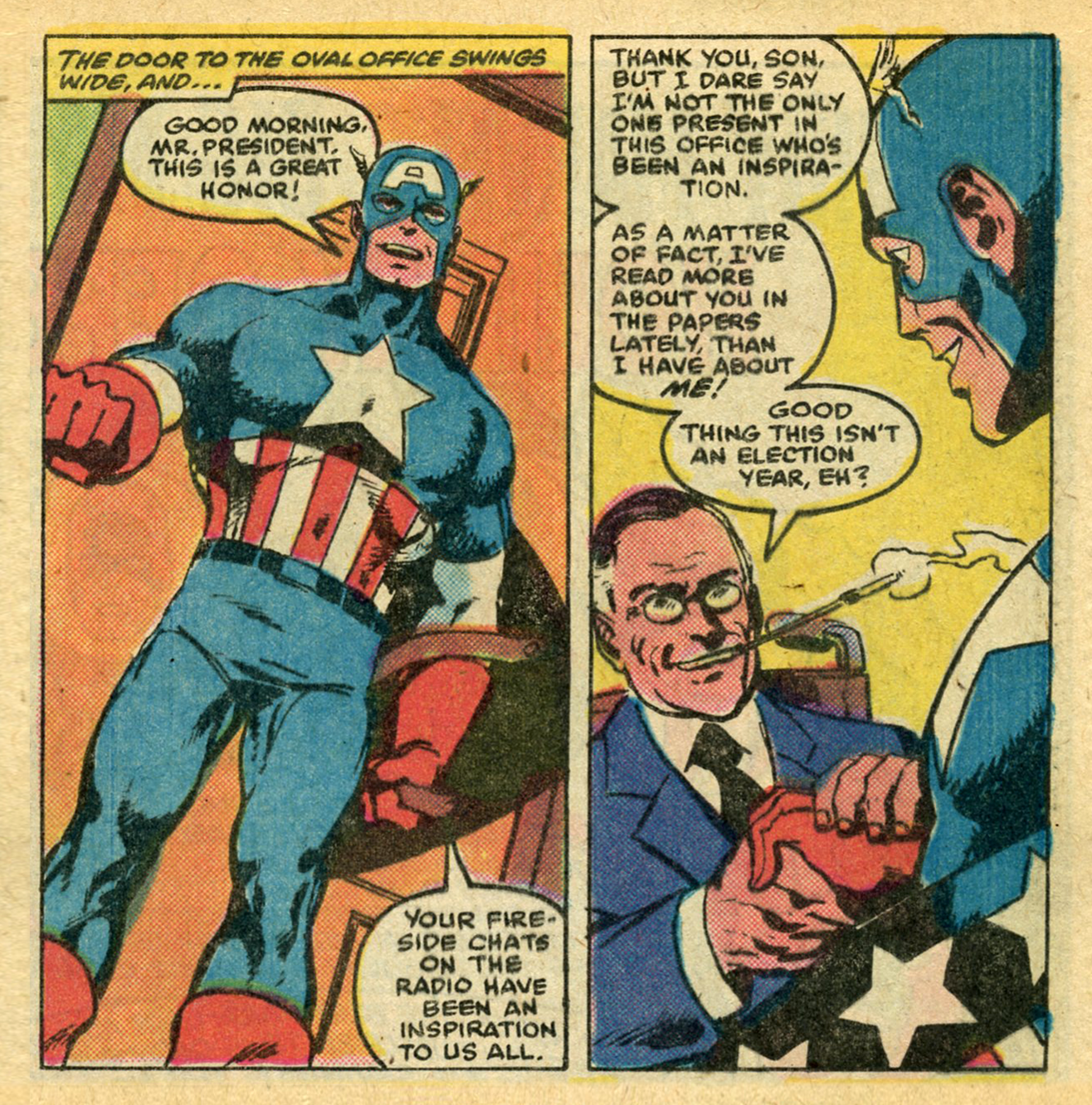
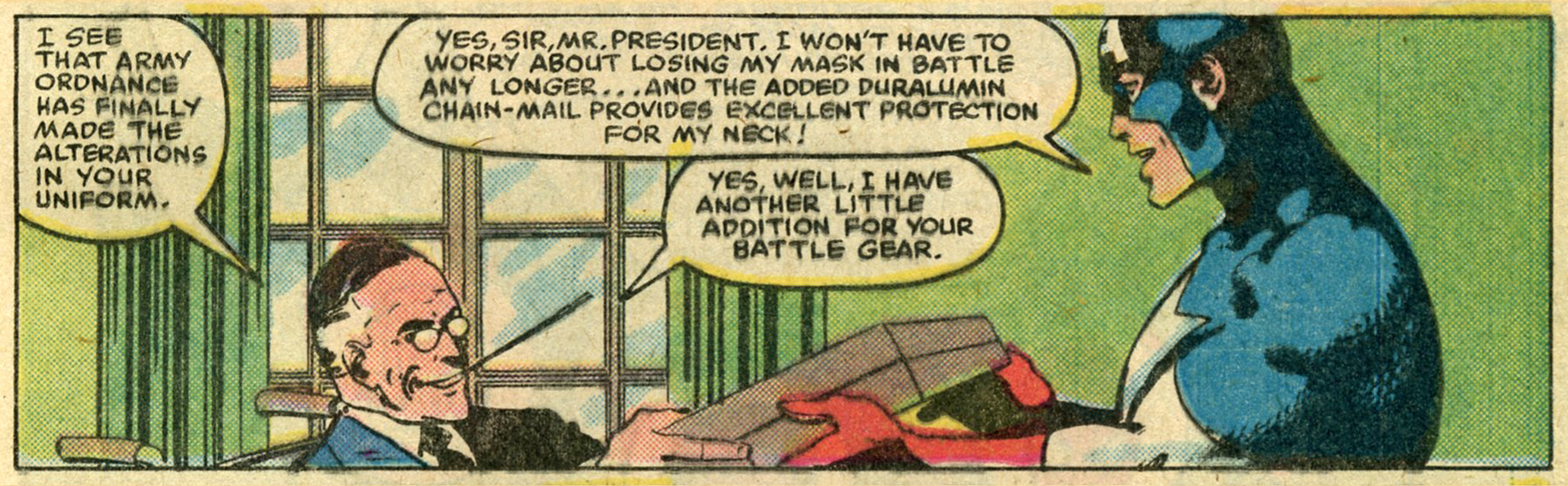
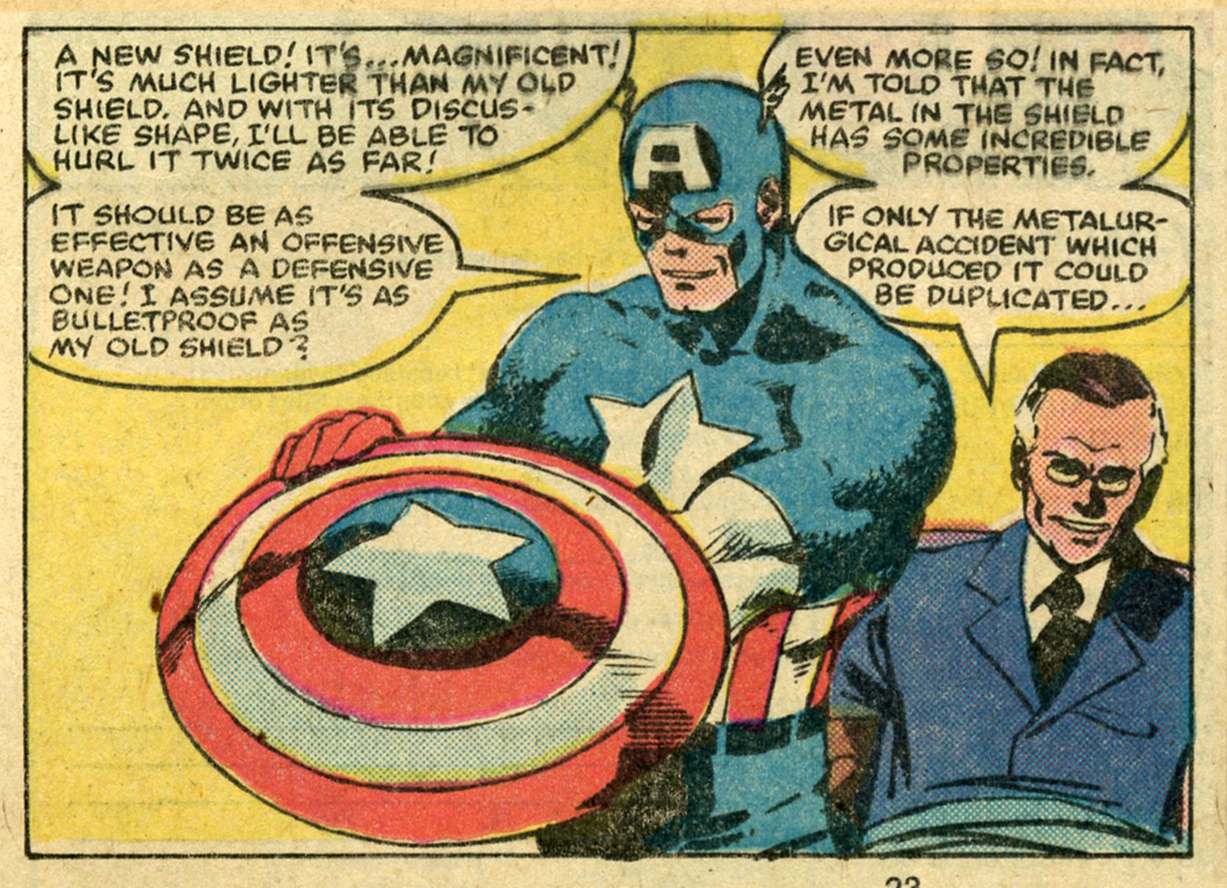
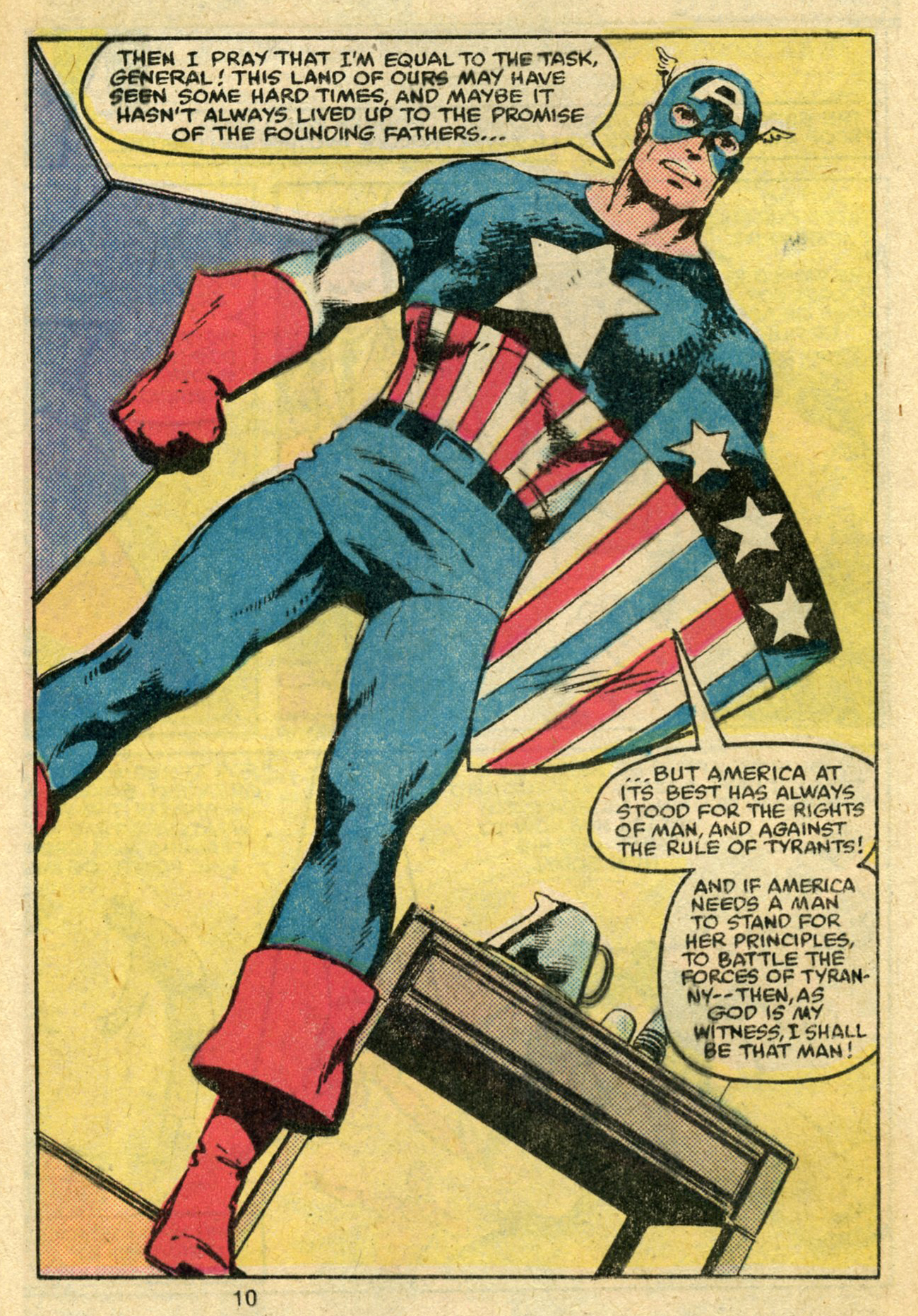
Captain America recieving his trademark circular shield from FDR in June, 1941. From Captain America #255 (March, 1981) (Roger Stern, writer; John Byrne, artist).

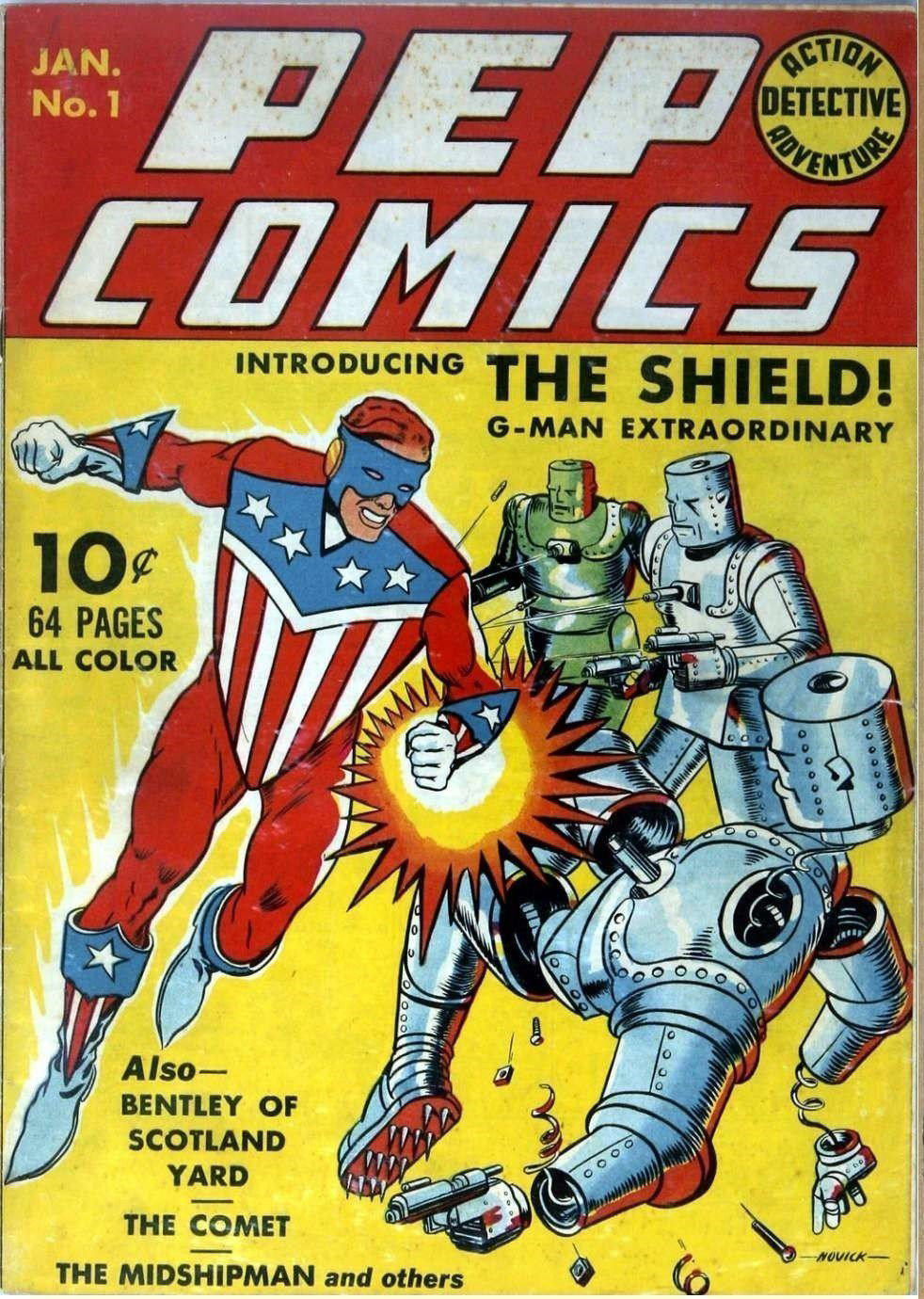
Pep Comics No 1 (Jan 1940) - The ShieldStern Byrne - Captain America vol 1 no 255 (March 1981) (2)The shield’s history developed slowly. Originally, in Captain America Comics #1 (March 1941), Cap carried a heraldic-style shield made of steel. By issue #2, it had been replacedwithout explanationwith the now-familiar circular design. In reality, the change had come about as a result of copyright issues; another comic book company had complained that Cap and his shield were a rip-off of a character called simply The Shield.

In 1981, it was revealed that the circular shield had been presented to Captain America by FDR in the Oval Office. Its creator was a metallurgist named Myron MacLain. While the original shield had simply been made of steel, MacLain’s was composed of an alloy of steel and the near-indestructable metal vibranium.

In a 2001 story, King T’Chaka of Wakanda meets Captain America in early 1941 and gives him the sample of vibranium from which the shield is made. A 2010 storyline presents a different version: Captain America and Nick Fury meet T’Chaka and his father during World War II, andafter the Red Skull crushes Cap’s triangular shield in a battleT’Chaka loans Cap a circular vibranium shield that inspires Cap to replace the destroyed shield permanently with a circular one.

Posted in Uncategorized | Tagged , , , , , , , | 1 Comment