1529: Fortifications

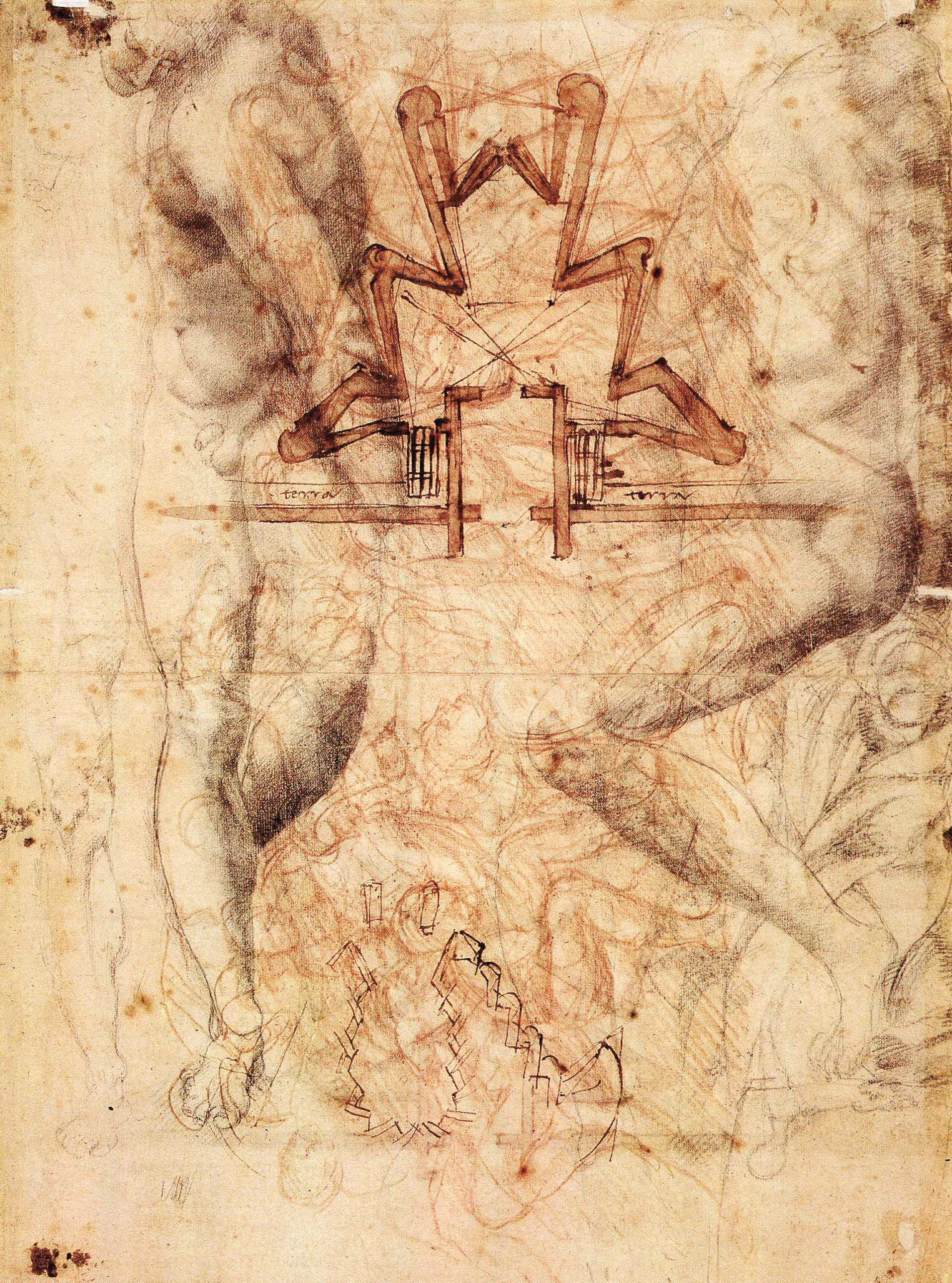
Michelangelo Buonarroti - Fortifications for Florence (1529)

In 1527, a republican government was established in the city-state of Florence after residents ousted the ruling Medici family. The pope at the time, Clement VII, was himself a Mediciand he took affront at the rebellion and resolved to capture the city and reestablish Medici rule. He formed an alliance with Charles V, Emperor of the Holy Roman empire, and the two began to prepare for an assault on the city.

Florence had already begun to prepare for war, forming a committee to rebuild and expand the city’s walls and fortifications. To design the new structures, they called on the great artist and architect Michelangelo Buonarroti.

Michelangelo took on the job at great riskrefusing the pleas of the Pope to stay loyal to the Medicis and throwing his lot in with the republicans. He was given the title Governor and Protector General of the Fortifications of Florence and set to work on a number of designs.

Clement and Charles began a siege of the city in October 1529 and, in part defended by Michelangelo’s fortifications, the city’s forces held out for eleven months. Ultimately, the Republic of Florence fell and Alessandro de’ Medici was installed as its new ruler. Some citizens resisted and tried to keep the idea of the republic alive, but the war was over, and many of the republic’s leaders were executed or banished.

Michelangelo himself fled to Rome to avoid capture and possible death at the hands of Alessandro. There, his participation in the republic was forgiven by Clement, who granted the artist a generous stipend and, a few years later, commissioned him to paint his fresco of The Last Judgement on the wall of the Sistine Chapel.

Posted in Uncategorized | Tagged , , , , , , , , , | Leave a comment

6th Century BC: Mouthpiece

Silver-gilt mouthpiece - Cypriot (late 6th–5th century BC)

This silver-gilt mouthpiece comes from Cyprus and dates from the late 5th or 6th century BC. It would have been placed on the the mouth of a dead body as part of the burial process.

Posted in Uncategorized | Tagged , , , , , | Leave a comment

1799: Nine Family Heads

Saidi Saeed Abdoul Naim -- Book on Divination by Sand and Magic and some of Astronomy (1799)

In the late 18th century, a physician from northern Africa named Saidi Saeed Abdoul Naim assembled this book of practices for dealing with physical, mental, and spiritual ailments. It also includes sections on secret alphabets, divination by sand, magic, and astronomy.

This illustration is one of nine “family heads” that Abdoul Naim—interpreting a verse in the Qur’an (27:48)—envisions as demonic beings.  “Whoever says that they are birds or anything else has lied,” he says, “for I saw them [myself] in Safar 1214 (July/August 1799).” (Sources here and here.)

Posted in Uncategorized | Tagged , , , , , , , | Leave a comment

1927: Work in Progress

Jameson's - 1940's

On May 20, 1927, James Joyce wrote to Harriet Shaw Weaver about what should happen if he were unable to complete Finnegans Wake. Another writer, Joyce said, should take it up and finish it; he had the person in mind:

As regards that book itself and its future completion I have asked Miss Beach [Sylvia Beach, the American expatriate who had published Ulysses] to get into closer relations with James Stephens. I started reading one of his last books yesterday, Deirdre, I thought he wrote The Return of the Hero which I liked. His Charwoman’s Daughter is now out in French. He is a poet and Dublin born. Of course he would never take a fraction of the time or pains I take but so much the better for him and me and possibly for the book itself. If he consented to maintain three or four points which I consider essential and I showed him the threads he could finish the design. JJ and S (the colloquial Irish for John Jameson and Son’s Dublin whisky) would be a nice lettering under the title. It would be a great load off my mind.

The two had met once or twice, but were not close; indeed, it’s unclear how familiar they were with each other’s work. Nevertheless, they met in 1929; Joyce spent a week explaining the work to Stephens, who then indeed promised to complete it if Joyce could not.

Here is one of Stephens’s poems:

The Coolun

Come with me, under my coat,
And we will drink our fill
Of the milk of the white goat,
Or wine if it be thy will;
And we will talk until
Talk is a trouble, too,
Out on the side of the hill,
And nothing is left to do,
But an eye to look into an eye
And a hand in a hand to slip,
And a sigh to answer a sigh,
And a lip to find out a lip:
What if the night be black
And the air on the mountain chill,
Where the goat lies down in her track
And all but the fern is still!
Stay with me, under my coat,
And we will drink our fill
Of the milk of the white goat
Out on the side of the hill.

Posted in Uncategorized | Tagged , , , , , , , , , | Leave a comment

2018: The Sky

2018-08-08-19

Just now. See more.

Posted in Uncategorized | Tagged , , , , , | Leave a comment

1998: Beyond the Skin

Katrín Sigurdardóttir - High Plane V (2006)

Inga hears from a friend that there is an exhibition at the Museum of Modern Art, and decides to go see it. She thinks for a moment and recalls that the museum is on 53rd Street, so she walks to 53rd Street and goes into the museum. It seems clear that Inga believes that the museum is on 53rd Street, and that she believed this even before she consulted her memory….The belief was sitting somewhere in memory, waiting to be accessed.

Now consider Otto. Otto suffers from Alzheimer’s disease, and like many Alzheimer’s patients, he relies on information in the environment to help structure his life. Otto carries a notebook around with him everywhere he goes. When he learns new information, he writes it down. When he needs some old information, he looks it up. For Otto, his notebook plays the role usually played by a biological memory. Today, Otto hears about the exhibition at the Museum of Modern Art, and decides to go see it. He consults the notebook, which says that the museum is on 53rd Street, so he walks to 53rd Street and goes into the museum.

Clearly, Otto walked to 53rd Street because he wanted to go to the museum and he believed the museum was on 53rd Street. And just as Inga had her belief even before she consulted her memory, it seems reasonable to say that Otto believed the museum was on 53rd Street even before consulting his notebook. For in relevant respects the cases are entirely analogous: the notebook plays for Otto the same role that memory plays for Inga….it just happens that this information lies beyond the skin.

—Andy Clark and David Chalmers: “The Extended Mind” (1998)

Image:
Katrín Sigurdardóttir: High Plane V, an installation at the Museum of Modern Art (2006)

Posted in Uncategorized | Tagged , , , , , , , , , , , , , , , , | Leave a comment

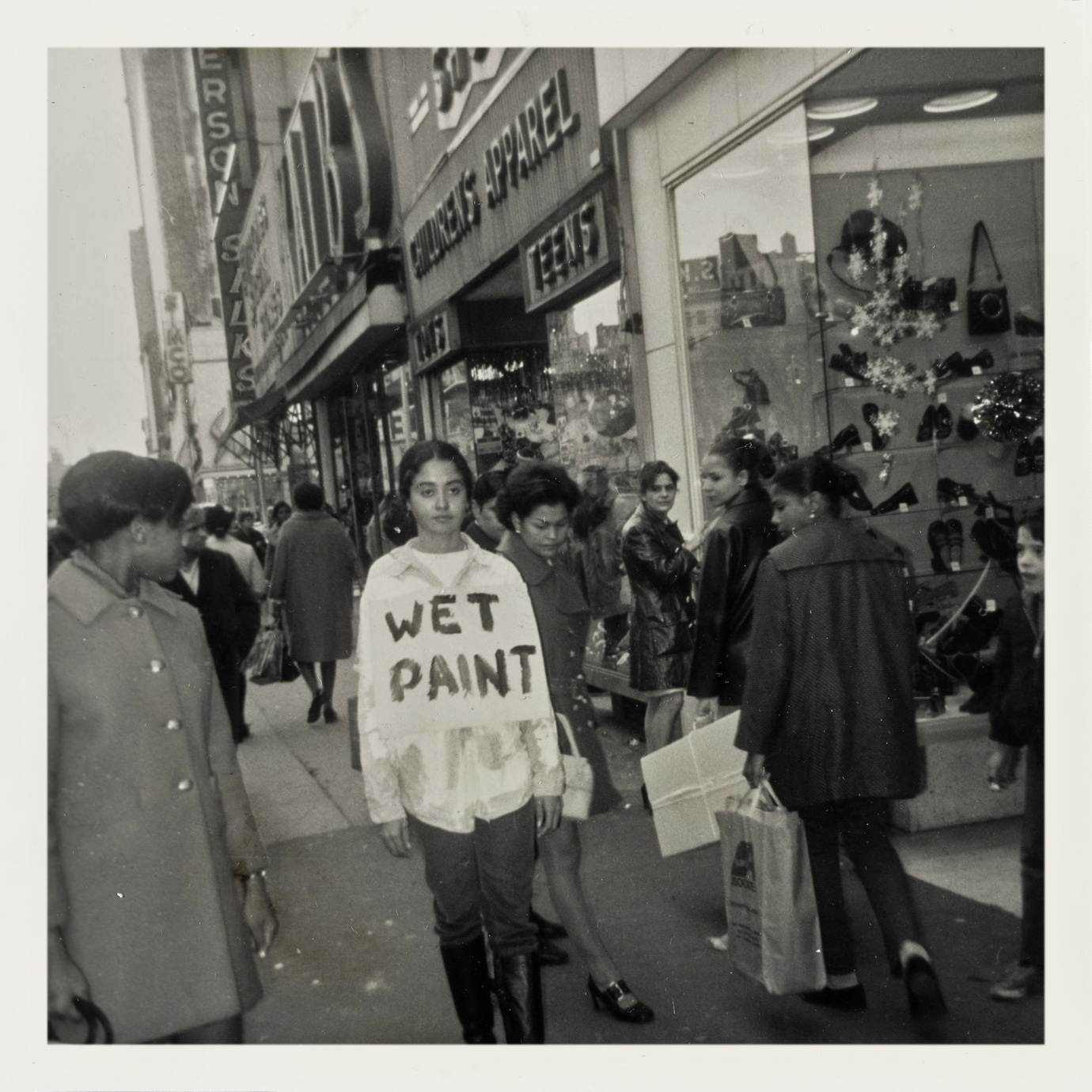
1970: Wet Paint

Adrian Piper - Catalysis III (1970)

Adrian Piper: Catalysis III (1970)

Posted in Uncategorized | Tagged , , , , , , , | 1 Comment

1939: Typewriter

Postcard - Giant Underwood Typewriter at New York World's Fair (1939)

Giant Underwood Typewriter at New York World's Fair (1940)This giant Underwood typewriter was on display in the Business Systems and Insurance Building at the 1939 New York World’s Fair. It weighed 14 tons and worked—letters could be typed on stationery measuring 9 by 12 feet.

Posted in Uncategorized | Tagged , , , , , , | Leave a comment

2018: The Sky

2018-07-23-20

Earlier this evening. See more here.

Posted in Uncategorized | Tagged , , , , , | 2 Comments

2001: Nothing But Black Space

Jacob Peeter Gowy - The Fall of Icarus (1638)

In a 2001 study, Tim and Virginia Kasser analyzed the dreams of people who had been assessed as either highly materialistic or non-materialistic. They asked the participants to share “the two most meaningful, memorable, or powerful dreams they remembered in their lives”and found three remarkable differences:

First, death played a bigger role in the dreams of highly materialistic individuals. It was mentioned in the dream itself or in associations with the dream in 20.5 percent of high materialists’ dreams, compared with only 3 percent of dreams of people less focused on materialism. To give a couple of examples, people who were dead in waking life appeared in the dreams of two highly materialistic individuals, and another saw “a ghostly lady dressed in black . . . hanging from the cross [of a church] calling my name.” For others who strongly valued materialistic aims, death was mentioned as an important association, even when it did not appear explicitly in the dream.

The second difference…was that 15 percent of dreams of people in the high-materialism group involved falling, in comparison with 3 percent of dreams of those in the low-materialism group. Falling is almost universally interpreted by theorists as representing insecurity, as one is out of control, is headed downward, and has nothing to hold on to. Two people from the high-materialism group reported dreams of falling into fires, a third fell from barn rafters, and a fourth worried about falling from logging equipment. Evocatively, a fifth person in that group dreamed that his father tossed him over the railing of the steps inside his house, but “instead of landing on the floor below, there was nothing but black space into which I was thrown . . . I saw myself fall. While I was falling into the black void, I was circling or spinning and screaming, but my screams were very faint.”

Another difference between the groups was that the dreams of highly materialistic individuals exhibited a very different attitude toward feared objects. Specifically, 18 percent of dreams of the low-materialism group involved reframing an originally feared object so that it was no longer so frightening; no one from the high-materialism group confronted their fears in this way. For example, two dreamers from the low-materialism group were initially afraid of a rhinoceros and a giant purple poodle, respectively, but found that the animals had benign intentions. Others in that group realized that their attacker was actually “a nice, happy guy” or were quite confident that they would not be hurt. One of them even reported that while being chased down cliffs by a boulder, “sometimes it was rather fun to run.” These dreams suggest that people who do not care much for materialistic pursuits may be more able to overcome insecurities than those with a strong materialistic value orientation.

Tim Kasser: The High Price of Materialism (2002)

Image:
Jacob Peeter Gowy: The Fall of Icarus (1638)

Posted in Uncategorized | Tagged , , , , , , , , , , , , , , , | Leave a comment