

Kay Sage: South to Southwesterly Winds Tomorrow (1957)
Kay Sage: South to Southwesterly Winds Tomorrow (1957)
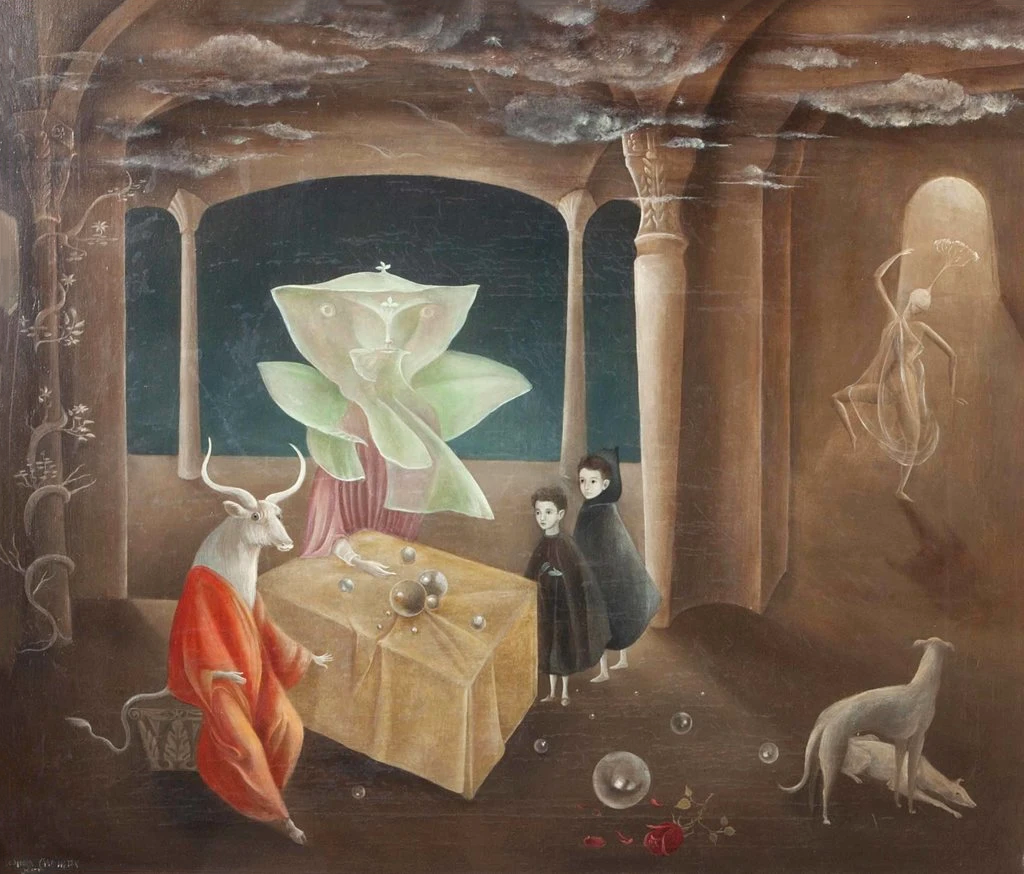
Leonora Carrington: And Then We Saw the Daughter of the Minotaur (1953)
 According to Miguel de Cervantes, Miguel de Cervantes is not the author of Don Quixote. Nor was the book written in Spanish. Rather, Cervantes tells us, the true author is Cid Hamete Benengeli, the book was written in Arabic, and he, Cervantes, is merely passing on a translation of the text as he found it:
One day, as I was in the Alcana of Toledo, a boy came up to sell some pamphlets and old papers to a silk mercer, and, as I am fond of reading even the very scraps of paper in the streets, led by this natural bent of mine I took up one of the pamphlets the boy had for sale, and saw that it was in characters which I recognised as Arabic, and as I was unable to read them though I could recognise them, I looked about to see if there were any Spanish-speaking Morisco at hand to read them for me; nor was there any great difficulty in finding such an interpreter, for even had I sought one for an older and better language I should have found him. In short, chance provided me with one, who when I told him what I wanted and put the book into his hands, opened it in the middle and after reading a little in it began to laugh. I asked him what he was laughing at, and he replied that it was at something the book had written in the margin by way of a note. I bade him tell it to me; and he still laughing said, “In the margin, as I told you, this is written: ‘This Dulcinea del Toboso so often mentioned in this history, had, they say, the best hand of any woman in all La Mancha for salting pigs.’”
When I heard Dulcinea del Toboso named, I was struck with surprise and amazement, for it occurred to me at once that these pamphlets contained the history of Don Quixote. With this idea I pressed him to read the beginning, and doing so, turning the Arabic offhand into Castilian, he told me it meant, “History of Don Quixote of La Mancha, written by Cid Hamete Benengeli, an Arab historian.” It required great caution to hide the joy I felt when the title of the book reached my ears, and snatching it from the silk mercer, I bought all the papers and pamphlets from the boy for half a real; and if he had had his wits about him and had known how eager I was for them, he might have safely calculated on making more than six reals by the bargain. I withdrew at once with the Morisco into the cloister of the cathedral, and begged him to turn all these pamphlets that related to Don Quixote into the Castilian tongue, without omitting or adding anything to them, offering him whatever payment he pleased. He was satisfied with two arrobas of raisins and two bushels of wheat, and promised to translate them faithfully and with all despatch; but to make the matter easier, and not to let such a precious find out of my hands, I took him to my house, where in little more than a month and a half he translated the whole just as it is set down here. (John Ormsby, trans.)
Don Quixote is thus a pseudotranslation—a work that purports to be a translation, but for which no original text actually exists. Pseudotranslations come in many varieties. Some, of course, are literary framing devices like Don Quixote, presented with an author’s winking eye—but many are frauds or hoaxes, intended to deceive the reader and the public. These might be presented for fame or gain, to shroud a religious claim in mystical ancient wisdom, or to support a political or cultural ideology by inventing a mythical history behind it.
Pseudotranslations can also allow the (actual) author a kind of freedom by absolving them of responsibility for the “original” text’s contents. Perhaps the text contains a political critique or espouses sexual freedom. The author is not the author—they’re just the messenger! Another freedom is also possible: a woman author, for example, may be taken more seriously if her work is presented as a translation of a man’s.
At the same time, when pseudotranslations ventriloquize “authors” from other cultures or other identities, they often partake in a kind of literary colonialism that betrays the sexist, racist and xenophobic attitudes of the actual creator of the work and their own society.
Here is list of pseudotranslations in rough historical order. Let me know if you have any to add. I’ve left off the quotation marks around “translated” and “authored”—and avoided repeating the phrases “claimed to be” or “purported,” leaving the representations of the texts themselves. The actual date and author do appear at the beginning of each entry. (I have not included one subcategory of pseudotranslations, those that are “translations” of fictional languages—although a few may have snuck in. J. R. R. Tolkien’s Lord of the Rings, most famously, is presented as a translation into English of a collection of manuscripts called The Red Book of Westmarch.)

1st or 2nd century CE: Anonymous, Dictys Cretensis: Letters of the Trojan War. For centuries, this work was known only in a 3rd or 4th century translation from Greek into Latin by Lucius Septimius: Dictys Cretensis: Ephemeris Belli Troiani. The discovery of fragmentary 1st or 2nd century Greek source texts in 1900 indicated that the Latin was not in fact a pseudotranslation; an introductory letter by Septimus, however, tells us that the Greek text was originally composed in Phoenician:
Dictys of Crete originally wrote his Journal of the Trojan War in the Phoenician alphabet, which Cadmus and Agenor1 had spread throughout Greece. Dictys had served in the War with Idomeneus.
After many centuries the tomb of Dictys at Cnossos (formerly the seat of the Cretan king) collapsed with age. Then shepherds, wandering near the ruins, stumbled upon a little box skilfully enclosed in tin. Thinking it was treasure, they soon broke it open, but brought to light, instead of gold or some other kind of wealth, books written on linden tablets. Their hopes thus frustrated, they took their find to Praxis, the owner of that place. Praxis had the books transliterated into the Attic alphabet (the language was Greek) and presented them to the Roman Emperor Nero. Nero rewarded him richly. (R. M. Frazer, trans.)
Dictys’s eyewitness account of the Trojan War is notable in that the gods play no role; during its long history it was read simply as an historical account.
100-300 CE: Anonymous, Corpus Hermeticum. Authored by the divine Hermes Trismegistus, a contemporary of Moses. Further texts appear in a collection compiled by John Stobaeus in the fifth century. Other texts appear later, including the Emerald Tablet, an early alchemical Arabic text which is a translation of a Greek original.
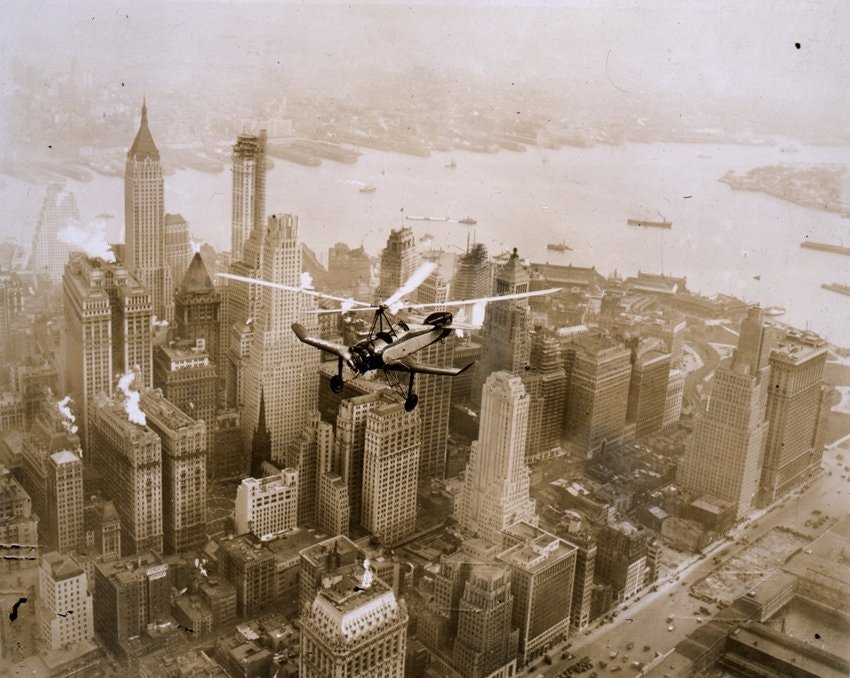
A Pitcairn PCA-2 Autogiro during its certification flight over New York City, 1930

Capitalist Henry Clay Madison is unmoved by the specter of a child laborer in John H. Collins’s Children of Eve (1915).
 Diamantový zámek visí nad červeným mořem…
(O zlatých zámcích.)
Illustration by Artuš Scheiner for a collection of Fairy Tales by Božena Němcová (1924). The first line of the caption means “the diamond palace hung over the red sea,” and I think the second means “O golden castles.”
 Robert Laurie and James Whittle: The Royal Pastime of Cupid, or Entertaining Game of the Snake (London, 1794)
The rules:
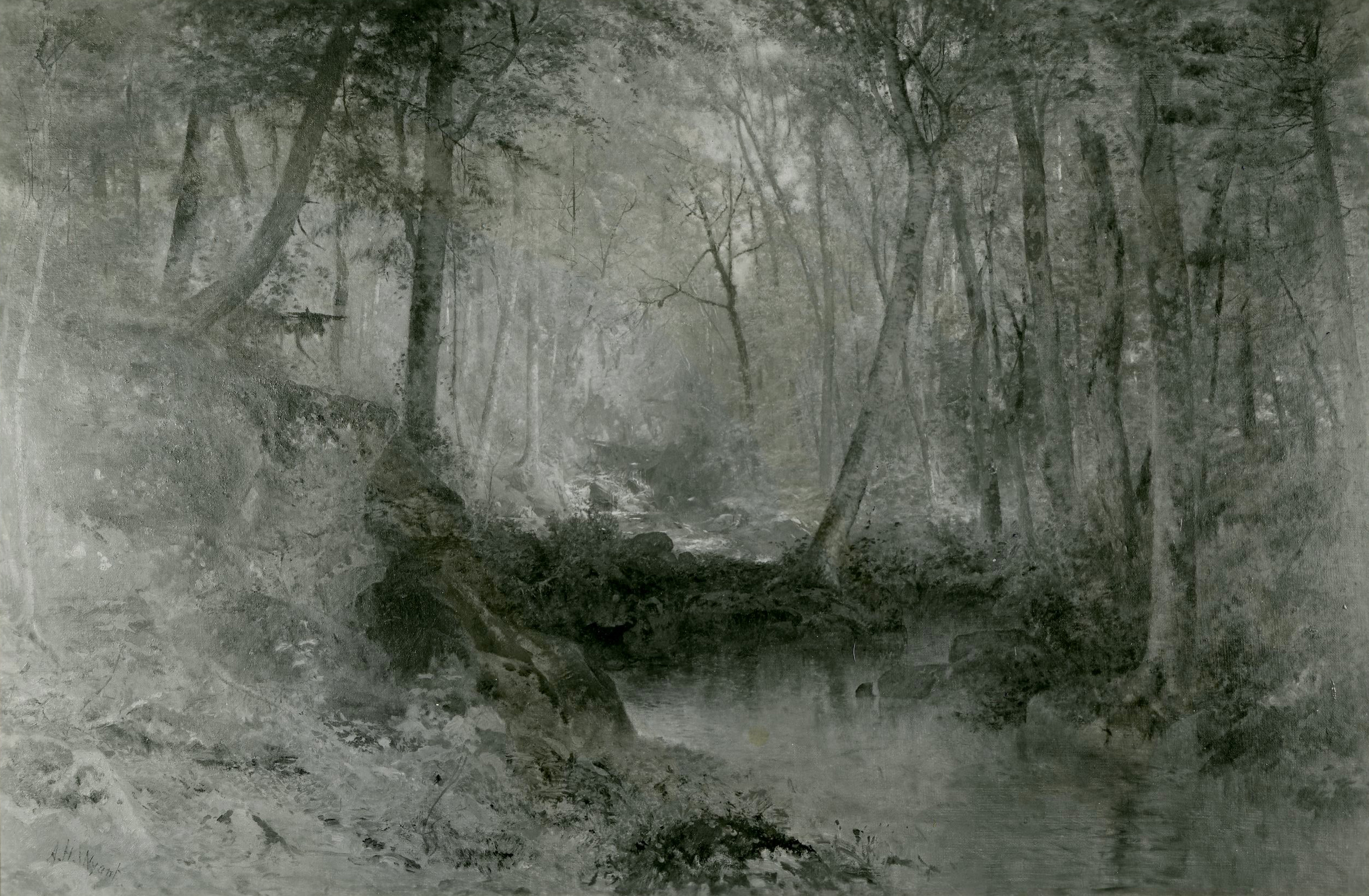
Alexander Wyant: In the Woods (ca. 1875-1876)

Frank William Brangwyn: The Swans (1921)

Lyonel Feininger: Calm at Sea II (1927)

 corvusfugit.com