
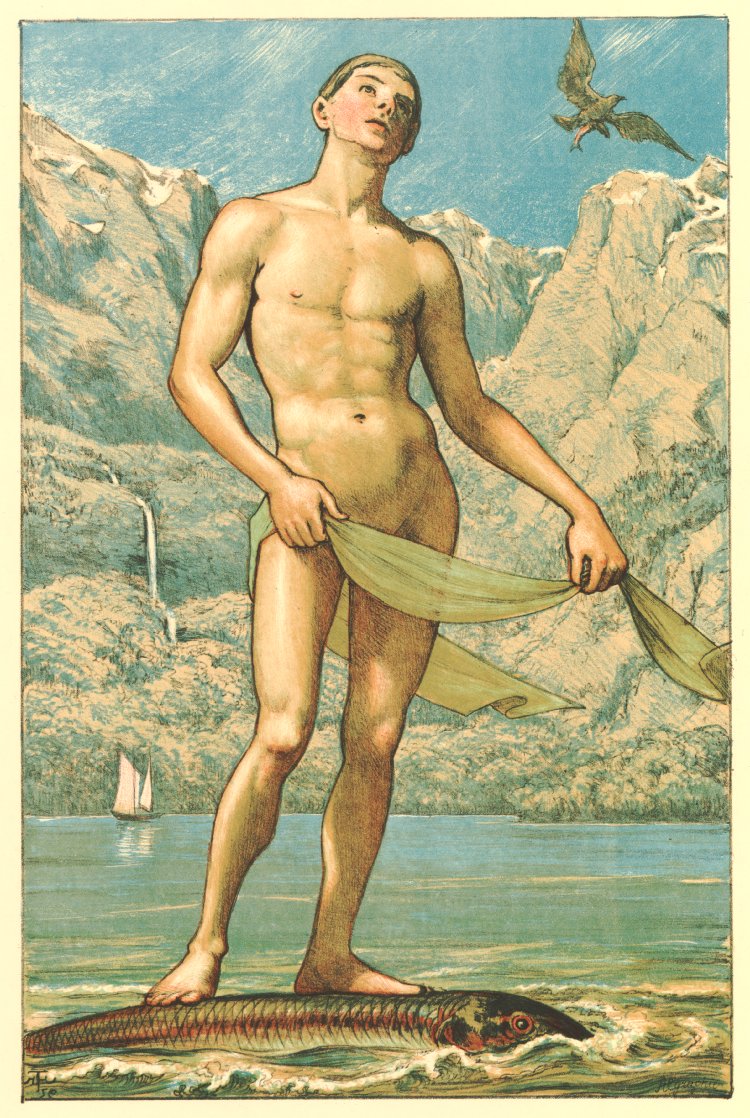
Hans Thoma: Frühling auf dem Gebirgssee [Spring on a Mountain Lake] (1898)
Hans Thoma: Frühling auf dem Gebirgssee [Spring on a Mountain Lake] (1898)
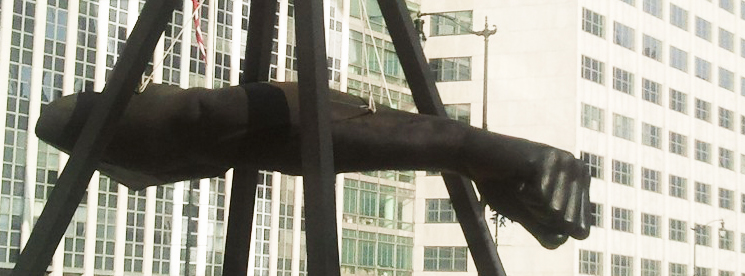
Robert Graham: Monument to Joe Louis in Detroit, Michigan (1986)
Louis—whose family moved to Detroit in 1926—was the world heavyweight boxing champion from 1937 to 1949 and one of the greatest heavyweights of all time. He is considered the first African-American to become a nationwide hero in the United States. The sculpture is 24 feet long.

Leo McCarey, director: Duck Soup (1933)

Thomas Alexander Harrison: Marine, Clair de lune (c. 1892-1893)

F Ramme: Anatomical model of the human eye (1850-1894) (source)

Hayao Miyazaki, director: Spirited Away (2001)

Money
an introductory lecture
This morning we shall spend a few minutes
Upon the study of symbolism, which is basic
To the nature of money. I show you this nickel.
Icons and cryptograms are written all over
The nickel: one side shows a hunchbacked bison
Bending his head and curling his tail to accommodate
The circular nature of money. Over him arches
UNITED STATES OF AMERICA, and, squinched in
Between that and his rump, E PLURIBUS UNUM,
A Roman reminiscence that appears to mean
An indeterminately large number of things
All of which are the same. Under the bison
A straight line giving him a ground to stand on
Reads FIVE CENTS. And on the other side of our nickel
There is the profile of a man with long hair
And a couple of feathers in the hair; we know
Somehow that he is an American Indian, and
He wears the number nineteen-thirty-six.
Right in front of his eyes the word LIBERTY, bent
To conform with the curve of the rim, appears
To be falling out of the sky Y first; the Indian
Keeps his eyes downcast and does not notice this;
To notice it, indeed, would be shortsighted of him.
So much for the iconography of one of our nickels,
Which is now becoming a rarity and something of
A collectors’ item: for as a matter of fact
There is almost nothing you can buy with a nickel,
The representative American Indian was destroyed
A hundred years or so ago, and his descendants’
Relations with liberty are maintained with reservations,
Or primitive concentration camps; while the bison,
Except for a few examples kept in cages,
Is now extinct. Something like that, I think,
Is what Keats must have meant in his celebrated
Ode on a Grecian Urn.
Notice, in conclusion,
A number of circumstances sometimes overlooked
Even by experts: (a) Indian and bison,
Confined to obverse and reverse of the coin,
Can never see each other; (b) they are looking
In opposite directions, the bison past
The Indian’s feathers, the Indian past
The bison’s tail; (c) they are upside down
To one another; (d) the bison has a human face
Somewhat resembling that of Jupiter Ammon.
I hope that our studies today will have shown you
Something of the import of symbolism
With respect to the understanding of what is symbolized.
—Howard Nemerov (1967)
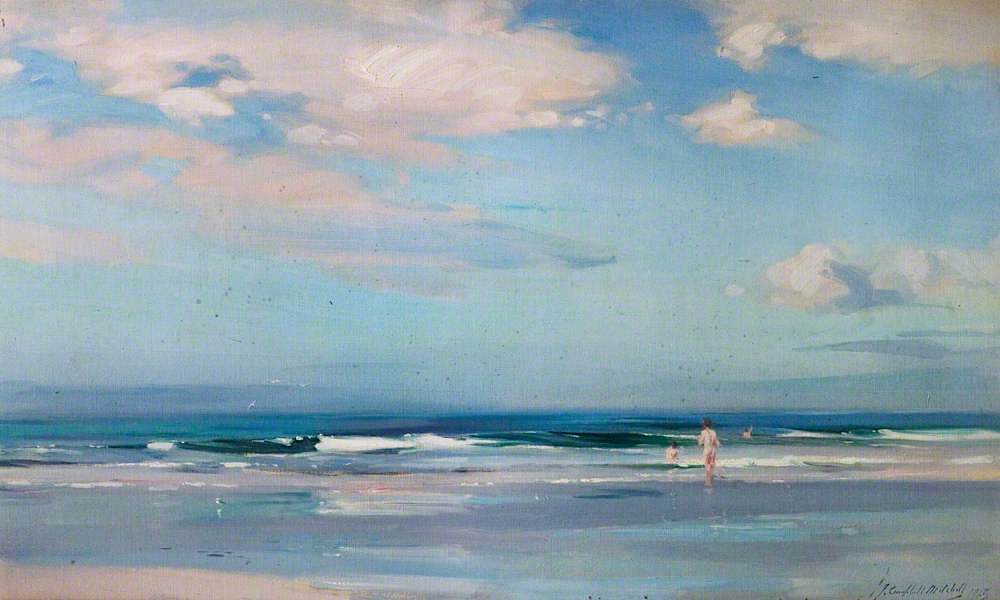
John Campbell Mitchell: The Sands at Machrihanish (1913)
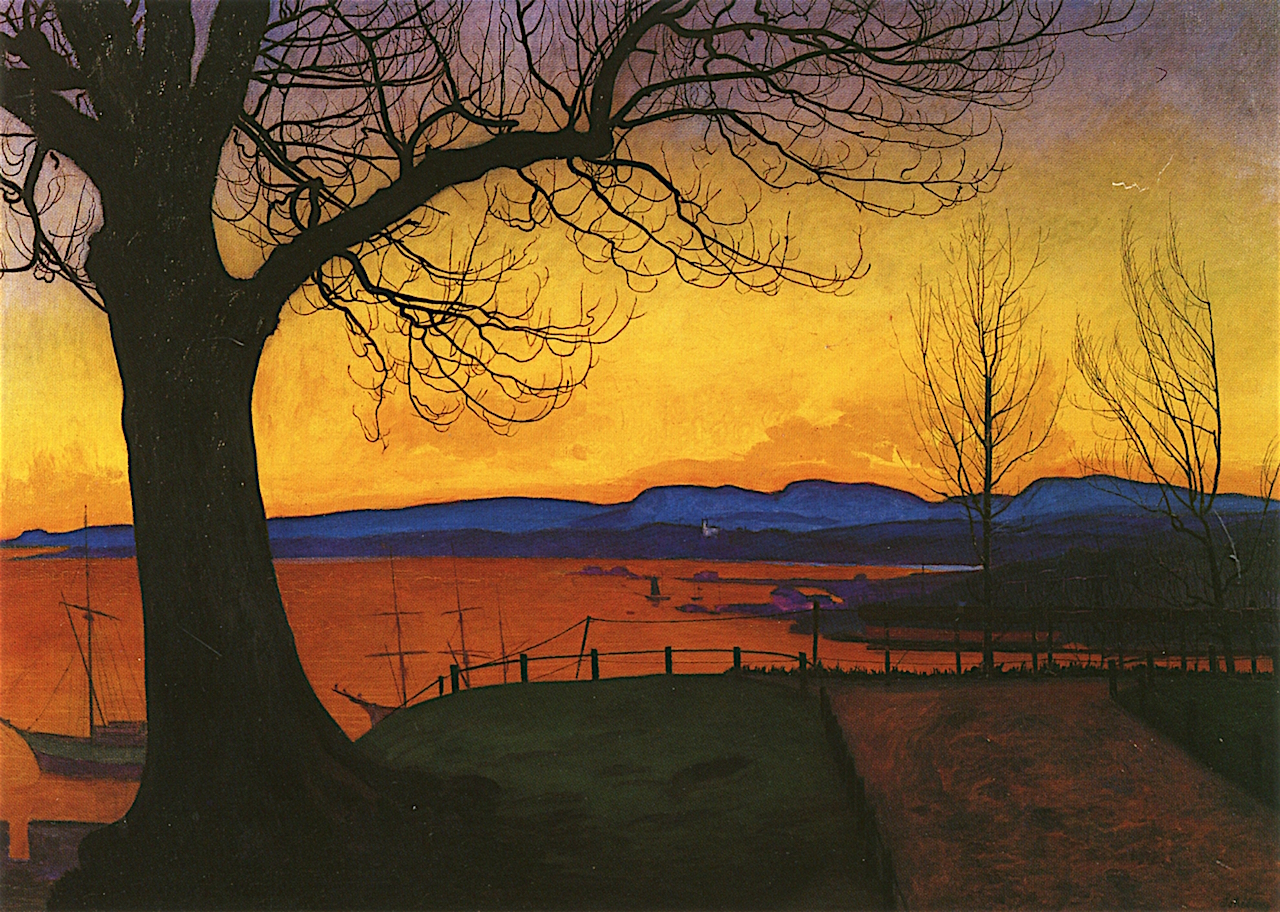
Harald Oskar Sohlberg: Evening, Akershus (1913)

The poet Percy Bysshe Shelley loved paper boats:
Shelley’s walks, when not determined elsewhere, often tended in the direction of a pond at no great distance from Primrose Hill, very proper for the delectable amusement of sailing paper boats; or in that of the Serpentine or the Surrey Canal, where the same pleasure could be pursued with a more daring spirit of adventure….Shelley’s happiness in this pastime of sailing paper boats had in it something vital and deep-seated; for it outlasted some passions that looked more serious….Sometimes before he started on his walk a tiny fleet would have been constructed by Mary’s fingers; sometimes by edge of pond or river Shelley would himself enact the naval architect. “He twisted a morsel of paper,” says Hogg, “into a form that a lively fancy might consider a likeness of a boat, and committing it to the water, he anxiously watched the frail bark, which, if it was not soon swamped by the faint winds and miniature waves, gradually imbibed water through its porous sides, and sank. Sometimes, however, the fairy vessel performed its little voyage, and reached the opposite shore of the puny ocean in safety. It is astonishing with what ken delight he engaged in this singular pursuit. It was not easy for an uninitiated spectator to bear with tolerable patience the vast delay, on the brink of a wretched pond upon a bleak common, and in the face of a cutting north-east wind, on returning to dinner from a long walk at sunset on a cold winter’s day; nor was it easy to be so harsh as to interfere with a harmless gratification, that was evidently exquisite….So long as his paper lasted, he remained riveted to the spot, fascinated by this peculiar amusement; all waste paper was rapidly consumed, then the covers of letters, next letters of little value; the most precious contributions of the most esteemed correspondent, although eyed wistfully many times, and often returned to the pocket, were sure to be sent at last in pursuit of the former squadrons. Of the portable volumes which were the companions of his rambles—and he seldom went without a book—the fly-leaves were commonly wanting; he had applied them as our ancestor Noah applied gopher-wood. But learning was so sacred in his eyes, that he never trespassed further upon the integrity of the copy ; the work itself was always respected.” “The best spot he ever found for this amusement,” says Peacock, was “a large pool of transparent water, on a heath above Bracknell, with determined borders free from weeds, which admitted of launching the miniature craft on the windward, and running round to receive it on the leeward side. On the Serpentine, he would sometimes launch a boat constructed with more than usual care and freighted with halfpence. He delighted to do this in the presence of boys, who would run round to meet it, and when it landed in safety and the boys scrambled for their prize, he had difficulty in restraining himself from shouting as loudly as they did.”
—Edward Dowden: The Life of Percy Bysshe Shelley (1886)

 corvusfugit.com