

Charlie Carroll: Portrait of Clubfoot 2 (2015)
Charlie Carroll: Portrait of Clubfoot 2 (2015)

Diana Rigg as Emma Peel in The Avengers (1967)

James Fairman: Jerusalem from the Mount of Olives (1875); as the Old City of Jerusalem is to the west of the Mount of Olives, this is a sunset.
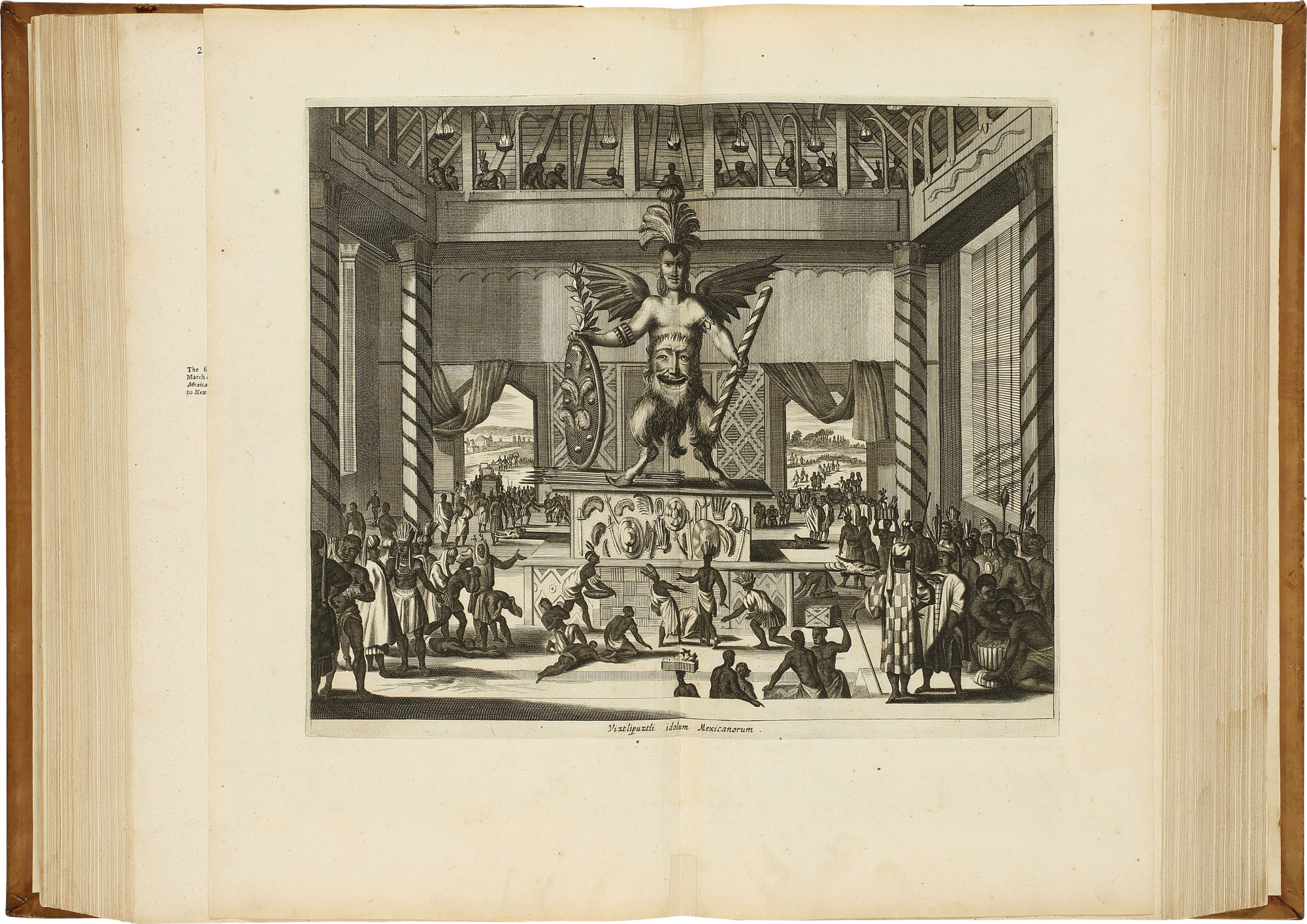
John Ogilby: America- Being the Latest, and Most Accurate Description of the New World (1671); the book is an English translation of Arnold Montanus’s De Nieuwe en Onbekende Weereld.
The title of this plate is “Viztlipuztli idolum Mexicanorum” —The Mexicans’ Idol of Viztlipuztli; the image purports to show the palace of Viztlipuztli, an Aztec idol. A later author provides this summary:
Their Chief was one they called Viztlipuztli whom they styled the most potent Lord of all Things, and to him they erected the most sumptuous Temple of the Kingdom in the City of Mexico. This Idol was made of Wood, but curiously adorned with Gold, Jewels, and Feathers. Ogilby gives us a Cut of him in a very Monstrous Shape. His Head, Face, Arms, and the upper Part of his Body, resemble those of a Man. He has a high Tuft of Feathers on his Head, tip’d with Gold, large Rings in his Ears, and Wings like those of a Bat proceeding from behind his Shoulders. On his Belly was represented the head of a wild Beast, somewhat like that of a Lion, with firery Eyes, a wide gaping Mouth full of Teeth, and a long shaggy Beard, which cover’d the Idol’s Thighs: His legs were like those of a Cow, straddling, with Claws in his Feet. In his right Hand he holds a Laurel Branch with a Buckler and a Plume of Feathers upon it, and in his left a Battoon of Command, full of crooked Streaks like Serpents. He sat in a triumphant blue Chair at the End of which was placed a Staff with a Serpent’s Head on it. Next the Shield lay four Arrows, pretended to be sent from Heaven. On his Claws were hung Jewels, Gold Boxes, and Shields, adorned with Feathers of divers Colours. There was a Curtain before him, which was never drawn but at Festivals. Acosta says, that two lesser Images stood near it, one of which, attended by 1000 People they carried at times to an Altar on a high Mountain, where they plac’d it, while the Multitude set all the Bushes about it on Fire, with great Shouts, and the Noise of Musical Instruments, Which to frighten the wild Beasts in the Woods, that they ran to the top of the Mountain, where they were inclos’d by the People, and many of them slain for an Offering to the Idol which was afterwards carried back to the Temple, and then the People made merry with the Venison. (source)
Huitzilopochtli was, in fact, the national god of the Mexica, the Aztec civilization of Tenochtitlan (Mexico City). He was the god of war, the sun, and human sacrifice.
 The name literally means something like “Hummingbird’s South” or “Hummingbird’s Left” and Huitzilopochtli was often portrayed either as a hummingbird or as an anthropomorphic figure with hummingbird feathers on his head and left leg. In iconographic representations, he had a black face and held a mirror as well as a scepter shaped like a snake.
Huitzilopochtli was believed to be engaged in a constant struggle with the darkness and required human sacrifice to give him strength.
The great Templo Mayor in Tenochtitlan was built in the 14th century and dedicated to Huitzilopochtli and Tlaloc, god of rain and agriculture; it was ultimately destroyed by the Spanish.
Image of Huitzilopochtli from the 16th century Codex Telleriano-Remensis.

Donald Lipski: U-90-45 (1990)

Jungle Action Vol. 2, #19 (January, 1976)
Cover Artists: Gil Kane, Dan Adkins, & Irv Watanabe

Frank Mujica: Untitled (Diptych) (2016)

Federico Fellini, director: La Dolce Vita (1960)

Martin Johnson Heade: Florida Pastoral. The painting is undated, but Heade lived and worked in Florida from 1883 until his death in 1904.
![Robert Walser - Diaz's Forest [1924]](https://corvusfugit.com/wp-content/uploads/2017/11/robert-walser-diazs-forest-19241.png)
Diaz’s Forest
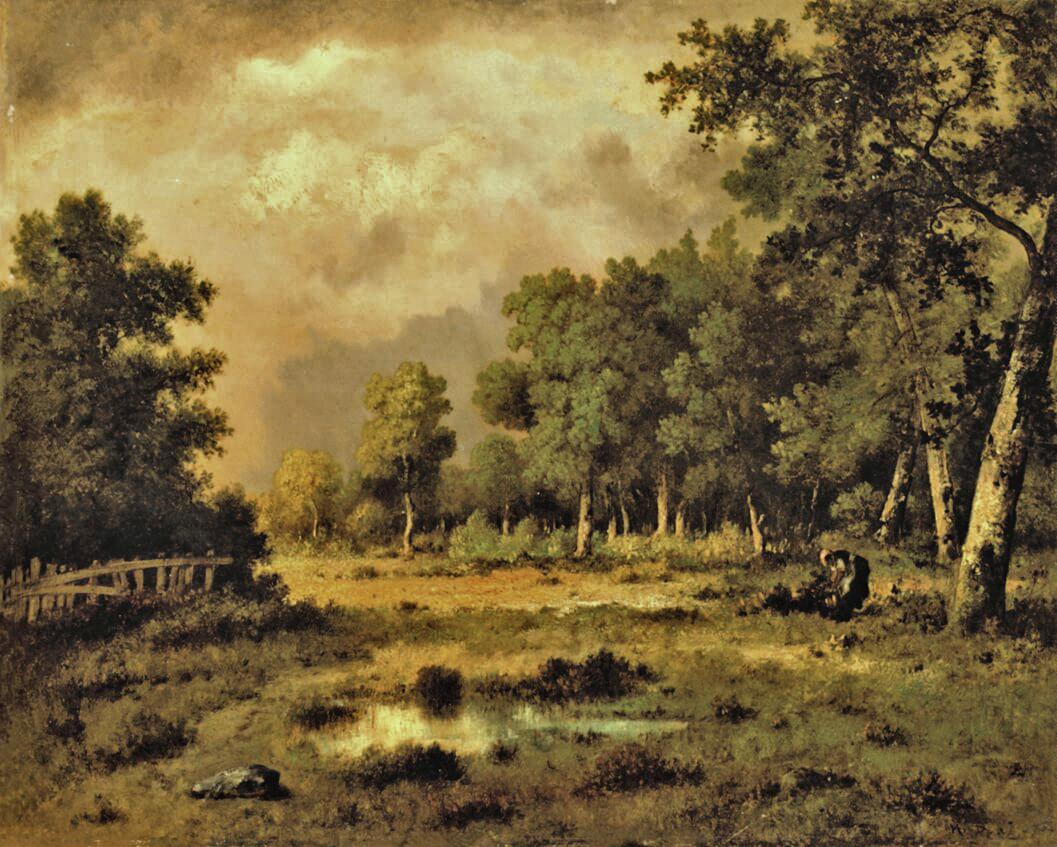
In a forest painted by Diaz, a little motherkin and her child stood still. They were now a good hour from the village. Gnarled trunks spoke a primeval tongue. The mother said to her child: “In my opinion, you shouldn’t cling to my apron strings like that. As if I were here only for you. Benighted creature, what could you be thinking? You’re just a small child, yet want to make grownups dependent on you. How ill-considered. A certain amount of thinking must enter your slumbering head, and to make that happen, I shall now leave you here, alone. Stop clutching at me with those little hands this instant, you uncouth, importunate thing! I have every reason to be angry with you—and I believe I am. It’s time you were told the unadorned truth, otherwise you’ll stay a help¬less child all your life, forever reliant on your mother. To teach you what it means to love me, you must be left to your own resources, you’ll have to seek out strangers and serve them, hearing nothing but harsh words from them for a year, two years, perhaps longer. Then you’ll know what I was to you. But always at your side, I am unknown to you. That’s right, child, you make no effort at all, you don’t even know what effort is, let alone tenderness, you uncompassionate creature. Always having me at your side makes you mentally indolent. Not for a minute do you stop to think—that’s what indolence is. You must go to work, my child, you’ll manage it if you want to—and you’ll have no choice but to want to. I swear to you, as truthfully as I am standing here with you in this forest painted by Diaz, you must earn your livelihood with bitter toil so that you will not go to ruin inwardly. Many children grow coarse when they are coddled, because they never learn to be thoughtful, thankful. Later, they all turn into ladies and gentlemen who are beautiful and elegant on the outside but self-absorbed nonetheless. To save you from becoming cruel and succumbing to foolishnesses, I am treating you roughly, because overly solicitous treatment produces people free from conscience and care.”
As the child heard these words, it opened its eyes wide in terror, trembling, and a tremor passed through the very leaves of Diaz’s forest, but the mighty trunks stood firm.
The fallen leaves upon the forest floor murmured: “What has been written in this brief essay appears to be quite simple, but there are times when everything simple and readily comprehensible recedes from human understanding and only can be grasped with great effort.” That’s what the leaves murmured. The mother was gone. The child stood there alone. Before this child stood the task of finding its way in the world, which is also a forest, of learning to hold itself in low esteem and to drive out all smug complacency from its own person, so that it might be pleasing to others.
This essay was written by Robert Walser in 1924, but like others of his “microscripts” was considered unintelligible until recently. It was first published in English in the 2015 collection Looking at Pictures, which also contains essays Walser published in his lifetime. (The translation is by Susan Bernofsky.)
The painting is Narcisse Diaz de la Peña’s The Forest Clearing (1875).


 corvusfugit.com