

Harry van der Weyden: Cliff End, Studland, Dorset (1909–1910)
Harry van der Weyden: Cliff End, Studland, Dorset (1909–1910)
![Hans Emmenegger - Waldbild [Forest Image] (1934)](https://corvusfugit.com/wp-content/uploads/2017/10/hans-emmenegger-waldbild-forest-image-1934.jpg)
Hans Emmenegger: Waldbild [Forest Image] (1934)

From the December 9, 1911 issue of The Outlook:
A number of years ago I was invited to visit a friend who lived at a large and beautiful country-seat on the Hudson. Shortly after my arrival I started, with a number of other guests, to make a tour of the very extensive grounds. We walked for an hour or more, and thoroughly explored the place. Upon my return to the house I discovered that I had lost a gold cuff-stud that I valued for association’s sake. I merely remembered that I wore it when we started out, and did not think of or notice it again until my return, when it was missing. As it was quite dark, it seemed useless to search for it, especially as it was the season of autumn and the ground was covered with dead leaves.
That night I dreamed that I saw a withered grape-vine clinging to a wall, and with a pile of dead leaves at its base. Underneath the leaves, in my dream, I distinctly saw my stud gleaming.
The following morning I asked the friends with whom I had been walking the previous afternoon if they remembered seeing any such wall and vine, as I did not. They replied that they could not recall any-thing answering the description. I did not tell them why I asked, as I felt somewhat ashamed of the dream, but during the morning I made some excuse to go out in the grounds alone. I walked hither and thither, and after a long time I suddenly came upon the wall and vine exactly as they looked in my dream. I had not the slightest recollection of seeing them or passing by them on the previous day. The dead leaves at the base were lying heaped up, as in my dream. I approached cautiously, feeling rather uncomfortable and decidedly silly, and pushed them aside. I had scattered a large number of leaves when a gleam of gold struck my eye, and there lay the stud exactly as in my dream.
Image: Albert Bierstadt: Autumn Woods (1886)
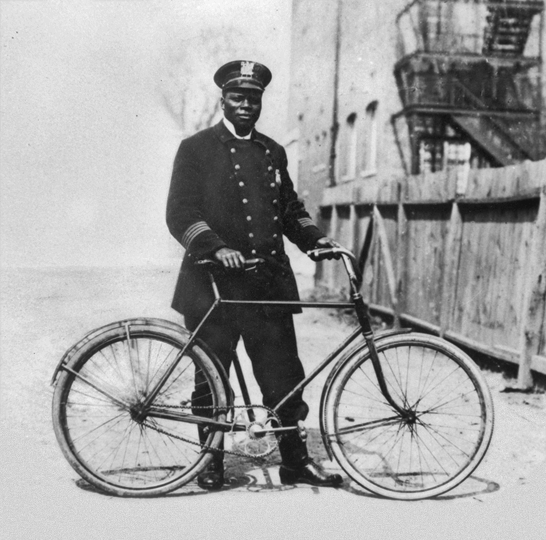
Patrolman James A. Saunders, Plainfield NJ’s first African-American police officer. Saunders was a member of the force from 1895 to 1917. (source)

This painting by Leonardo da Vinci is known as the Isleworth Mona Lisa, named for the London neighborhood of an early 20th century owner of the work. Experts believe it was painted in about 1503, before the version that now hangs in the Louvre.
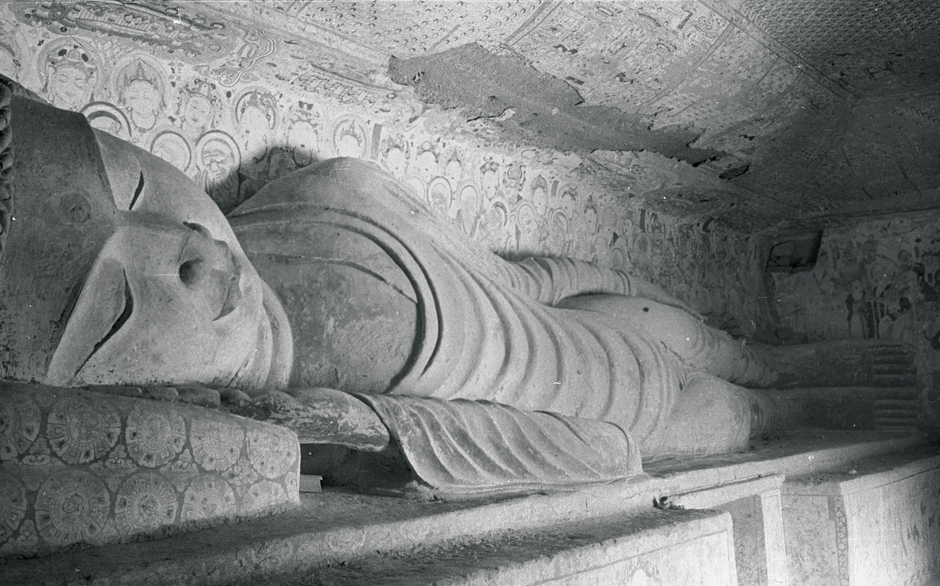
The Mogao Caves, carved into cliffs near the town of Dunhuang in northwest China, date from the 4th to the 14th century AD and lay along the ancient trade route known as the Silk Road. There are about 500 of them, and when they were discovered in the early 20th century, they held tens of thousands of manuscripts and scrolls, and thousands of sculptures and wall paintings.
This photo was taken by James Lo in the 1940s; the sculpture represents the Buddha achieving parinirvana—the nirvana-after-death that occurs when a person dies after attaining nirvana during their life, ending the cycle of death and rebirth. It dates from the Middle Tang dynasty (781–848). See more here.
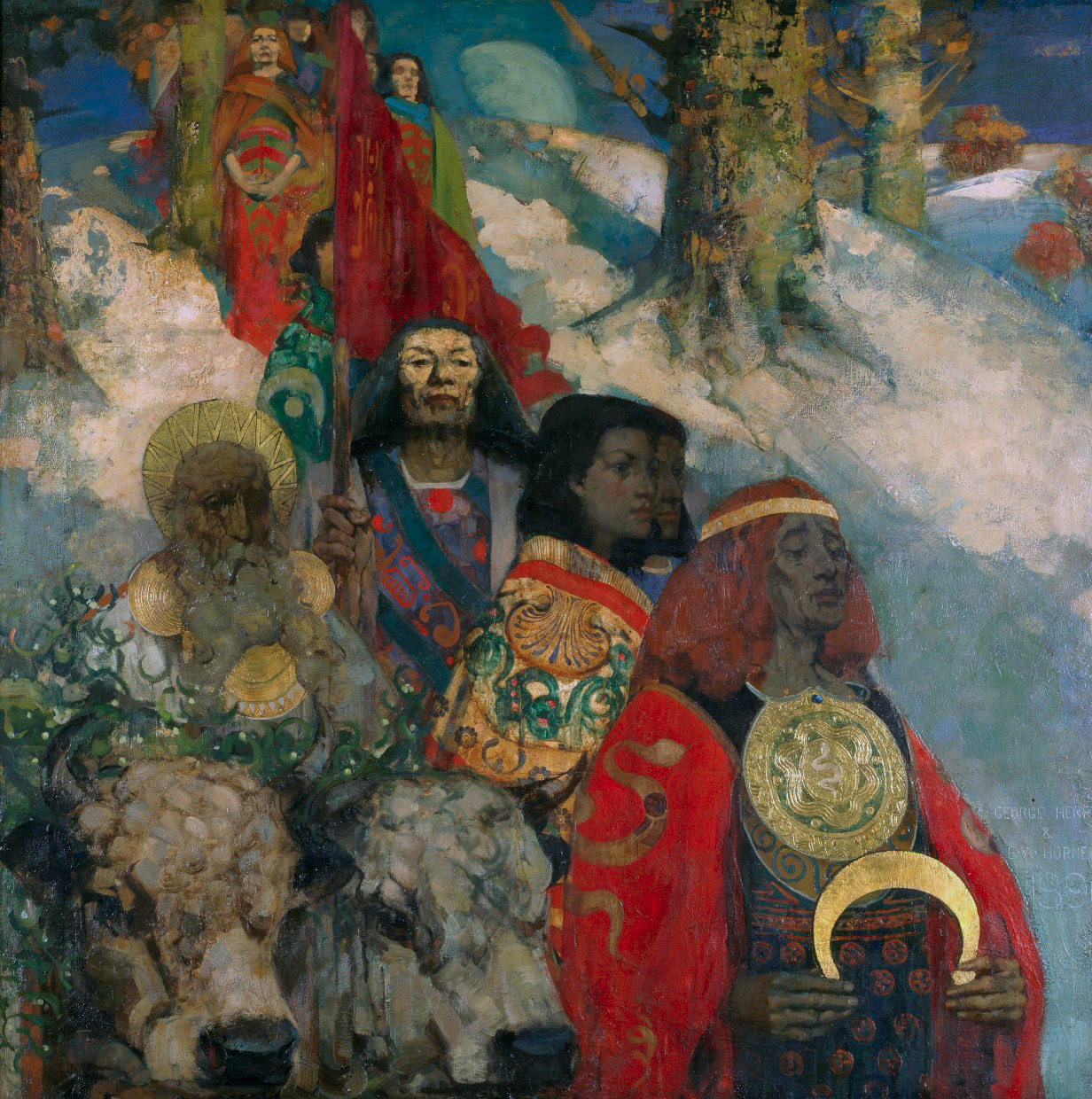
George Henry and E. A. Hornel: Druids Bringing In The Mistletoe (1890)
The painting follows the description of Pliny the Elder (1st century AD) in describing the ritual of oak and mistletoe:
HISTORICAL FACTS CONNECTED WITH THE MISTLETOE
The Druids—for that is the name [the Gauls] give to their magicians— held nothing more sacred than the mistletoe and the tree that bears it, supposing always that tree to be the robur [oak]. Of itself the robur is selected by them to form whole groves, and they perform none of their religious rites without employing branches of it; so much so, that it is very probable that the priests themselves may have received their name from the Greek name for that tree [δρῦς]. In fact, it is the notion with them that everything that grows on it has been sent immediately from heaven, and that the mistletoe upon it is a proof that the tree has been selected by God himself as an object of his especial favour.
The mistletoe, however, is but rarely found upon the robur; and when found, is gathered with rites replete with religious awe. This is done more particularly on the fifth day of the moon, the day which is the beginning of their months and years, as also of their ages, which, with them, are but thirty years. This day they select because the moon, though not yet in the middle of her course, has already considerable power and influence; and they call her by a name which signifies, in their language, the all-healing. Having made all due preparation for the sacrifice and a banquet beneath the trees, they bring thither two white bulls, the horns of which are bound then for the first time. Clad in a white robe the priest ascends the tree, and cuts the mistletoe with a golden sickle, which is received by others in a white cloak. They then immolate the victims, offering up their prayers that God will render this gift of his propitious to those to whom he has so granted it. It is the belief with them that the mistletoe, taken in drink, will impart fecundity to all animals that are barren, and that it is an antidote for all poisons. (Karl Friedrich Theodor Mayhoff, trans.) (source)

I am obliged to record in my journal of this date (April 16, 1882) a singular event which I am forced to believe because of the overwhelming evidence.
Yesterday, while engaged in the trial of Richard Mandel…I was brought to an unexpected close in my prosecution, by the loss of one link in the chain of evidence which I had supposed complete.
I hunted in vain for the necessary proof among my papers; it could not he found, and very much vexed, I begged the court to allow me one more day to complete my evidence. The request was reluctantly granted and the court adjourned.
I spent the remainder of the day in searching for the missing paper, but failed to find it, and at last, wearied out with my efforts, I retired to sleep.
It seemed to me that I was in the court-room, addressing the jury, my closing argument for the prosecution, and that I stated to the judge and jury my regret that a very important piece of evidence was wanting.
“Your Honor,” I remarked in my dream, “the want of this proof will materially weaken my case.” At this point in my dream a stranger came hastily into the court-room and laid a paper on the table, saying he had found it while coming through Charing Cross. I opened it, and found to my joy, the missing evidence.
At this part of my dream I awoke and in much perplexity as to what it all meant, I made my way to court, where the exact events foreshadowed by the dream came true. I was unable to put my hands on the missing paper, and expressed my regret to the court in almost the identical words of my dream. I had scarcely finished when a stranger came in with the paper, and told about finding it that morning in Charing Cross, through which he had occasion to pass a few days after the opening of the trial, when I must have lost the paper from my bag.
In attempting to describe my emotions at this singular event, I should say that for some time I was uncertain whether I was awake or asleep. And I can hardly persuade myself yet that a mere figment of the brain could have literal a fulfillment.
—Firemen’s Magazine Vol. IX, No. 4 (April 1885)
Image: Engraving of a scene from the Tichborne case, during the examination of Miss Mary Ann Loader. The Graphic, 1874 (source)

William H. Clarkson: Floods in the Arun Valley (c. 1934)

Larry Keating’s hardhat. Keating, a member of Iron Workers Local 40, was a foreman during the cleanup of of wreckage and debris from the World Trade Center following 9/11. (source)
The men — Larry Keating, Danny Doyle, Mike Emerson and Bobby Graves — are veteran ironworkers in Local 40. They were at ground zero ”from the first day to the last day,” as they proudly describe it, working closely with firefighters, cutting steel and picking through wreckage for human remains. It was devastating work, and the four men say they got through their long, grueling shifts by banding together and talking each other through the horror.
”It’s over, but it’s not over,” Mr. Keating said. ”You were working in a graveyard and saw a lot of stuff you weren’t meant to see, and a lot of it still lingers. We talked each other all the way through the cleanup, and we’re still doing it.”
”Now that the cleanup’s over, a lot of guys have gone off the deep end,” [said Brian Lyons, a site supervisor at ground zero]. ”When you were working down there, you had responsibility and pride. You could do something about the tragedy. But when the job was over, and we laid the guys off, some took it very hard and couldn’t stop coming back to the site. Some had to be escorted off the property. They kept showing up like they were lost. Some of them wanted to work for nothing. You had to snap them into reality and say: ‘The job’s over. Go home.'” (source)

 corvusfugit.com