2106: Transitional Object

Cornelia Parker - Transitional Object (PsychoBarn) (2016)

In 2016, Cornelia Parker installed this replica of the house from Hitchcock’s Psycho on the roof of the Metropolitan Museum of Art in New York city. It’s made from repurposed wood from a red barn; the title of the work is Transitional Object (PsychoBarn).

In 1953, Donald Winnicott introduced the term “transitional object” to describe those blankets, soft toys, and bits of cloth to which young children frequently develop intense, persistent attachments. Winnicott theorized that such…attachments represent an essential phase of ego development leading to the establishment of a sense of self. Subsequent psychological theorists have linked the T.O. to the processes of: separation-individuation; ego and body ego development; the birth of memory, libidinal object constancy, and the capacity for symbolization, creativity; and the capacity for object relations and empathy. (source)

Posted in Uncategorized | Tagged , , , , , , , , , , , , , | Leave a comment

1966: A World of Limitless Dimensions

Jack Kirby - Fantastic Four Vol 1, No 51 (June, 1966)

Jack Kirby: collage from Fantastic Four Vol. 1, #51 (June, 1966)

Original art:

Jack Kirby - Fantastic Four Vol 1, No 51 (June, 1966) original art

Posted in Uncategorized | Tagged , , , , , , | Leave a comment

1886: Methods

Raphaelle Peale - Cheese and Three Crackers (1813)

The following list of terms used to express diverse modes of divination, with explanations, will be found unusually complete and may interest students of occult science. The expressions have been gathered from various sources :

Aeromancy, by appearances in the air.
Alectoromancy, Alectryornancy, by a fowl picking up grains of wheat.
Aleuromancy, by meal.
Alphitomancy, by barley flour.
Amniomancy, by the amnion.
Anagrammatism, by anagrams of a person’s name.
Anthropomancy. by human entrails.
Anthroposcopy, by the features of men.
Arithmancy, by the use of numbers.
Astragalomancy, Astragiromancy, by little sticks, bones, tablets, or dice.
Astrology, by the heavenly bodies.
Austromancy, by winds.
Axiomancy, by the axe or hatchet.
Belomancy, by arrows.
Bibliomancy, by the Bible.
Bletonism, by subterranean springs.
Botanomancy, by herbs.
Capnomancy, by smoke from the altar.
Cartomancy, by playing cards.
Catoptromancy, by mirrors.

Continue reading

Posted in Uncategorized | Tagged , , , , , , , , , , | Leave a comment

340 AD: Patron Saint of Beekeepers

Jacques I Laud - Saint Ambrose

According to tradition, a swarm of bees settled on the face of the infant St. Ambrose, leaving a drop of honey and thus foretelling the saint’s eloquencehis honeyed tongue. He is the patron saint of bees and beekeepers.

A certain woman having some stalls of bees which yielded not unto her the desired profit, but did consume and die of the murrain, made her moan to another woman, who gave her counsell to get a Consecrated Host and put it among them. According to whose advice she went to the priest to receive the Host; which when she had done she kept it in her mouth, and being come home again she took it and put it into one of her hives; whereupon the murrain ceased, and the honey abounded. The woman there-fore lifting up the hive in due time to get the honey, saw there (most strange to be seen) a Chappel built by the Bees with an Altar in it, the walls adorned by marvellous skill of architecture, with windows set in their places, also a door and a steeple with bells. And the Host being laid on the Altar, the Bees making a sweet noyse flew round about it.

Charles Butler: The Feminine Monarchie (1609); Butler was among the first to identify the queen bee as a (female) queen and not a (male) king.

Image:
Jacques I Laudin (1627-1695): Saint Ambrose

Posted in Uncategorized | Tagged , , , , , , , , , , , , , , , , | Leave a comment

1661: Elizabeth Russell

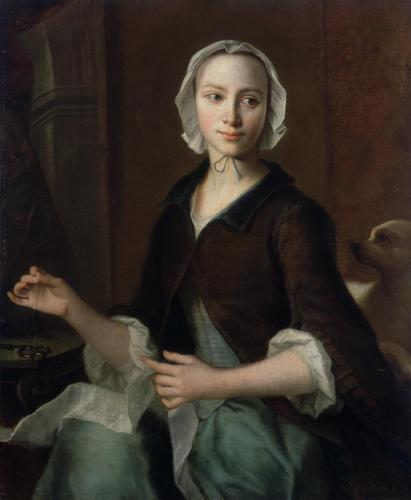
Christian Seybold - Seamstress (First half - middle of the 18th century)

[———–] Russell, always known under the guise or habit of a woman, and answered to the name of Elizabeth, as registered in Streatham parish, Nov. 21, 1661, but at death proved to be a man. He was buried April 14th, 1772. In speaking of this extraordinary person it will be necessary, in order to avail confusion among the relative pronouns, to make constant use of the masculine gender, however oddly it may sometimes be combined. The various adventures of his life, had they been collected by a contemporary, would have formed a volume as entertaining as those of the celebrated Bamfylde Moore Carew, whom he accompanied in many of his rambles. Upon examining the parish register, it appears that John Russell had three daughters and two sons; William, born in 1668, and Thomas in 1672. There is little doubt, therefore, that the person here recorded is one of the two; and that, when he assumed the female dress, he assumed also the name of his sister Elizabeth, who probably either died in her infancy, or settled in some remote part of the country; under this name, in the year 1770, he applied for a certificate of his baptism; He attached himself at an early period of his life to the gypsies, and being of a rambling disposition, visited many parts of the continent as a stroller or vagabond. When advanced in years he sikik settled at Chipstead in Kent, where he kept a large shop. Sometimes he travelled the country with goods, in the character of a married woman, having changed his maiden name for that of his husband, who carried the pack; and to his death was reputed a widow, being known by the familiar name of “Bet Page !” In the course of his travels he attached himself to itinerant physicians, learned their nostrums, and practised their art. His long experience gained him the character of an infallible doctress; to which profession he added that of an astrologer, and practised both with great advantage, yet such was his extravagance, that when he died he possessed no more than six shillings. It was a common custom with him to spend whatever he had in his pocket at an alehouse, where he usually treated his companions. About twelve months before his death he came to reside at his native place: his extraordinary age procured him the notice of many of the most respectable families in the neighbourhood, particularly that of Mr. Thrale, in whose kitchen he was frequently entertained. Dr. Johnson, who found him shrewd and sensible, with a good memory, was very fond of conversing with him. His faculties, indeed, were so little impaired with age, that a few days before he died be planned another ramble, in which his landlord’s son was to have accompanied him. His death was very sudden. The surprise of the neighbours may well be imagined, upon finding that the person, who, as long as the memory of any one living could reach, had been always reputed a woman, was discovered to be a man; and the wonder was the greater as he had lived much among women, and had frequently been his landlady’s bedfellow, when an unexpected lodger came to the house. Among other precautions, to prevent the discovery of his sex, he constantly wore a cloth tied under his chin ; and his neighbours, not having the penetration of Sir Hugh Evans, who spied Falstaff’s beard through his muffler, the motive was unsuspected. It may be observed that, supposing him to be the younger son of John Russell, he would have been 100 years of age, if the elder, his age would have been 104. He frequently averred he was 108. He had a mixture of the habits and employments of both sexes; for, though he could drink copiously with men, whose company he chiefly affected, yet he was an excellent sempstress, and celebrated for making a good shirt. There was, however, a wildness and eccentricity in his general conduct, which seemed to border on insanity.

—B. & J. Homans: Eccentric Biography, Or, Memoirs of Remarkable Characters, Ancient and Modern: Including Potentates, Statesmen, Divines, Historians, Naval and Military Heroes, Philosophers, Lawyers, Impostors, Poets, Painters, Players, Dramatic Writers, Misers, &c. &c. &c. : the Whole Alphabetically Arranged : Forming a Pleasing Delineation of the Singularity, Whim, Folly, Caprice, &c. of the Human Mind (1804)

Image:
Christian Seybold: Seamstress (First half – middle of the 18th century)

Posted in Uncategorized | Tagged , , , , , , , , , , | Leave a comment

1912: Many-Headed

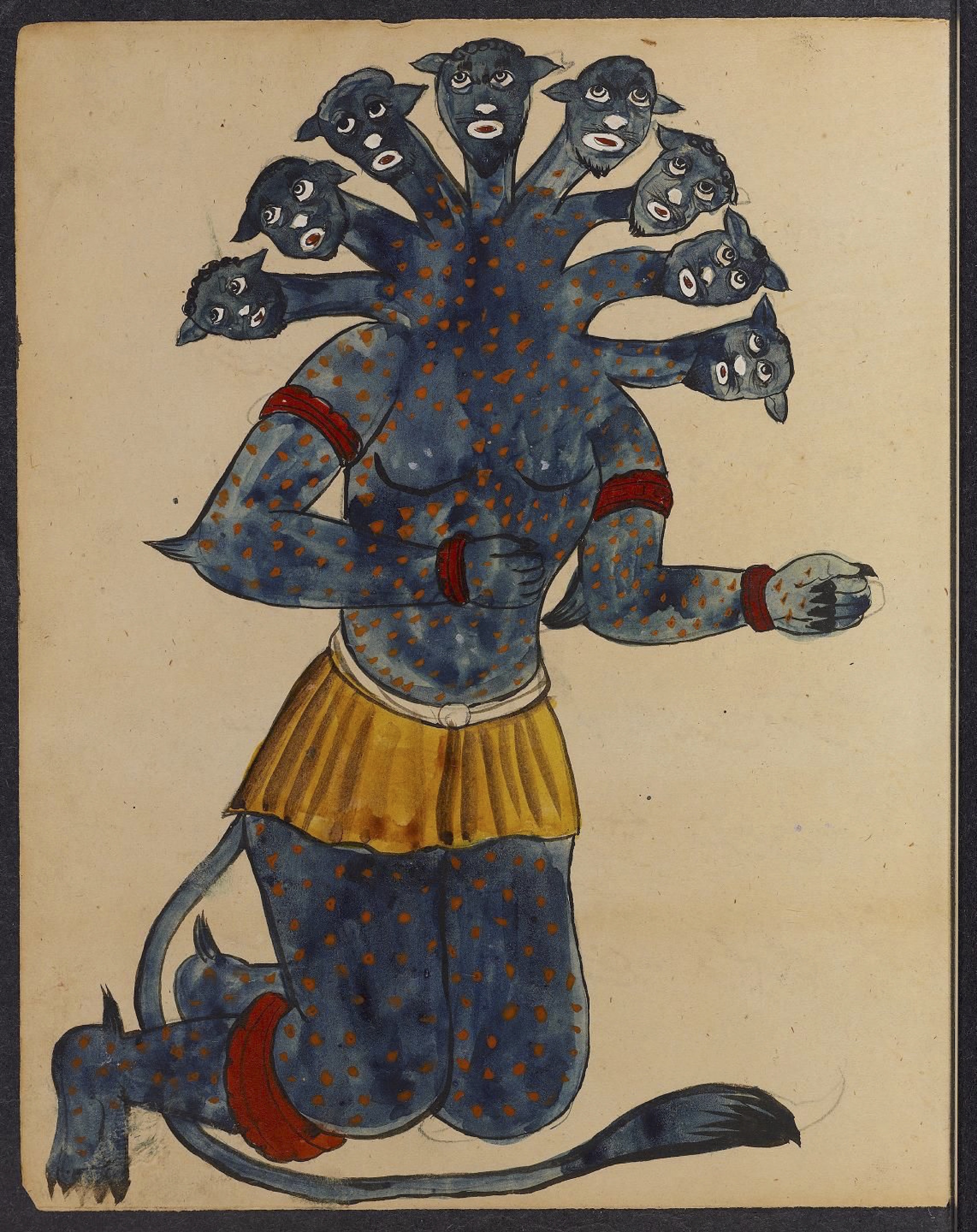
Book of Creatures - 11   Book of Creatures - 10

Demons associated with astrological signsfrom a Persian manuscript on magic and astrology, 1912.

Posted in Uncategorized | Tagged , , , , , | Leave a comment

1863: Dictionary of Hell

louis-breton-amducias-(1863) louis-breton-malphas-(1863)

Entries from the 1863 edition of Jacques Auguste Simon Collin de Plancy’s Dictionnaire Infernal:

Amduscias: Grand-duc aux enfers. Il a la forme d’une licorne; mais lors-qu’il est évoqué, il se montre sous une figure humaine. Il donne des concerts, si on les lui commande; on entend alors, sans rien voir, le son des trompettes et des autres instruments de musique. Les arbres s’inclinent à sa voix. Il commande vingt-neuf légions.

Malphas: Grand président des enfers, qui apparaît sous la forme d’un corbeau. Quand il se montre avec la figure humaine, le son de sa voix est rauque; il bâtit des citadelles et des tours inexpugnables, renverse les remparts ennemis, fait trouver de bons ouvriers, donne des esprits familiers, reçoit des sacrifices et trompe les sacrificateurs : quarante légions lui obéissent.

Amduscias: Grand duke of Hell. He has the form of a unicorn; but when he is summoned, he shows himself in the guise of a human being. He gives concerts when so commanded: one hears, while seeing nothing, the sound of trumpets and other musical instruments. The trees bow to his voice. He commands twenty-nine legions.

Malphas: Great president of Hell, who appears in the form of a raven. When he appears in human guise, the sound of his voice is hoarse; he builds citadels and impregnable towers, overthrows the enemy’s ramparts, brings together good workmen, hands out familiars, receives sacrifices, and deceives the priests. Forty legions obey him.

The illustrations are by Louis Breton and engraved by M. Jarrault.

Posted in Uncategorized | Tagged , , , , , , , , , , , , | Leave a comment

1912: Little Demons

Richard Tennant Cooper - An unconscious naked man lying on a table being attacked by little demons armed with surgical instruments; symbolising the effect of chloroform on the human body

Richard Tennant Cooper: An unconscious naked man lying on a table being attacked by little demons armed with surgical instruments; symbolising the effect of chloroform on the human body (1912); from a series of medically-themed paintings commissioned in 1912 by Henry Wellcome. See the full set here.

Posted in Uncategorized | Tagged , , , , , | Leave a comment

1859: Mondscheinlandschaft

SKD438348

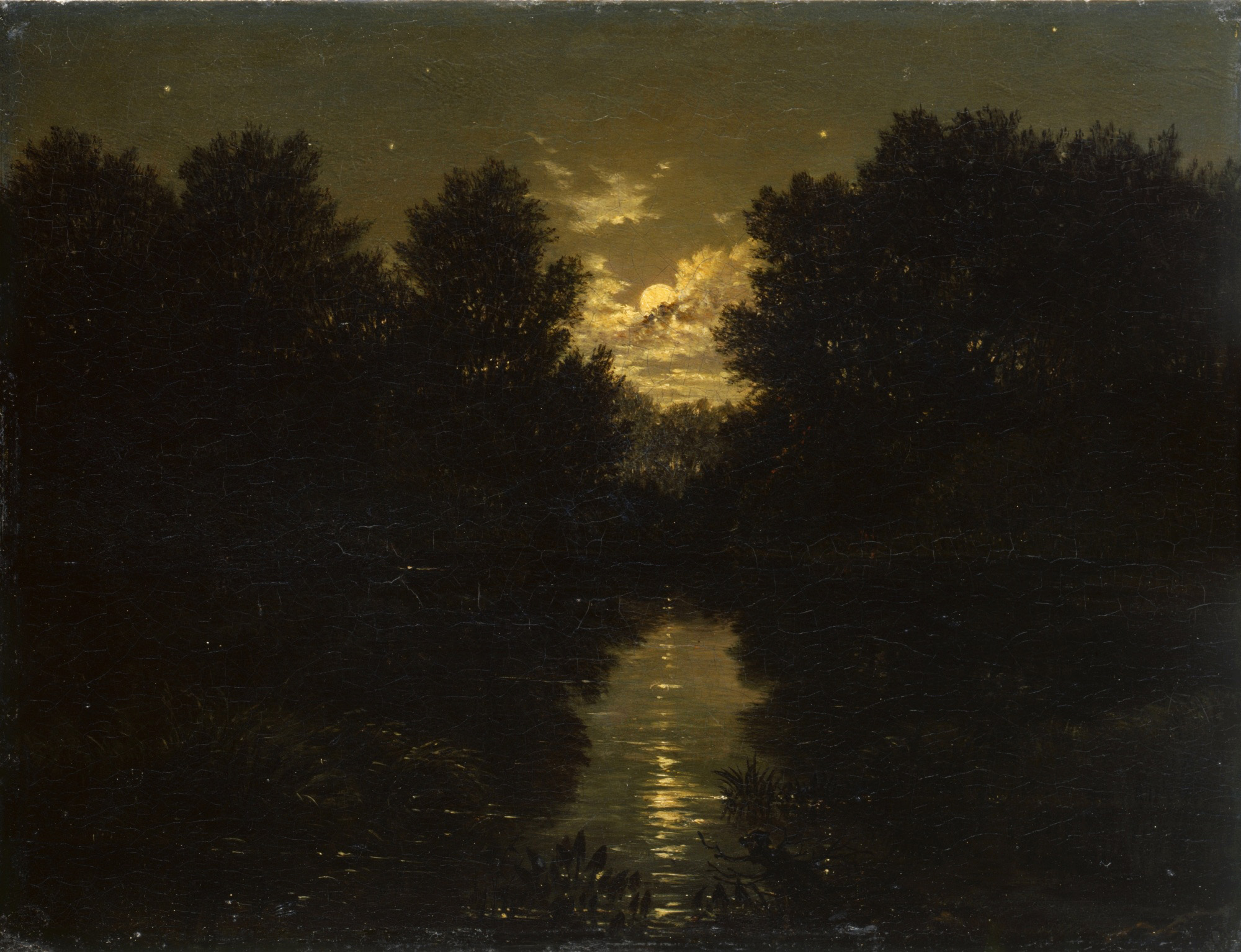
Carl Gustav Carus: Moonlit Landscape (1859)

Posted in Uncategorized | Tagged , , , , , , , | Leave a comment

1968: I Had a Dream

Edward Biberman - I Had a Dream (1968),

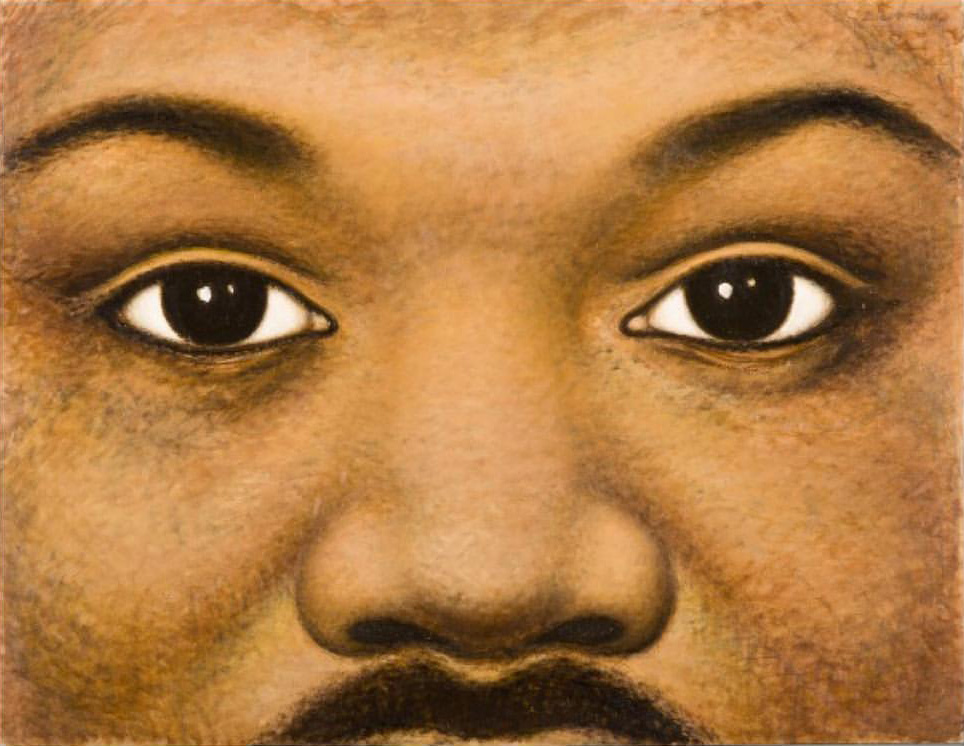
Edward Biberman: I Had a Dream (1968)

Posted in Uncategorized | Tagged , , , , , , , | Leave a comment