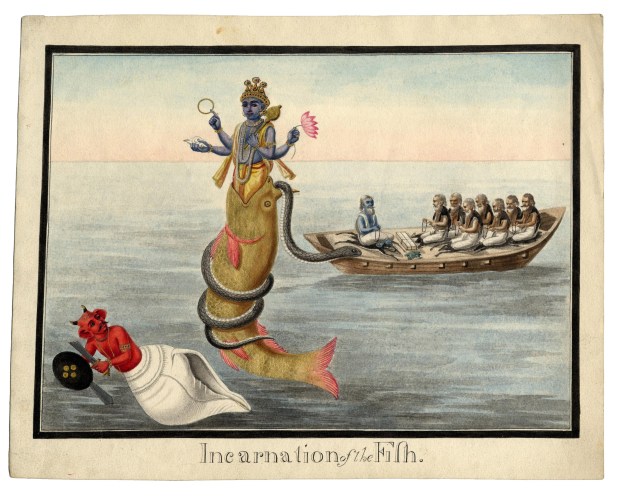
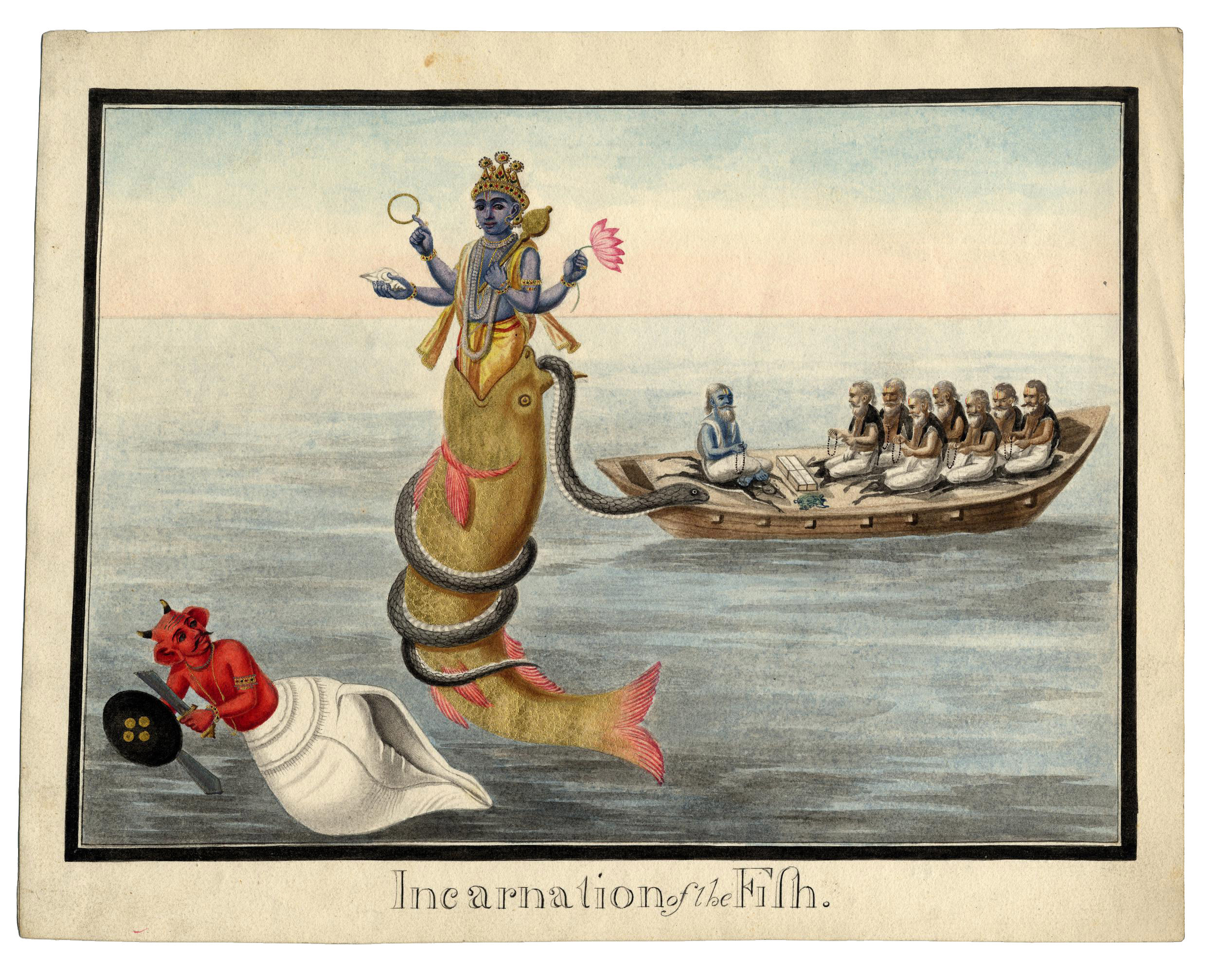
 In Hindu mythology, there are four historical eras, yugas, that repeat in a cycle; the first of these is the Satya Yuga, followed by the Treta Yuga, the Dvapara Yuga, and, finally, the Kali Yuga. We are presently in a Kali Yuga that started in 3102 BC. The story of the picture above takes place at the end of the most recent Satya Yuga, about 2.2 million years ago, according to one reckoning (Wikipedia). Now, each yuga is but a single day for Brahma, the Hindu creator god, and at the end of each one, he sleeps—and when he sleeps, he stops creating and thus the universe ceases to exist until he wakes.
The version of the story in this image is told in the Bhagavata Purana, one of the great compendiums of Hindu lore. What follows is an edited version of this retelling:
The Satya Yuga was about to end and a great flood was to come and destroy all the life on earth to start afresh for the next yuga. After a day full of creation, Lord Brahma was tired. He wanted to go to sleep and was soon snoring loudly.
While Lord Brahma was sleeping an asura—a demon—named Hayagriva emerged from Brahma’s nose. With Brahma asleep, Hayagriva realized that it was the right time to take in all the knowledge of the Vedas—the ancient Hindu scared texts. Hayagriva concentrated and soon absorbed the knowledge in the Vedas. He then hid deep inside the ocean, thinking that nobody would find him there.
Lord Vishnu saw this and was worried. If the Vedas were stolen by the asura, the knowledge of the Vedas could not be passed on to the next yuga. Vishnu is the God of Preservation; whenever the earth is in danger and when evil threatens to overpower good, Lord Vishnu descends from the heaven to incarnate on the earth.
At the same time, there was a king named Manu. He was a staunch devotee of Lord Vishnu. His greatest desire was to see Lord Vishnu with his own eyes. For this he performed severe penance for thousands of years. Wondering what to do, Lord Vishnu looked at Manu performing penance and smiled, realizing that he could achieve much more than just save the Vedas.
The next morning, Manu went to the river to begin his prayers. He took the water in his hands and held it high above his head and offered it to the Lord Vishnu to mark the beginning of his prayer. He was about to pour the water into the river, when he heard a tiny voice from his hands. “O great king! Please do not put me back in the river!”
Continue reading →






 corvusfugit.com