

Illustration from The Children’s Object Book (F. Warne & Co., 1880’s) (source)
Illustration from The Children’s Object Book (F. Warne & Co., 1880’s) (source)
![Takayuki Fukada - 憧景 [Longing]](https://corvusfugit.com/wp-content/uploads/2017/08/takayuki-fukada-e686a7e699af-longing.jpg)
Takayuki Fukada: 憧景 [Longing]; winner of the The International Aquatic Plants Layout Contest, 2015. (source)

Giovanni Battista Piranesi: Allegorical Frontispiece of Rome and its history from Le Antichità Romane (1756)

William Beechey: Portrait of Sir Francis Ford’s Children Giving a Coin to a Beggar Boy (c. 1793)

“Der Götter und Riesenkampff bey dem Weltuntergang” [The Gods and the Great Battle at the Apocalypse]; illustration from The World Theater, or The Universal World History From Creation To The Year 1840, etc. by C Strahlheim (1834-41).

The Common Crow (corvus brachyrhynchos); frontispiece of The Crow and Its Relation to Man (E. R. Kalmbach, 1918).
When feeding on injurious insects, crustaceans, rodents, and carrion, and when dispersing seeds of beneficial plants, the crow is working largely for the best interests of man; when destroying small reptiles, amphibians, wild birds, poultry, corn, and some other crops, when molesting live stock and distributing their diseases, and when spreading seeds of noxious plants, the bird is one of the farmer’s enemies; when destroying spiders and mollusks, however, its work appears in the main to have a neutral effect. The misdeeds of which the crow has been convicted greatly outnumber its virtues, but these are not necessarily equal in importance. Much of its damage to crops and poultry can be prevented, while the bird’s services in the control of insect pests can ill be spared. At the same time no policy can be recommended which would allow the crow to become so numerous that its shortcomings would be greatly accentuated. As the capabilities of the crow for both good and harm are great, it is believed that an extermination of the species would have ultimate consequences no less serious than an overabundance.
Inasmuch as this investigation aimed at reaching general conclusions respecting the status of the crow, in order that our attitude toward the bird might be based on sound economic principles, it may be said that the laws relating to it, at present in force in most States, are altogether satisfactory. It is well that no protection be afforded the bird and that permission be granted for shooting it when it is actually found doing damage. Bounties can not be recommended, neither can a campaign of wholesale destruction where complete extermination is the object sought. However, a reasonable reduction of numbers is justifiable in areas where there is an overabundance of the birds. The attitude of the individual farmer toward the crow should be one of toleration when no serious losses are suffered, rather than one of uncompromising antagonism resulting in the unwarranted destruction of these birds which at times are most valuable aids to man.

James Ensor: The Expulsion of the Fallen Angel (1889)
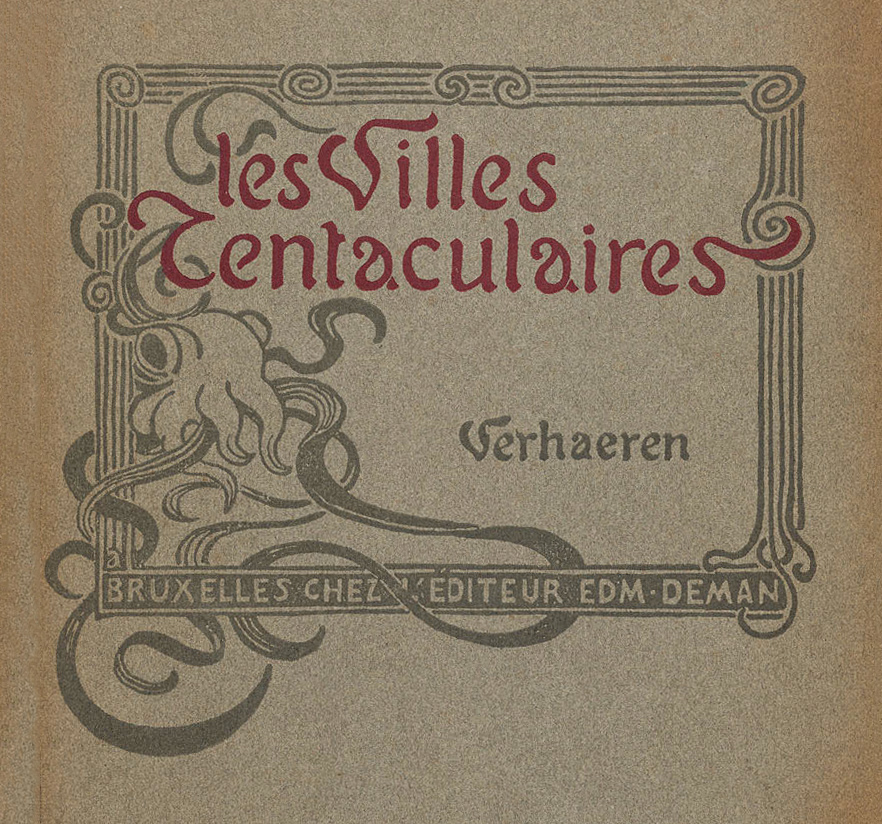
This is the beginning of “La plaine,” the poem that opens Emile Verhaeren’s 1895 book of poems, Les villes tentaculaires [The Tentacled Cities]. The cover is by Théo van Rysselberghe (source). I couldn’t find a translation online, so I did the best I could:
La Plaine
La plaine est morne, avec ses clos, avec ses granges
Et ses fermes dont les pignons sont vermoulus,
La plaine est morne et lasse et ne se défend plus,
La plaine est morne et morte – et la ville la mange.Formidables et criminels,
Les bras des machines diaboliques,
Fauchant les blés évangéliques,
Ont effrayé le vieux semeur mélancolique
Dont le geste semblait d’accord avec le ciel.L’orde fumée et ses haillons de suie
Ont traversé le vent et l’ont sali :
Un soleil pauvre et avili
S’est comme usé en de la pluie.Et maintenant, où s’étageaient les maisons claires
Et les vergers et les arbres parsemés d’or,
On aperçoit, à l’infini, du sud au nord,
La noire immensité des usines rectangulaires.Telle une bête énorme et taciturne
Qui bourdonne derrière un mur,
Le ronflement s’entend, rythmique et dur,
Des chaudières et des meules nocturnes ;Le sol vibre, comme s’il fermentait,
Le travail bout comme un forfait,
L’égout charrie une fange velue
Vers la rivière qu’il pollue ;
Un supplice d’arbres écorchés vifs
Se tord, bras convulsifs,
En façade, sur le bois proche.The Fields
The fields are forlorn, with their fences and barns,
And their farms with their wormeaten gables.
The fields are forlorn and tired, defeated.
The fields are forlorn; they are dead—and the city eats them.Menacing and criminal,
The arms of diabolical machines
Mowed down the evangelical corn,
Terrifying the old melancholy sower.
The movement seemed to agree with the sky.The hideous smoke and its sooty rags
Pervaded and soiled the wind.
A poor and depleted sun
Faded away in the rain.And now, where the bright houses once stood
With the orchards and the trees dappled with gold,
There appears, into infinity, from South to North,
The black vastness of rectangular factories.An enormous and taciturn beast
Hums behind a wall;
The snoring is heard, rhythmic and hard,
Of boilers and nocturnal gears.The ground vibrates, as if decomposing.
Labor boils over like an atrocity.
The sewer carries a velvety muck
Towards the river it pollutes.
An affliction of trees, scorched and jagged,
Twists itself, arms convulsing,
Facing from the nearby wood.
You can read the whole poem here.
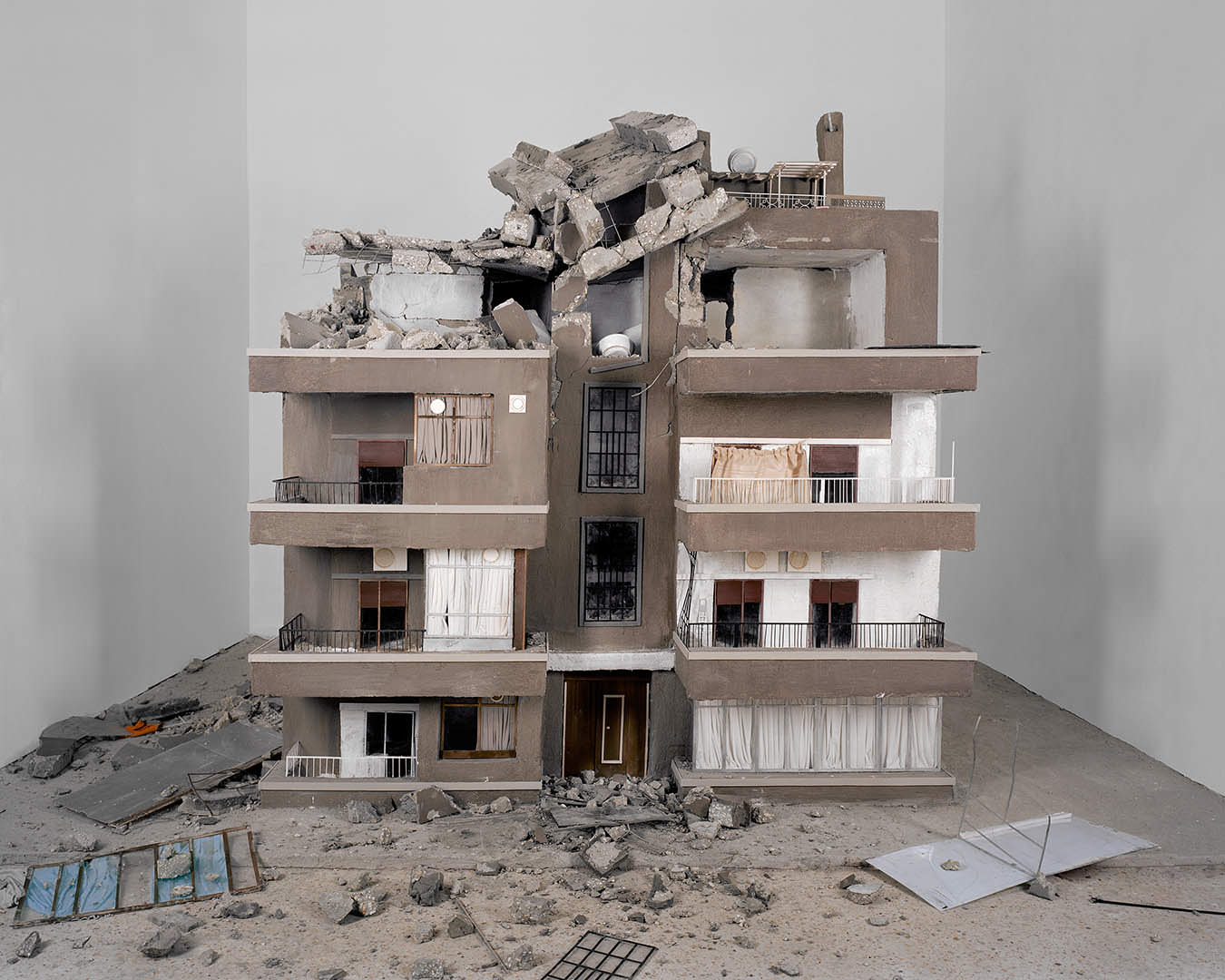
A still from Hrair Sarkissian’s video Homesick (2014), in which he destroys a scale model of the apartment building in Damascus in which he grew up and where his parents still live.

 corvusfugit.com