
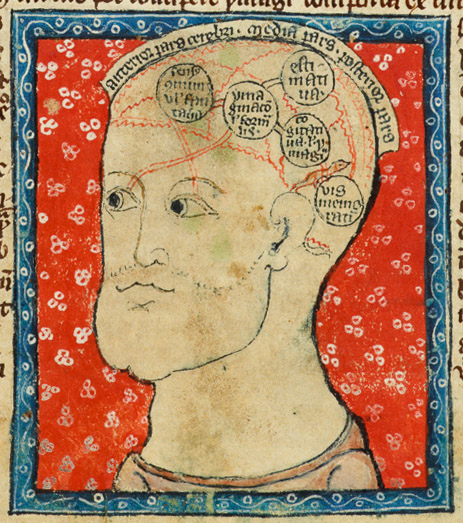
 This llustration from an early fourteenth century compendium shows the five functions of the brain: perception, imagination, estimation, cogitation, and memory. Drawn from the works of Thomas Aquinas and the Arabic philosopher Avicenna, the theory posits that sensory information enters the brain and is apprehended by perception; imagination and cogitation then put all the information together; the result is then evaluated by estimation and stored in memory. The short text is entitled Qualiter caput hominis situatur—“regions of the human head” (source).
Welcome to corvusfugit.com!
Corvus fugit means "the crow flies."-
Join 424 other subscribers
Recent Top Posts
Blogroll
Tags
- 1860's
- 1870's
- 1880's
- 1890's
- 1900's
- 1910's
- 1920's
- 1930's
- 1940's
- 1950's
- 1960's
- 1970's
- 2000's
- 2010's
- Africa
- African-Americans
- Animals
- Art
- Belgium
- Birds
- Books
- Children
- Christianity
- Drawing
- France
- Germany
- Great Britain
- Italy
- Labor
- Landscapes
- LGBTQ
- Mammals
- Miniatures
- Netherlands
- New York City
- Painting
- Photography
- Poetry
- Portraits
- Printmaking
- Religion
- Science Fiction
- Sculpture
- Seascapes
- Ships & Sailing
- The Sky
- Trees
- Unions
- USA
- Women

 corvusfugit.com